
Every summer, North Myrtle Beach homeowners spend significant time and money watering, fertilizing, and nursing ornamental plants that are simply not well-suited to life on the coast. High-maintenance plants that require constant irrigation, rich soil amendments, and regular pest management to survive are a poor match for coastal Carolina’s sandy soil, salt air, and alternating drought and deluge weather pattern. The better solution has been growing here naturally for thousands of years.
Native and drought-tolerant plants adapted to coastal SC conditions offer a fundamentally different landscape experience: they establish quickly, require far less supplemental water once rooted, handle salt air without damage, and support the pollinators and wildlife that make a coastal property a genuinely living environment. At KeckCo Turf and Ornamental Services, we incorporate coastal-appropriate natives into landscape design throughout North Myrtle Beach and the Grand Strand. Here is what works best and why.
- Why native plants outperform imports in coastal SC
- Top native trees and shrubs for North Myrtle Beach
- Native perennials and grasses for coastal landscapes
- Proven drought-tolerant non-natives for coastal SC
- Getting natives established: the first-season challenge
- Designing a low-maintenance native landscape
- Frequently Asked Questions
Why Native Plants Outperform Imports in Coastal SC
Native coastal Carolina plants evolved in the specific conditions that define North Myrtle Beach — nutrient-poor, fast-draining sandy soil; salt-laden air; periodic intense drought punctuated by heavy rain events; and the intense summer heat of the southeastern coastal plain. They have not simply adapted to these conditions; they are dependent on them and perform best when placed in the environment they evolved in.
By contrast, many ornamental plants commonly sold at garden centers across the South originate from temperate climates with richer soils, more consistent rainfall, and minimal salt exposure. These plants can be kept alive in coastal SC with enough supplemental water, soil amendment, and pest management — but they will never be as healthy, resilient, or low-maintenance as a plant that belongs here. The long-term economics clearly favor natives and coastal-adapted plants, particularly as water costs rise and the labor cost of maintaining high-maintenance landscapes increases.
Top Native Trees and Shrubs for North Myrtle Beach
Wax Myrtle (Morella cerifera) is arguably the most valuable native shrub for North Myrtle Beach landscapes. It grows vigorously in sandy soil, tolerates full salt spray, provides year-round evergreen screening, attracts birds with its berry crop, and can be maintained as a hedge or allowed to grow into a multi-stem small tree. It is nearly maintenance-free once established and among the most drought-tolerant plants in the coastal SC palette.
Yaupon Holly (Ilex vomitoria) is similarly outstanding — an evergreen native shrub with excellent salt and drought tolerance that provides bright red berries through winter. Dwarf varieties work well as foundation plantings and bed edging; standard varieties develop into large shrubs or small trees that provide significant bird habitat and screening value. Sparkleberry (Vaccinium arboreum) is an underused native that delivers outstanding four-season interest — spring flowers, summer fruit for birds, fall color, and attractive gray exfoliating bark in winter.
Dwarf Palmetto (Sabal minor) is the quintessential coastal SC native — salt-tolerant, drought-tolerant after establishment, and perfectly suited to the sandy soil conditions throughout the Grand Strand. It provides strong textural contrast in mixed plantings and thrives in conditions that would kill non-adapted ornamentals.
Native Perennials and Grasses for Coastal Landscapes
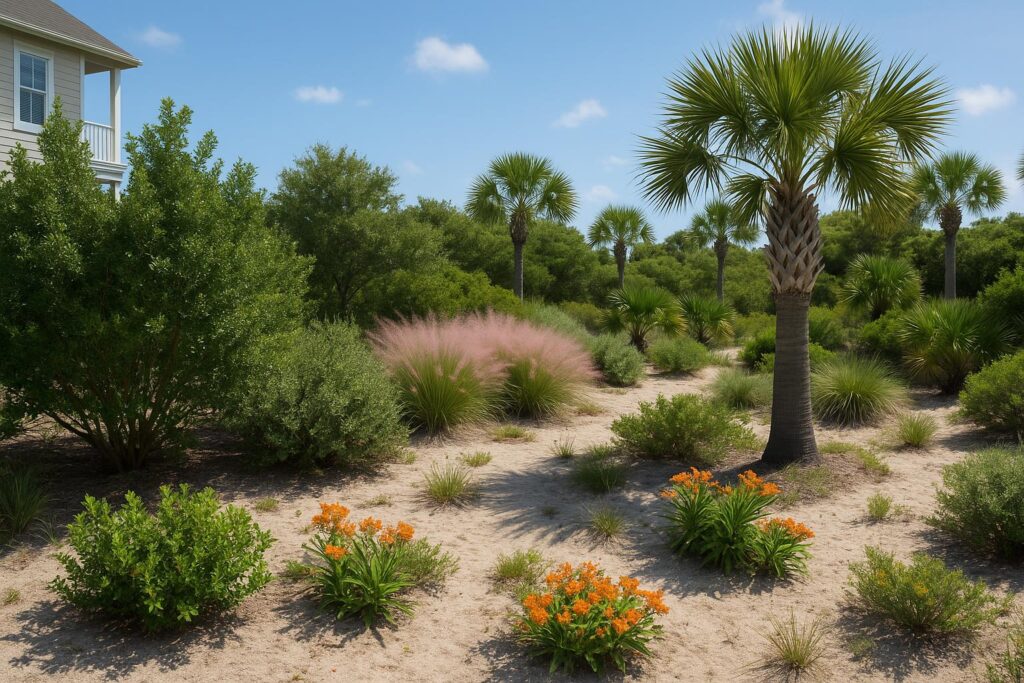
Muhly Grass (Muhlenbergia capillaris) is the signature ornamental grass of coastal Carolina, delivering a spectacular display of pink to purple feathery plumes from September through November after being a neat, drought-tolerant clump of fine-textured foliage through the summer months. It handles salt air, sandy soil, and summer drought with no supplemental water once established and requires only an annual late-winter cutback to maintain its shape.
Butterfly Weed (Asclepias tuberosa) is an essential native perennial for coastal SC landscapes — a monarch butterfly host plant that produces vivid orange flowers in summer, thrives in the dry, sandy soil that defeats most perennials, and is completely drought-tolerant once established. Blue Wild Indigo (Baptisia australis) is another outstanding native perennial with beautiful blue-purple flowers in spring, attractive blue-green foliage through summer, and the deep tap root system that makes it exceptionally drought-resistant in sandy coastal soils.
Native Grasses beyond muhly include sea oats (Uniola paniculata) for dune and beach-adjacent areas, switchgrass (Panicum virgatum) for wetter low areas, and little bluestem (Schizachyrium scoparium) for dry upland sites — all offering low maintenance, excellent drought tolerance, and significant wildlife value.
Proven Drought-Tolerant Non-Natives for Coastal SC
While natives offer the best long-term performance, several well-adapted non-native plants have earned their place in North Myrtle Beach landscapes through decades of proven performance. Crape Myrtle (Lagerstroemia indica) is the standard-bearer — outstanding summer bloom, excellent heat and drought tolerance, and good salt tolerance make it the most planted ornamental tree on the Grand Strand for good reason. Choose mildew-resistant varieties for the humid coastal environment.
Society Garlic (Tulbaghia violacea) is a low-growing, evergreen perennial with lavender flowers that blooms for months through summer and early fall, handles sandy soil and full coastal sun, and requires virtually no maintenance beyond occasional division. Blue Plumbago (Plumbago auriculata) delivers sky-blue flowers continuously from summer through frost, handles coastal heat and salt exposure well, and pairs beautifully with native grasses and other drought-tolerant perennials in mixed plantings.
Getting Natives Established: The First-Season Challenge
The primary challenge with native plants is the establishment period — typically the first full growing season after planting, during which the plant is developing the root system it will eventually rely on instead of supplemental irrigation. Despite their ultimate drought tolerance, most native plants need regular watering during the first summer after installation. A plant that will be completely drought-tolerant in year two still needs 2–3 waterings per week during a July heat wave in its first summer.
Fall planting, where the plant establishes roots through the cooler months before facing its first summer, is the strategy that most reliably produces low-maintenance native plantings. For plants that must be installed in summer, mulching heavily (3 inches), watering on a consistent schedule for the first 8–12 weeks, and choosing the most established plant specimens available from the nursery gives the best outcome.
Designing a Low-Maintenance Native Landscape
The most successful coastal native landscapes layer plants by size, texture, and bloom season to create year-round visual interest with minimal maintenance. A typical coastal SC native foundation planting might include wax myrtle or yaupon holly as the large background shrub layer, native ornamental grasses and perennials in the mid-layer, and low-growing ground covers like native ferns or liriope at the front edge — all mulched heavily and irrigated during establishment only.
Design with wildlife in mind as a guiding principle and the plant selection becomes clearer — native plants that support pollinators, provide bird food, and create habitat tend to be the same plants that perform best in coastal SC’s challenging conditions, because they belong here. A coastal native landscape actively supporting butterflies, native bees, and songbirds is also far more interesting and dynamic to live with than a monoculture of non-native ornamentals maintained through constant intervention.
Frequently Asked Questions
Do native plants really need less water than traditional ornamentals in North Myrtle Beach?
Yes — once established, typically after their first full growing season. During the establishment period, natives need regular irrigation comparable to any newly planted ornamental. After establishment, most coastal SC natives can survive entirely on natural rainfall during all but the most severe droughts, which represents a significant reduction in irrigation demand compared to high-maintenance non-native plantings.
Where can I buy native plants for North Myrtle Beach landscapes?
Several native plant nurseries operate in the Carolinas, and many local garden centers carry an increasing selection of coastal SC natives. Look for plants labeled as South Carolina or southeastern coastal natives rather than generic “native plant” designations, as “native” without geographic context can mean native to an entirely different climate. KeckCo can source appropriate coastal natives for landscape projects we undertake.
Can native plants handle North Myrtle Beach salt air?
Coastal SC native plants evolved with salt air as a baseline condition and handle it far better than most non-native ornamentals. Plants like wax myrtle, yaupon holly, sea oats, and dwarf palmetto can handle direct salt spray from ocean exposure without significant damage — a tolerance that most non-native ornamentals simply do not have.
Are native plants less attractive than traditional ornamentals?
This is the most common misconception about native plantings. Many coastal Carolina natives — muhly grass in fall bloom, crape myrtle in summer, butterfly weed with its vivid orange flowers, yaupon holly with winter berries — are genuinely beautiful plants that hold their own against any imported ornamental. The difference is they achieve this beauty with dramatically less input and maintenance.
Does KeckCo design and install native plant landscapes?
Yes. KeckCo Turf and Ornamental Services incorporates coastal-appropriate native and drought-tolerant plants into landscape design and installation projects throughout North Myrtle Beach, Little River, and the Grand Strand. We can help you transition an existing high-maintenance landscape to a more sustainable, lower-input design that is better adapted to coastal SC conditions.
What is the best native plant for privacy screening in North Myrtle Beach?
Wax myrtle is the best all-around native screening plant for North Myrtle Beach properties. It grows quickly (2–3 feet per year in good conditions), maintains dense evergreen coverage year-round, handles salt spray and sandy soil extremely well, and can be maintained as a formal hedge or left to develop naturally. For larger scale screening, American holly is another excellent native option with outstanding wildlife value.
The most beautiful and resilient North Myrtle Beach landscapes are the ones that work with the coastal environment rather than against it. Native and drought-tolerant plants deliver year after year with far less input — less water, less fertilizer, fewer pesticides, less intervention — because they belong here. That is not a compromise; it is an upgrade.
Ready to build a more resilient, lower-maintenance coastal landscape?
KeckCo Turf and Ornamental Services designs and installs native and drought-tolerant landscapes throughout North Myrtle Beach and the Grand Strand. Let’s build something beautiful that actually belongs here.