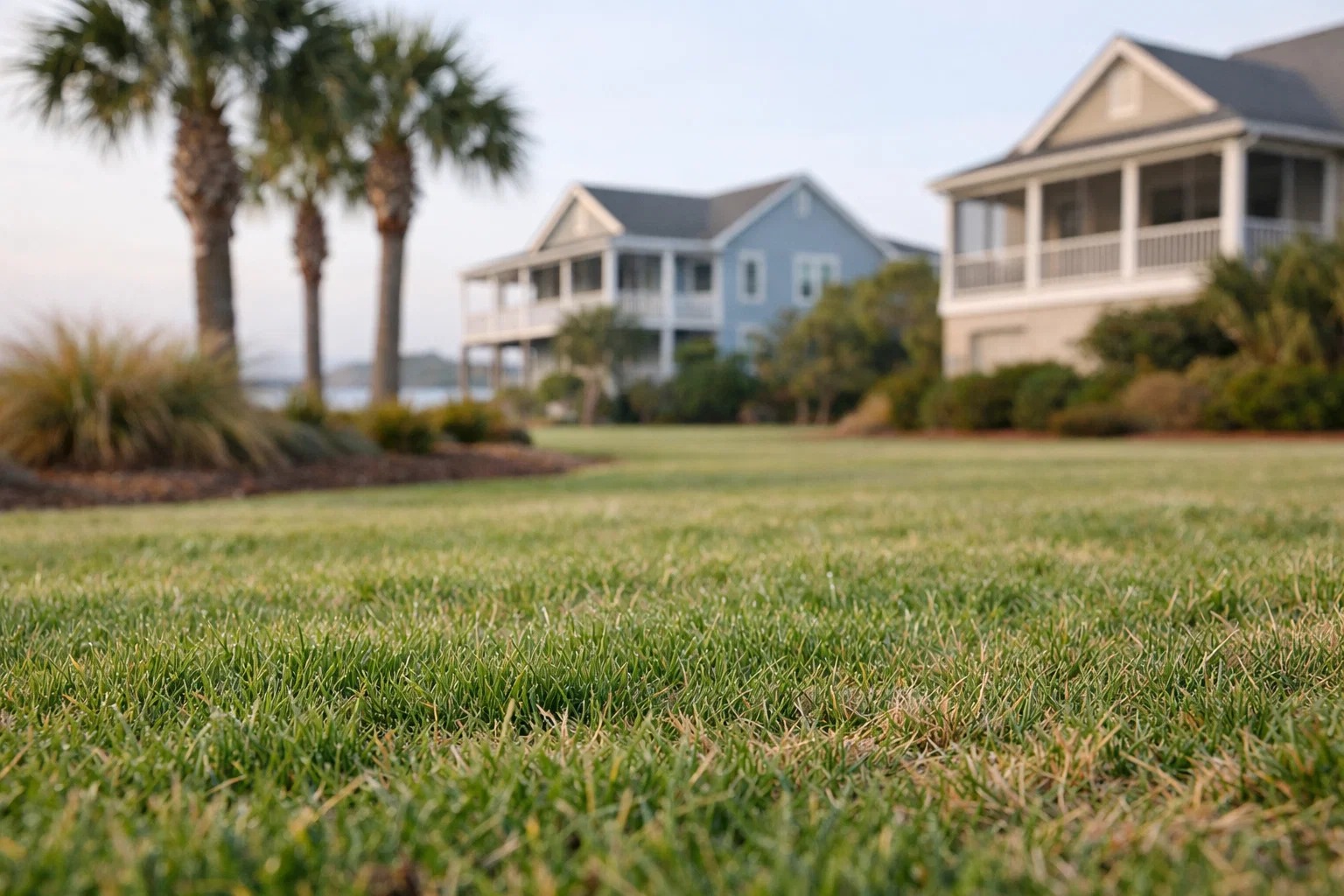

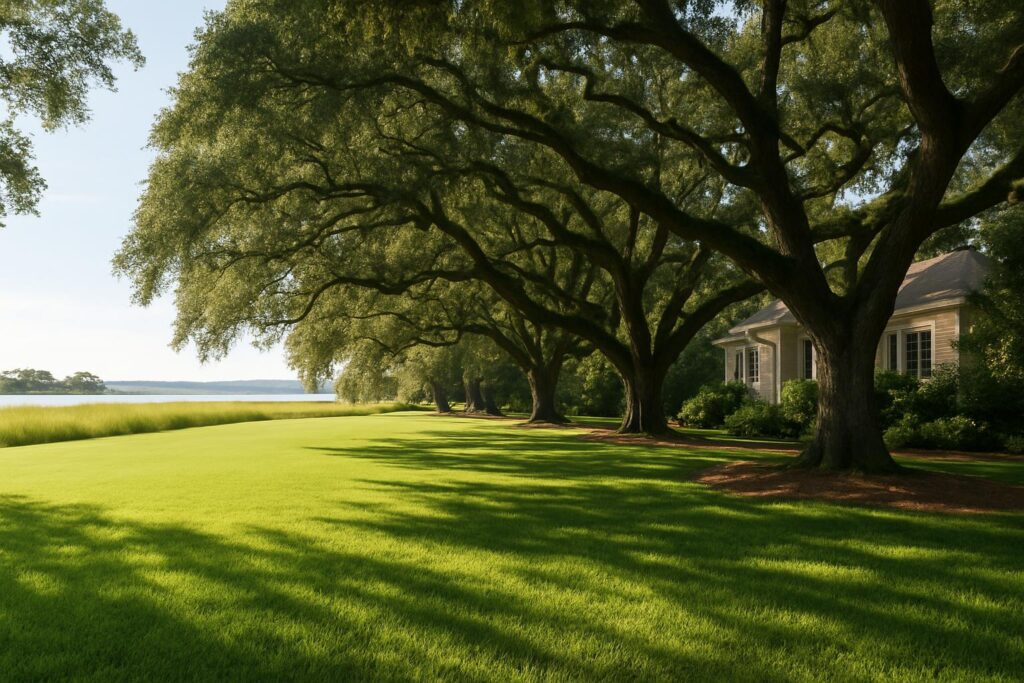
One of the most common sources of lawn frustration in North Myrtle Beach is a grass or plant choice that simply does not match the light conditions where it was installed. Centipede grass that performs beautifully in the open part of the yard struggles and thins under the canopy of a live oak. Shade-tolerant ground covers die in the blazing western exposure. The result is a patchwork yard — great in some spots, perpetually failing in others — that no amount of fertilizer, water, or fungicide is going to fully fix, because the fundamental mismatch between plant and location is the actual problem.
At KeckCo Turf and Ornamental Services, we evaluate sun and shade conditions as the starting point for any turf or planting recommendation on North Myrtle Beach properties. Here is the framework we use — and the specific plants and grasses that perform best in each light condition along the Grand Strand.
- Understanding your yard’s light conditions
- Best grass types and plants for full sun in North Myrtle Beach
- Best options for partial shade and filtered light
- Managing deep shade areas under live oaks and canopy trees
- Handling the transition zones between sun and shade
- Common sun-shade planting mistakes on coastal properties
- Frequently Asked Questions
Understanding Your Yard’s Light Conditions
Before choosing any grass or plant, you need an accurate read on how much direct sun a given area actually receives. Full sun is generally defined as 6 or more hours of direct sunlight per day. Partial shade is 3–6 hours, often with afternoon protection from a structure or canopy. Full shade is fewer than 3 hours of direct sun, which is the challenge zone on most North Myrtle Beach properties with mature live oaks, southern magnolias, or dense pine canopies.
Importantly, sun exposure in July is different from sun exposure in March. As the sun angle changes through the year, areas that receive full sun in spring may be in partial shade by midsummer due to shifting canopy shadows. If you are evaluating a problem area in your yard, assess the light conditions in July specifically, at the time of year when the problem typically appears — not in early spring when the view of sun potential may look different.
Best Grass Types and Plants for Full Sun in North Myrtle Beach
Full-sun lawn areas in North Myrtle Beach are where centipede grass thrives — and where it is the right default choice for most residential properties. Centipede handles the heat, salt air, and sandy soil of the coastal environment better than most warm-season alternatives, and its low fertilizer requirements match well with the nutrient-poor sandy soil conditions that dominate the area. St. Augustine is another excellent full-sun option, particularly in slightly moister areas, and offers more shade tolerance if edge conditions shift.
For ornamental plantings in full-sun coastal SC locations, the top performers include crape myrtles, yaupon holly, wax myrtle, dwarf palmetto, lantana, blue plumbago, and ornamental grasses like muhly grass and pink muhly. All handle the combination of intense summer heat, salt air, and periodic drought that defines North Myrtle Beach full-sun exposure in July and August.
Best Options for Partial Shade and Filtered Light
Partial shade is actually the most opportunity-rich light condition for North Myrtle Beach landscape diversity. The reduction in direct sun lowers heat stress on plants, allows a wider range of ornamentals to thrive, and can create beautiful layered plantings that are impossible in full coastal sun. St. Augustine grass tolerates partial shade significantly better than centipede, making it the better choice for lawn areas with 3–5 hours of daily sun.
For ornamentals in partial shade, loropetalum, Indian hawthorn, dwarf gardenia, cast iron plant, and native ferns all perform well in coastal SC’s partial shade conditions. Camellia japonica and camellia sasanqua are outstanding flowering shrubs for the filtered light underneath canopy trees, providing bloom in fall and winter when most other ornamentals are dormant. The partial shade zone is also where shade-tolerant ground covers like Asian jasmine and liriope grass begin to outperform turf grass as a practical maintenance solution.
Managing Deep Shade Areas Under Live Oaks and Canopy Trees
Deep shade under mature live oak canopies is one of the most challenging conditions in any North Myrtle Beach yard, and the correct answer is almost never “try a different type of grass.” No warm-season turfgrass performs well in deep shade. Centipede fails. St. Augustine becomes thin and spindly. Zoysia does marginally better but still struggles under dense, low-branching live oaks with year-round canopy coverage.
The practical solutions for deep shade areas are ground covers, mulch beds, or thoughtful landscape design that accepts the tree’s influence rather than fighting it. A well-mulched tree ring extended to the drip line of the canopy is actually the healthiest option for the tree — it protects surface roots, prevents mower damage, and eliminates the turf-versus-tree competition for water and nutrients. Cast iron plant, mondo grass, and native wild ginger are shade-hardy ground covers that can survive the challenging conditions under live oak canopies in coastal SC.
Handling the Transition Zones Between Sun and Shade
The edge where full sun meets canopy shade is often the most visually ragged part of a North Myrtle Beach lawn — the grass thins progressively from the open area into the shade, creating an irregular, patchy transition that never looks quite right regardless of what you do. These transition zones are better managed as intentional landscape beds rather than lawn areas, using low-growing ornamentals that bridge the visual gap between the full-sun turf and the shade-adapted plantings under the canopy.
A border of liriope, dwarf mondo grass, or native muhly grass at the sun-shade transition creates a clean, defined edge that is far easier to maintain than struggling turf and provides year-round visual structure to the landscape without the watering, fertilizing, and pest management complexity of maintaining grass in a marginal light environment.
Common Sun-Shade Planting Mistakes on Coastal Properties
The most common mistake is assuming that what works in the open lawn will work in a shaded area with the right management adjustments. It usually will not. No amount of fertilizer or specialty products will allow centipede grass to thrive in deep shade — the light deficit is a hard biological limit, not a management variable. Accepting this reality early saves significant money spent on failed attempts to grow grass where it cannot grow.
The second common mistake is choosing landscape plants based on how they look in the garden center in full sun, without researching their light requirements. A beautiful full-sun flowering shrub installed in a partial-shade location will survive but never bloom properly and will gradually decline in health. Matching plants to light conditions at the time of purchase — not based on how they look on a bright day in the nursery — is the foundation of a successful coastal landscape.
Frequently Asked Questions
Can any grass grow under my live oak trees in North Myrtle Beach?
In true deep shade under a mature live oak with year-round canopy coverage, no warm-season turfgrass will perform well long-term. St. Augustine is the most shade-tolerant of the coastal SC warm-season grasses, but even it requires a minimum of 4–6 hours of direct sun. For deep live oak shade, ground covers, mulch beds, or shade-tolerant landscape plantings are the realistic alternatives.
What is the best grass for shady yards in North Myrtle Beach?
St. Augustine grass has the best shade tolerance among the warm-season grasses that perform well in coastal SC conditions. For partial shade areas receiving 4–6 hours of daily sun, St. Augustine is a good turf option. For areas with less than 4 hours, ground covers and shade-adapted landscape plantings are more reliable than any turfgrass.
Why does my centipede grass get thin under my trees every summer?
Centipede grass needs a minimum of 6 hours of direct sun per day to maintain good density. As trees mature and canopies fill out over time, areas that once had adequate sun for centipede gradually enter the shade tolerance threshold where the grass can no longer sustain itself. This explains why centipede thins progressively under tree canopies as trees age even when the lawn was originally healthy.
What ground covers work best in deep shade in North Myrtle Beach?
Cast iron plant (Aspidistra elatior), mondo grass (Ophiopogon japonicus), liriope (liriope muscari), and native wild ginger (Hexastylis arifolia) are proven ground covers for deep shade conditions in coastal SC. All handle the heat, humidity, and sandy soil of North Myrtle Beach well and require minimal maintenance once established.
Does KeckCo help with landscape redesign for shade problem areas?
Yes. KeckCo Turf and Ornamental Services provides landscape assessment and design recommendations for North Myrtle Beach properties struggling with shade-related turf and planting failures. We can recommend the right plant solutions for your specific light conditions and oversee installation of replacement plantings or ground cover conversions.
Is it better to remove trees or accept shade and change my plantings?
Mature trees — particularly live oaks — are enormously valuable assets on a North Myrtle Beach property for shade, storm wind buffering, property value, and environmental benefits. In almost all cases, adapting the landscape design to work with the tree is far better than removing a mature tree to rescue a lawn. Exceptions exist for dead, diseased, or structurally hazardous trees.
Matching the right plants and grass types to the right light conditions in your North Myrtle Beach yard eliminates the most common source of perpetual, unfixable-seeming lawn and landscape problems. Start with an honest assessment of your sun and shade conditions in July — the hardest month of the year for any plant — and build your plant selections around that reality rather than around what you wish were possible.
Struggling with patchy grass or failing plants in shaded areas?
KeckCo Turf and Ornamental Services can assess your North Myrtle Beach yard’s light conditions and recommend the right grass, ground covers, and ornamentals for every spot on your property.