
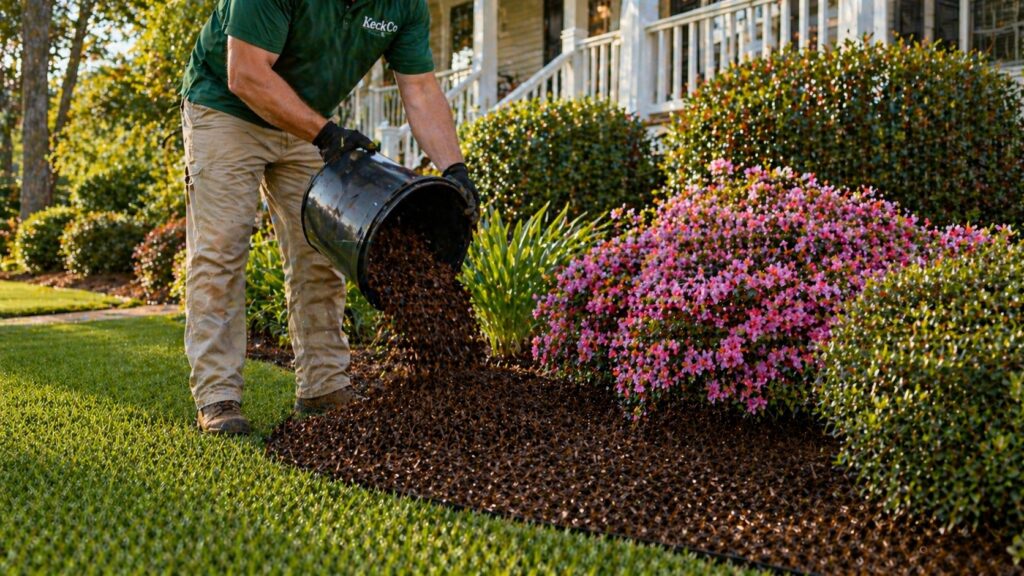
Fresh mulch is one of the most visible improvements you can make to a North Myrtle Beach landscape in spring — and one of the most misapplied. Done right, mulching protects your plant roots from summer heat, retains moisture in sandy coastal soil that dries out fast, suppresses weeds before they establish, and gives your beds a clean, polished look that holds up through the season. Done wrong, it smothers roots, harbors pests, promotes rot, and costs you shrubs that were perfectly healthy before you tried to help them.
The coastal conditions of the Grand Strand — sandy soil, high humidity, salt air, and heavy spring and summer rain events — make mulching decisions here different from what you’d read in a national gardening guide. The right mulch type, depth, and application technique for a North Myrtle Beach ornamental bed is specific to this environment. Here’s what actually works along the coast, and what doesn’t.
Why mulching matters more in coastal Carolina
In most parts of the country, mulching is a good practice. In North Myrtle Beach, it’s close to essential. The sandy, low-organic-matter soil that characterizes most of the Grand Strand loses moisture faster than almost any other soil type — a bed without mulch can go from adequately moist to dangerously dry within 24 to 48 hours during a hot, breezy coastal summer. Ornamental plants that would tolerate a missed watering in heavier soil can show heat and drought stress rapidly in unprotected sandy coastal beds.
Summer soil temperatures in unprotected North Myrtle Beach beds can reach levels that damage fine feeder roots, particularly in shallow-rooted ornamentals like azaleas, gardenias, and dwarf hollies. A 2–3 inch layer of organic mulch insulates the soil, moderating temperature swings between the heat of a July afternoon and the relative cool of early morning. This temperature buffering effect is one of the least appreciated benefits of mulching — and one of the most impactful for plant health through a coastal SC summer.
The humidity and rain patterns of the Grand Strand also make weed pressure in beds significant from April through October. Bare soil in a coastal Carolina ornamental bed is an open invitation to dollarweed, spurge, and a rotating cast of opportunistic weeds that thrive in sandy, moist conditions. A properly applied mulch layer reduces weed germination dramatically, cutting the time you spend hand-pulling weeds through the growing season.
The best mulch types for North Myrtle Beach beds
Pine straw is the most widely used and generally the best-performing mulch for ornamental beds in the North Myrtle Beach area, and for good reason. It’s lightweight, which makes it easy to apply and adjust. It allows water to penetrate readily — critical in a climate with heavy summer rain events where mulch that sheds water can leave roots dry underneath. As it breaks down, it adds slight acidity to the soil, which benefits acid-loving coastal plants like azaleas, gardenias, blueberries, and centipede grass borders. And it stays in place remarkably well even in the coastal wind that can displace lighter mulch materials.
Double-shredded hardwood bark mulch is an excellent second choice for beds where a darker, more formal appearance is preferred — particularly around foundation plantings and entry beds where curb appeal is the priority. It breaks down more slowly than pine straw, holds its color longer, and provides excellent moisture retention. The shredded texture helps it knit together and resist displacement from heavy rain events better than larger bark nuggets. Choose double-shredded over single-shredded for coastal beds — the finer texture performs noticeably better.
Pine bark mini-nuggets work well in beds with established, larger shrubs like wax myrtle, yaupon holly, and larger crape myrtles where the coarser texture complements the plant scale. They drain well after rain — an advantage in beds prone to standing water — and resist compaction better than finer materials over a long season. They are not a good choice for slopes or areas exposed to strong coastal wind, where they tend to migrate.
Mulch types to avoid on the coast
Dyed mulch — the bright red, black, or brown color-treated products — is one of the most popular options at big box stores and one of the least suitable for coastal Carolina ornamental beds. The dyes used to achieve those vivid colors fade rapidly in the intense UV exposure and frequent rain of a Grand Strand summer, often looking washed out and blotchy within six to eight weeks of application. More importantly, many dyed mulches are made from recycled wood waste including pallets and construction lumber that may contain chemical treatments — not something you want breaking down around ornamental plants and in coastal soil near waterways.
Large bark nuggets look attractive in photographs and in the store, but they perform poorly in coastal SC beds. They shed water rather than allowing it to penetrate, creating a situation where rain runs off the mulch surface and away from the root zone rather than soaking in. They also displace easily in the coastal wind and during heavy rain events, migrating out of beds and onto lawns and hardscapes. In a climate with frequent afternoon thunderstorms from June through September, mulch stability matters.
Rubber mulch has become popular in some markets as a long-lasting alternative to organic materials. It is not appropriate for ornamental planting beds. Rubber mulch gets extremely hot in direct summer sun — surface temperatures in full-sun beds in North Myrtle Beach can reach levels that damage shallow plant roots and crowns. It also provides none of the soil amendment benefits that organic mulch delivers as it breaks down, and disposal when it eventually needs replacing is a significant problem.
Getting the depth right
Two to three inches is the correct mulch depth for North Myrtle Beach ornamental beds — deep enough to retain moisture, moderate soil temperature, and suppress weed germination, but not so deep that it creates the moisture and oxygen problems that damage plant crowns and shallow roots. This range applies to both pine straw and shredded hardwood bark, though pine straw is typically applied at the slightly higher end of the range due to its lower density.
More is not better. A four-inch or deeper layer of mulch — common in beds that receive a fresh application on top of last year’s without removing or raking out the old material first — creates an anaerobic environment at the soil surface that suffocates roots, promotes fungal disease, and retains so much moisture against plant crowns that rot becomes a serious risk. In North Myrtle Beach’s humid summer climate, crown rot in over-mulched beds is a genuine and common plant killer.
Before applying fresh mulch each spring, assess what’s already in the bed. If last year’s mulch has broken down to less than an inch, apply a full 2–3 inch layer. If there’s still an inch or more of intact material, rake it loose to restore air circulation and top up to the 2–3 inch target rather than applying a full fresh layer on top. Raking existing mulch before topping up also disrupts any weed seeds that have landed on the surface since last application.
When to mulch in coastal SC
The ideal timing for spring mulch application in North Myrtle Beach is late March through mid-April, after any pruning and bed edging work is complete but before the soil has fully warmed and weed germination begins in earnest. Mulching after pruning makes practical sense — you’re not working around or displacing fresh mulch as you cut, and the clean beds are easier to edge precisely before the material goes down.
Applying mulch before the soil warms fully has an important secondary benefit: it extends the window before heat-loving summer weeds like spurge and chamberbitter begin germinating in the beds. A mulch layer in place by early April gives you a head start on weed suppression for the entire season. Waiting until May or June to mulch — a common pattern for homeowners who keep meaning to get to it — means spending the early summer already pulling weeds from bare beds that have been exposed since winter.
A second, lighter mulch refresh in mid-fall — October is ideal — extends protection through the mild but occasionally freezing coastal winter, insulates root zones of marginally cold-hardy plants like gardenias and certain palms, and gives beds a refreshed appearance heading into the holiday season. For most North Myrtle Beach ornamental beds, two applications per year — spring and fall — is the complete mulching program.
Application technique: what most homeowners get wrong
The most important technique detail in mulching — and the most consistently ignored — is keeping mulch away from plant crowns and tree trunks. Every shrub and tree in your bed has a crown where the stem meets the soil. This transition zone needs to breathe. Piling mulch against it — the “mulch volcano” that appears around every other tree in North Myrtle Beach neighborhoods — traps moisture against the bark, creates the warm, moist conditions that favor crown rot and bark-boring insects, and can girdle trees over several seasons as the mulch presses against the cambium layer.
Leave a 2–3 inch gap between the mulch and the base of every shrub and tree in the bed. The mulch should slope gently away from the crown, not pile up against it. For trees, pull mulch back to the root flare — the point where the trunk begins to widen at the base. If you can’t see the root flare, there’s already too much material around the base.
Edge the bed cleanly before applying mulch, not after. A clean bed edge — a crisp vertical cut between the turf and the bed — defines the boundary that mulch will sit inside. Mulching an un-edged bed looks untidy immediately and the material migrates into the lawn edge within a few weeks. Edge first, then mulch. The result holds its shape far longer and makes the entire landscape look more intentional and well-maintained.
The mulching mistakes that damage coastal plants
Mulch volcanoes are the most visible and widespread mistake in North Myrtle Beach ornamental beds. Drive through almost any Grand Strand neighborhood and you’ll see crape myrtles, wax myrtles, and foundation shrubs buried under mounded mulch piled 6 to 8 inches deep against the base. This practice is so normalized that many homeowners assume it’s correct — it isn’t. It’s one of the most common causes of slow plant decline and premature death in coastal SC ornamental plantings, and the damage often takes two to three seasons to become fully apparent.
Applying mulch without edging first is a technique mistake that compounds over seasons. Mulch applied to an undefined bed edge migrates into the lawn within a few weeks, the edge gradually becomes indistinct, and by midsummer the bed looks ragged despite the fresh mulch application. One clean edge pass before spring mulching takes 20 minutes and makes the difference between a bed that looks freshly maintained for six months and one that looks neglected by June.
Refreshing mulch every year without ever removing accumulated material is another problem that builds slowly. Each season’s application goes on top of the previous, and within three to four years many North Myrtle Beach beds have five, six, or more inches of accumulated mulch — well past the point where the depth is causing root damage, moisture problems, and crown rot. Every two to three years, rake beds out completely, dispose of the excess, and start fresh at the correct 2–3 inch depth.
Frequently Asked Questions
Common mulching questions from North Myrtle Beach and coastal SC homeowners.
Pine straw is the top choice for most coastal Carolina ornamental beds — it allows water to penetrate readily, adds beneficial acidity as it breaks down, and stays in place well in coastal wind and rain. Double-shredded hardwood bark is an excellent alternative for foundation beds where a darker, more formal appearance is preferred. Both outperform dyed mulch, large bark nuggets, and rubber mulch in the specific conditions of the Grand Strand.
Two to three inches is the correct depth for North Myrtle Beach ornamental beds. This provides adequate moisture retention, temperature moderation, and weed suppression without creating the anaerobic, over-moist conditions at the soil surface that damage roots and plant crowns. More than three inches — a common outcome when fresh mulch is applied on top of previous years’ material without assessment — causes more harm than benefit in coastal SC’s humid summer climate.
Late March to mid-April is the ideal window for spring mulching in North Myrtle Beach — after pruning and bed edging are complete, but before soil fully warms and summer weed germination begins. A second lighter refresh in October extends protection through winter and freshens the appearance of beds heading into the holiday season. Two applications per year covers most coastal SC ornamental beds effectively.
The crown of every plant — where the stem meets the soil — needs to breathe. Mulch piled against it traps moisture against the bark, creating conditions that favor crown rot, fungal disease, and bark-boring insects. In North Myrtle Beach’s humid summer climate this damage accelerates quickly. Leave a 2–3 inch gap between mulch and every plant base, with mulch sloping away from rather than piling against the crown. The “mulch volcano” look that’s common across Grand Strand neighborhoods is harmful to the plants it surrounds.
Yes — a properly applied 2–3 inch mulch layer significantly reduces weed germination in ornamental beds by blocking light from reaching the soil surface where weed seeds need it to sprout. It won’t eliminate weeds entirely, particularly persistent perennials like dollarweed and nutsedge that spread via underground rhizomes rather than seeds, but it dramatically reduces the volume of hand-pulling required through the season. Consistent mulching combined with clean bed edges is the most effective low-chemical weed management approach for coastal SC ornamental beds.
Dyed mulch is not the best choice for coastal Carolina ornamental beds for two reasons. First, the dyes fade rapidly under the intense UV exposure and frequent rain of a Grand Strand summer, often looking washed out within six to eight weeks. Second, many dyed mulch products are made from recycled wood waste that may include chemically treated material — not ideal for breaking down around ornamental plants or near coastal waterways. Natural pine straw or double-shredded hardwood bark performs better and is the more appropriate choice for the coastal environment.
For most North Myrtle Beach ornamental beds, a spring application and a lighter fall refresh covers the annual cycle. Before each spring application, assess the existing depth — if more than an inch of last year’s material remains, rake it loose and top up rather than applying a full fresh layer. Every two to three years, rake beds out completely and start fresh at the correct 2–3 inch depth. Accumulation beyond three to four inches from consecutive yearly applications is one of the most common causes of slow plant decline in coastal SC beds.
Yes — KeckCo Turf and Ornamental Services provides mulching, bed edging, pruning, and full ornamental bed maintenance throughout North Myrtle Beach, Little River, Myrtle Beach, and the Grand Strand. We use mulch types suited to coastal Carolina conditions and apply them at the correct depth and technique — no mulch volcanoes, no over-application, no shortcuts. Call 843-273-0735 or visit keckcoturf.com to schedule your spring bed service.
Mulching is one of the highest-return maintenance tasks in any North Myrtle Beach landscape — but only when it’s done right. The right material, the right depth, the right timing, and the discipline to keep it away from plant crowns makes the difference between mulch that protects your ornamental beds for a full season and mulch that quietly damages the plants it was meant to help.
Two to three inches, edge first, leave a gap around every crown. Those three rules cover most of what separates a well-mulched coastal Carolina bed from one that’s working against you.
Let KeckCo refresh your beds the right way this spring.
KeckCo Turf and Ornamental Services handles spring mulching, bed edging, and ornamental pruning for homeowners across North Myrtle Beach, Little River, Myrtle Beach, and the Grand Strand. We use materials suited to coastal Carolina conditions, apply them at the correct depth, and never leave a mulch volcano behind. Call today to schedule your spring bed service before the season fills up.