
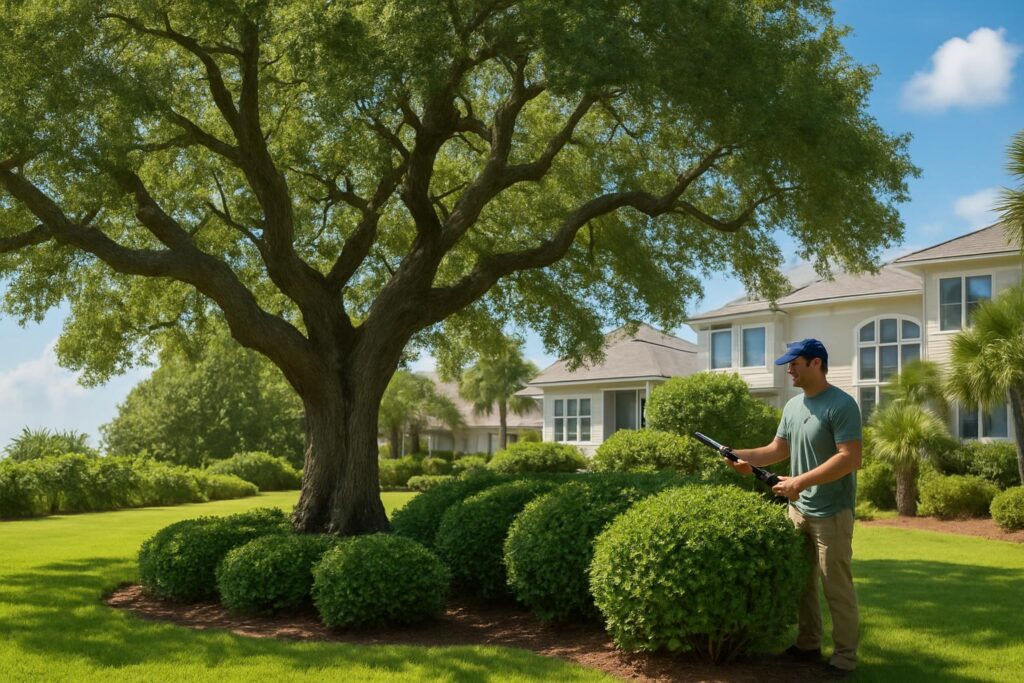
Lawn care dominates the summer conversation in North Myrtle Beach, but the trees and large shrubs on your property are working just as hard against July’s heat, humidity, and salt air — and they have fewer visible early warning signs when something is wrong. A lawn shows stress within days. A tree can carry a serious problem for weeks or months before the damage becomes obvious, and by the time it does, a straightforward fix has often become a complicated one.
At KeckCo Turf and Ornamental Services, tree and ornamental shrub care is an integral part of what we do on properties throughout North Myrtle Beach and the Grand Strand. Here is what needs attention on your trees and large shrubs right now in July, and how to identify the issues that warrant professional intervention before they escalate.
- Watering trees correctly in summer heat
- Reading the warning signs of summer tree stress
- Summer pruning: what is safe and what is not
- Summer pest pressure on trees and large shrubs
- Storm damage assessment and response
- Mulch rings: the single best thing you can do for your trees
- Frequently Asked Questions
Watering Trees Correctly in Summer Heat
Established trees — those in the ground for more than 3–5 years — typically do not need supplemental irrigation during normal North Myrtle Beach summers, provided they are mulched properly and the property is not in extended drought. Their root systems extend far beyond the canopy drip line, accessing moisture from a large soil volume. The trees that need irrigation attention in July are newly planted specimens from the current or previous planting season, which have not yet established the extensive root systems that make mature trees drought-resilient.
For trees planted within the last 1–2 years, deep, infrequent watering is the correct approach during summer: water to saturate the soil to 12–18 inches deep, then allow partial drying before watering again — typically every 5–7 days during July heat, more frequently during extended drought or heat wave conditions. Shallow daily watering keeps the root system in the top few inches of soil, which then dehydrates rapidly between waterings and limits the tree’s drought resilience for years into the future.
Reading the Warning Signs of Summer Tree Stress
The most important skill for a North Myrtle Beach homeowner in July is recognizing early tree stress signals before they progress to significant structural or health problems. Wilting or curling leaves during midday heat — when temperatures peak and transpiration demand exceeds root water supply — is normal and not concerning if the leaves recover their normal appearance by morning. Persistent wilting that does not recover overnight is a stress signal that warrants investigation.
Yellowing leaves mid-summer (before normal fall color development) can indicate several issues: iron deficiency in the alkaline pH conditions that sometimes develop in coastal SC soils, root stress from compaction or construction damage, or the early stages of trunk or root disease. Premature leaf drop in July — particularly affecting specific branches rather than the whole tree — is often a sign of a canker disease, vascular pathogen, or branch collar damage that requires professional diagnosis. Any sudden, dramatic wilting of a large branch or section of the canopy (sometimes called “flagging”) should be assessed promptly.
Summer Pruning: What Is Safe and What Is Not
The general principle for summer tree pruning is: remove only what must be removed, and avoid all major structural work until the tree is dormant in late fall or winter. Heavy pruning in July stimulates a flush of new growth that the tree’s stressed summer physiology cannot support well, opens large wounds at the time of year when heat and pathogens are most active, and removes the leaf area that is producing the carbohydrates the tree needs to maintain root function through the remainder of summer.
What is appropriate in July: removing dead, diseased, or storm-damaged branches as promptly as practical (leaving damaged wood in place is worse than removing it); raising canopy skirts if low branches are impeding access or directing storm wind into structures; and removing any crossing or rubbing branches that are causing mechanical damage. All pruning cuts should be made just outside the branch collar without leaving stubs — flat-cut stubs are the leading cause of decay entry in ornamental trees after improper pruning.
Summer Pest Pressure on Trees and Large Shrubs
Several pest organisms reach peak activity in North Myrtle Beach trees and large shrubs during July. Ambrosia beetles are a serious concern for stressed trees — they bore into weakened trunks and introduce fungal diseases that can kill trees rapidly. The presence of fine sawdust-like frass around small entry holes at the base of a trunk is the diagnostic sign of ambrosia beetle activity and warrants immediate professional assessment.
Scale insects — particularly tea scale on camellias, wax scale on holly, and magnolia scale on southern magnolias — reach their most visible and damaging stage in summer. Look for waxy or shell-like bumps on stems and undersides of branches, often accompanied by sooty mold (black powder) on leaves below infested areas. Horticultural oil applications are effective on scale crawlers in late spring but are too risky in July’s heat — systemic insecticides are the appropriate control option for active summer infestations.
Spider mites are a significant threat to arborvitae, dwarf alberta spruce, and some ornamental shrubs during hot, dry stretches in July. They thrive in hot, dry conditions and can cause widespread bronzing and needle loss before their presence is recognized. Shake a suspicious-looking branch over white paper — if small moving dots appear, you have mites and need miticide treatment promptly.
Storm Damage Assessment and Response
North Myrtle Beach’s July storm season — afternoon thunderstorms, tropical squalls, and occasionally significant tropical systems — creates ongoing tree damage risk. Broken branches from high winds are the most common outcome, but secondary storm damage including root zone flooding, lightning strikes, and wind-induced lean in newly planted specimens also require post-storm assessment.
After any significant storm event, walk your property and assess your trees before resuming normal activities. Large hanging branches — called “widow makers” in arborist terminology — can fall without warning and pose serious safety risks. These should be removed promptly by qualified professionals rather than left until the next scheduled service visit. Small branch breakage can generally wait for the next service cycle, but document the damage with photographs and report it to your service provider.
Mulch Rings: The Single Best Thing You Can Do for Your Trees
If you take one action for your trees this July, make it mulching. A proper mulch ring — extending from the trunk out to the drip line of the canopy (or as far as practical in maintained lawn areas), 2–3 inches deep, and pulled back slightly from the trunk — delivers more benefit to a tree’s long-term health than almost any other management practice.
Mulch moderates soil temperature (reducing root stress in July’s heat), retains soil moisture between rain events, suppresses grass and weed competition for water and nutrients, prevents mechanical damage from mowers and string trimmers, and improves soil biology as it breaks down. The typical lawn mower and string trimmer wounds at the base of trees in North Myrtle Beach are among the most common preventable causes of long-term tree decline — a mulch ring eliminates the need for any mowing or trimming near the trunk entirely.
Frequently Asked Questions
Why are my crape myrtle’s leaves turning yellow in July?
Yellow crape myrtle leaves in summer most commonly indicate iron deficiency from soil pH issues, overwatering causing root stress, or occasionally cercospora leaf spot fungal disease. Check soil moisture first — chronically wet soil around crape myrtles is a common cause of yellowing in North Myrtle Beach’s summer irrigation season.
Should I fertilize my trees in July?
Fertilizing established trees in July is generally not recommended. Summer heat puts trees under water and thermal stress, and nitrogen fertilizer at this time stimulates the kind of soft new growth that wilts readily and is attractive to pests. Wait until early fall or the following spring to fertilize trees. Newly planted trees benefit from a light starter fertilization at planting but not heavy summer feeding.
My tree has a large amount of insects on the trunk — what should I do?
Inspect whether they are boring into the bark or congregating on the surface. Surface aggregations of insects like ladybugs, stink bugs, or bark beetles are often harmless. Small round entry holes with sawdust-like frass indicate ambrosia or bark beetles, which require professional assessment immediately. Any significant boring insect activity in a tree is a potential emergency.
A major storm broke a large branch in my tree — what should I do?
If the branch is hanging in the canopy (a “widow maker”), call a professional arborist or tree service promptly — do not attempt to remove it yourself. If it has fallen and the wound is clean, apply no wound dressings or sealants (these are not recommended in modern arboriculture) and allow the branch collar to close naturally. Monitor the area for signs of decay or insect entry over the following months.
Does KeckCo provide tree care and large shrub maintenance?
Yes. KeckCo Turf and Ornamental Services provides ornamental tree and large shrub care including pruning, pest management, and health assessment throughout North Myrtle Beach, Little River, and Myrtle Beach. For tree removal requiring extensive rigging or large-equipment work, we coordinate with qualified tree contractors. Contact us to discuss your tree and shrub care needs.
How far should the mulch ring extend around my trees?
Ideally, mulch should extend to the drip line of the tree canopy — the outer edge of the canopy overhead. In practice, many properties cannot achieve full drip-line coverage due to proximity to driveways, lawn areas, and structures, but extending the mulch ring as far as feasible and practical provides meaningful benefit. A minimum 3-foot radius from the trunk is the baseline recommendation.
Trees and large shrubs are the structural backbone of any North Myrtle Beach landscape, and they carry their value — shade, storm buffering, privacy, property aesthetics — for decades. Giving them the right attention in July means less intervention later, healthier structure heading into fall storm season, and the kind of long-term landscape investment that pays off year after year.
Concerned about a tree or large shrub on your North Myrtle Beach property?
KeckCo Turf and Ornamental Services provides ornamental tree care, shrub maintenance, pest management, and storm damage assessment throughout the Grand Strand. Call us today.