
Every October the same phone call comes in from homeowners across the Grand Strand. The summer was fine, the lawn made it through the heat and the chinch bug season, and then, almost overnight, a circle of yellow-orange grass appears in the front yard and keeps getting bigger. More often than not, that ring is large patch fungus, and in North Myrtle Beach it is the single most common lawn disease of fall. It shows up just as the weather turns pleasant and most people assume the lawn is simply heading toward dormancy.
At KeckCo Turf and Ornamental Services, owner Brian Keck spent more than twenty years managing turf on coastal golf courses, where large patch is treated as a calendar event rather than a surprise. This guide explains why large patch fungus in North Myrtle Beach flares up every fall, how to tell it apart from other problems, and the specific steps that keep it from turning into dead spots next spring.
Why large patch shows up in North Myrtle Beach every fall
Large patch is caused by a soil-borne fungus, Rhizoctonia solani, that lives in the thatch and upper soil of warm-season lawns year-round. It is closely related to the brown patch that attacks cool-season grasses in summer, but the strain that damages our centipede, St. Augustine, and zoysia lawns wakes up under a very different set of conditions. It becomes active when soil temperatures fall below about 70°F in the fall and again when they climb back through the same range during spring green-up.
That timing is exactly what makes coastal South Carolina such a reliable host. Our soils cool slowly in October, so the lawn spends weeks sitting in the fungus’s favorite temperature band, and that stretch usually coincides with long dew periods, cooler nights, and the occasional nor’easter that leaves the ground saturated for days. Centipede is the most susceptible grass we grow, which is unfortunate given that it is also the most common lawn grass in North Myrtle Beach, Little River, and Cherry Grove.
The fungus does not cause a problem every year on every lawn. It needs a combination of a susceptible grass, the right soil temperature, and extended leaf wetness or soggy soil. Remove one of those and the disease usually stays quiet, which is why the management steps further down focus so heavily on water, nitrogen, and drainage.
How to recognize large patch (and what it is not)
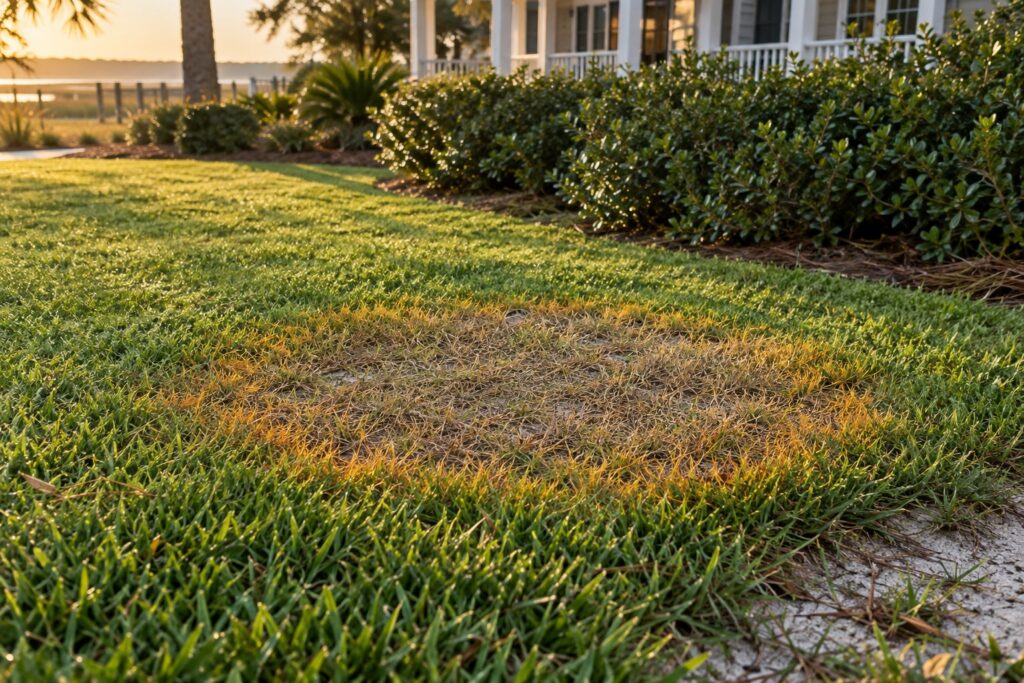
Large patch starts as a small circle of yellowing or orange-tinted grass, usually a couple of feet across, and expands outward over several weeks. Rings of ten or twenty feet are common on lawns that go untreated, and neighboring circles often merge into irregular shapes. The most telling feature is the border: when the fungus is actively spreading, the outer edge of the patch has a distinct orange or smoky bronze band where freshly infected grass is dying.
If you pull gently on a grass blade from that border, it usually slips free from the stolon with very little effort, and the lower leaf sheath will look dark, water-soaked, or rotted rather than dry. The center of an older patch may begin to recover with thin green growth while the edges keep advancing, which gives many lawns a doughnut or frog-eye appearance by November.
Two other problems get confused with large patch in our area. Chinch bug damage appears in hot, sunny, dry spots during summer, not in cool, wet fall weather, and the grass dries out rather than rotting at the base. Normal fall dormancy is uniform: the whole lawn fades gradually to tan, without circles or a sharp, active edge. If you see rings with an orange border in October in a low, shady, or frequently watered part of the yard, large patch should be at the top of the list.
What to do when you find large patch this fall
When large patch is already active, the goal is to stop the spread, protect the grass that has not been infected yet, and give the damaged areas the best chance to recover when the lawn wakes up in spring. Fungicides do not bring dead grass back, so the earlier you act after the first ring appears, the smaller the repair job will be.
1Cut back irrigation right away. Most North Myrtle Beach lawns need no more than one deep watering per week in October, and many need none when fall rains are steady. Water early in the morning so the grass dries during the day, never in the evening.
2Stop all nitrogen. Do not try to green up the patch with fertilizer. Nitrogen in fall feeds the fungus far more than it helps the grass, and the September 1 cutoff for coastal lawns still applies.
3Apply a labeled fungicide to the patch and a buffer around it. Products containing azoxystrobin, propiconazole, fluoxastrobin, or a combination such as azoxystrobin plus propiconazole are effective on large patch. Treat the visible ring plus several feet beyond its active edge, and follow with a second application about three weeks later.
4Mow at the normal height and bag the clippings from infected areas. Keep centipede at 1.5 to 2 inches, avoid scalping, and mow the healthy parts of the lawn first so you are not dragging infected material across clean turf.
5Mark the patch locations. A quick phone photo or a few landscape flags will remind you where to look in March, because large patch commonly reactivates in the same spots during spring green-up.
The preventive window for coastal SC lawns
Lawns that have had large patch before are very likely to get it again, which makes prevention far more cost-effective than chasing rings once they appear. Clemson Extension recommends making the first preventive fungicide application in the fall once soil temperatures drop toward 70°F, with a second application roughly three weeks later and, on lawns with a history of spring damage, one more after green-up.
On the Grand Strand, soil temperatures typically fall into that range somewhere between early October and early November, a little later than the Midlands and Upstate because the ocean keeps our soils warm. In practice, that means most North Myrtle Beach lawns benefit from a first preventive treatment in early to mid October and a follow-up in early November. A simple soil thermometer pushed two inches into the lawn in the morning tells you exactly where you stand in any given year.
Prevention fits neatly into the rest of the fall program. It does not conflict with pre-emergent weed control or with the final mowings of the season, and it pairs well with an irrigation controller adjustment to the once-a-week fall schedule we recommend for most properties.
Mistakes that make large patch worse
The most common mistake we see in North Myrtle Beach is watering a large patch ring because it looks dry. The grass looks thirsty, so the homeowner turns the sprinklers up, and the extra moisture is exactly what the fungus needs to spread faster. If you suspect large patch, the right instinct is less water, not more.
The second mistake is a fall application of a high-nitrogen “winterizer” product. These are marketed heavily every autumn, but on centipede and St. Augustine they push soft new growth into the very weeks when the fungus is most active, and they reduce cold hardiness at the same time. The third is cutting the lawn short in the fall to “clean it up,” which removes leaf area the plant needs and exposes stressed crowns.
Finally, many homeowners fight the symptoms for years without addressing the cause. A downspout that dumps into the lawn, a low spot that stays wet for days after every storm, or a layer of thatch over half an inch thick will keep bringing the disease back. Fixing drainage, aerating to relieve compaction, and managing thatch are the long-term cures, and they also make the lawn more resilient to everything else coastal weather throws at it.
Repairing the damage next spring
Some recovery happens on its own. Centipede and St. Augustine spread by stolons, so small patches often fill back in once the lawn is fully green and actively growing in May. Larger areas that were left untreated through fall and spring may stay thin or bare well into summer, and those are the areas where weeds move in.
For bare spots larger than a few feet, plugging or sodding after the lawn has fully greened up and soil temperatures are consistently warm is the most reliable fix. Before replacing anything, correct whatever caused the disease in that spot, whether that is an irrigation head spraying the same area twice, a drainage problem, or heavy shade. New sod laid back into the same conditions will often develop the same problem the following fall.
- Brown Patch Fungus in North Myrtle Beach: How to Spot It and Stop It Fast
- Overwatering vs. Underwatering: How to Tell the Difference in a Coastal SC Lawn
- End-of-Summer Irrigation Prep: What to Adjust Before Fall Arrives in North Myrtle Beach
- Dethatching Centipede Grass: When, Why, and How to Do It Without Causing Damage
- French Drains vs Catch Basins: Choosing the Right Drainage Solution for Coastal Yards
Frequently Asked Questions
What does large patch look like in a North Myrtle Beach lawn?
Large patch appears as circular areas of yellow to orange grass that expand from a couple of feet to ten feet or more across, often with a smoky orange or bronze border where the fungus is actively spreading. Blades at the edge pull out easily and the leaf sheaths look dark and rotted. In North Myrtle Beach it typically appears in October and November and again during spring green-up.
When should I treat for large patch in coastal South Carolina?
Preventive treatments work best when soil temperatures fall toward 70°F, which on the Grand Strand usually happens between early October and early November. Make a first application then and a second about three weeks later. Lawns with a history of spring damage benefit from one more application after green-up.
Is large patch the same as brown patch?
They are caused by closely related strains of the same fungus, Rhizoctonia solani, and the names are often used interchangeably. In coastal SC, the disease on warm-season grasses like centipede and St. Augustine in fall and spring is properly called large patch. Brown patch usually refers to the summer disease of cool-season grasses like tall fescue.
Will my centipede grass recover from large patch on its own?
Small patches often fill back in by late spring as centipede spreads by stolons, especially if the fungus was stopped in the fall. Large areas left untreated through fall and spring may stay thin into summer and invite weeds. Patches larger than a few feet across usually need plugs or sod once the lawn is fully green.
Should I water a lawn that has large patch?
Reduce watering rather than increasing it. Large patch thrives on extended leaf wetness and saturated soil, so most North Myrtle Beach lawns should be watered no more than once a week in fall, early in the morning, and not at all when rain is regular. Extra water to rescue a dry-looking patch usually makes it spread faster.
Can I use a fall fertilizer to help the lawn fight off fungus?
No. Nitrogen applied to centipede or St. Augustine after September 1 in coastal SC feeds large patch and reduces cold hardiness. If a soil test shows low potassium, a potassium-only product can support winter hardiness, but nitrogen should wait until the lawn is fully green next spring.
Does KeckCo treat large patch fungus in North Myrtle Beach?
Yes. KeckCo Turf and Ornamental Services diagnoses and treats large patch for homes throughout North Myrtle Beach, Little River, and the Grand Strand, including preventive fall programs, irrigation adjustments, and drainage corrections that address the cause. Call 843-273-0735 to schedule a lawn assessment.
Large patch is predictable, which is good news. It comes back to the same lawns at the same time of year, and a fall plan built around cooler soil, careful watering, no late nitrogen, and well-timed fungicide applications keeps those orange rings from turning into bare ground next spring.
Seeing orange rings in your North Myrtle Beach lawn?
KeckCo Turf and Ornamental Services diagnoses and treats large patch fungus and the drainage and irrigation problems behind it, for homes across North Myrtle Beach, Little River, and the Grand Strand. Call us for a lawn assessment before the damage spreads.