
Thatch is the spongy layer of partially decomposed organic material — dead grass blades, stems, and roots — that accumulates between the living grass and the soil surface in any lawn. A modest amount of thatch, under half an inch, is actually beneficial: it insulates the soil, moderates temperature and moisture fluctuations, and provides some cushioning. When thatch exceeds that threshold, however, it becomes an active impediment to lawn health — blocking water and fertilizer from reaching the root zone, providing ideal habitat for pest insects like chinch bugs, holding excess moisture that promotes fungal disease, and reducing the lawn’s responsiveness to everything you apply to it.
Centipede grass in North Myrtle Beach is particularly prone to thatch buildup because of the humid coastal climate, the warm season length that allows extensive growth, and the specific growth habit of centipede itself. Understanding when your lawn needs dethatching, when it does not, and how to do it correctly without causing more damage than you prevent is what this article is about.
How to Measure Your Thatch Depth
The most reliable way to assess thatch depth is to cut a small core sample from the lawn using a sharp spade or soil probe — slice down about 3 inches and extract a plug that shows the full profile from the surface down to mineral soil. The thatch layer is immediately visible as the brownish, spongy material between the green living grass blades at the top and the dark sandy soil at the bottom. Measure the thatch layer thickness directly on the plug.
Half an inch or less: no dethatching needed. The lawn may still benefit from core aeration, which disrupts and helps decompose modest thatch naturally without the more aggressive intervention of mechanical dethatching. Half an inch to three-quarters of an inch: dethatching is beneficial and will produce visible improvement in the lawn’s response to irrigation and fertilizer. More than three-quarters of an inch: dethatching is overdue and is likely already limiting lawn performance in measurable ways. More than one inch: severe thatch that requires aggressive dethatching followed by a recovery period and likely soil amendment.
Signs That Centipede Needs Dethatching
Beyond the direct measurement, several observable lawn behaviors indicate significant thatch accumulation. Water pooling on the lawn surface for extended periods after irrigation or rain — when the soil below the thatch is actually dry — indicates thatch that is acting as a water-repellent layer rather than the soil contact problem it appears to be. This hydrophobic thatch behavior is more common in thick, compressed thatch layers that have dried and become partially water-resistant over time.
Fertilizer response that is noticeably weaker than it should be — applications that produced visible greening in previous years now seem to do little — often reflects thatch intercepting the fertilizer before it reaches the soil and root zone. Increased insect activity from chinch bugs and unusual amounts of fungal disease relative to neighboring properties are also consistent with heavy thatch that provides pest habitat and moisture retention. And a lawn surface that feels spongy or bouncy underfoot rather than firm and cushioned is a tactile indicator of thatch depth that most experienced homeowners learn to recognize reliably.
The Right Timing Window for Dethatching in Coastal SC
Dethatching is physically stressful to the lawn — it removes significant amounts of organic material and disrupts the living plant crowns and stolons that make up the surface layer. Timing it when the grass is in active growth and can recover the disruption quickly is essential. For centipede in North Myrtle Beach, the correct dethatching windows are late spring (late April to May, after the lawn has broken fully out of dormancy and resumed active growth) and late summer to early fall (late August to mid-September, before growth slows significantly in October).
Never dethatch centipede during summer heat stress peak (mid-July through mid-August), when the physical stress of dethatching combined with heat, drought, and pest pressure creates a very high risk of significant turf damage. Never dethatch during or entering dormancy (October through March) — the lawn does not have the active growth needed to recover from dethatching’s physical disruption during this period. The late August to mid-September fall window is the one most North Myrtle Beach homeowners should target for annual or biennial dethatching work, as it provides adequate recovery time before dormancy while the lawn is transitioning out of peak stress.
Dethatching Methods: Vertical Mowing vs. Power Raking
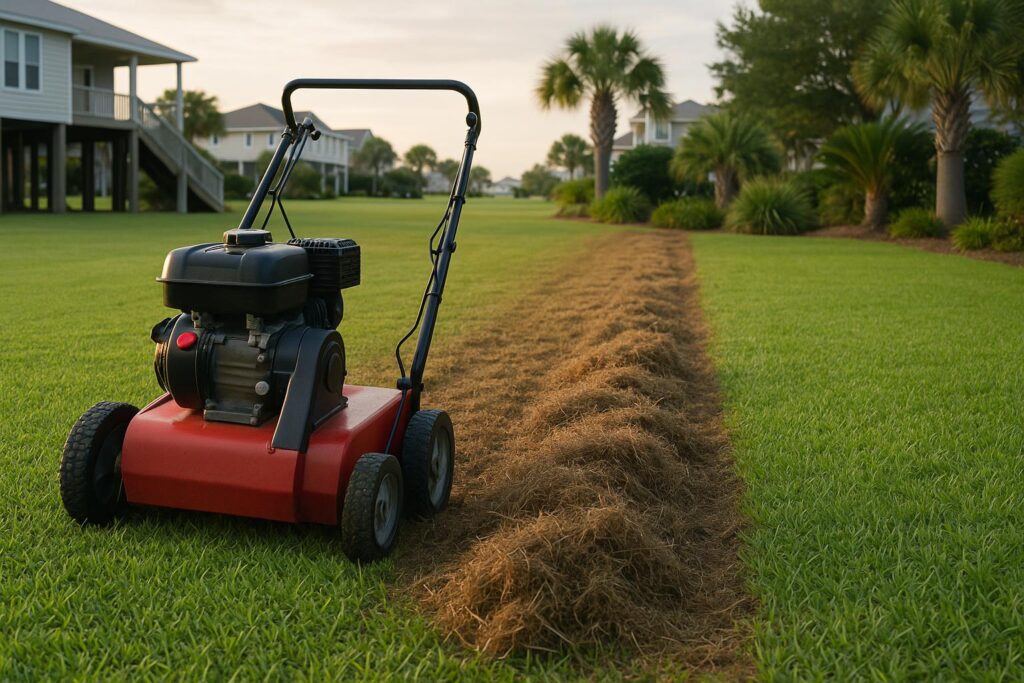
Vertical mowing (also called verticutting) is the preferred professional method for centipede grass dethatching in coastal SC. A vertical mower uses rotating blades oriented perpendicular to the ground rather than parallel — they cut down through the thatch layer in narrow, closely spaced slices, physically cutting the thatch material free from the soil contact and lifting it to the surface for collection. The blade depth and spacing can be adjusted to control aggression — shallower cuts at wider spacing for light thatch disruption; deeper cuts at closer spacing for aggressive thick thatch removal. Properly calibrated, vertical mowing removes thatch while minimizing damage to the living crowns and stolon network.
Power raking uses spring-tine attachments that rake aggressively through the thatch layer, tearing and pulling material to the surface. It is more aggressive and less precise than vertical mowing — effective on moderate thatch in cool-season grasses but potentially very damaging to centipede’s shallow, surface-level growth habit if applied too aggressively. If power raking centipede, use the least aggressive tine setting that moves material to the surface and avoid multiple passes in the same direction over the same areas.
What to Do Immediately After Dethatching
Collect and remove all debris from the dethatching operation. The material removed is not appropriate for mulching back into the lawn — it contains the very organic matter that accumulated as thatch, and returning it to the surface defeats the purpose of the operation. Bag and compost the debris or dispose of it off the property.
Follow dethatching with core aeration if the timing window allows — aeration in the same visit or within a few days maximizes the benefit to the soil profile and the recovery trajectory of the lawn. Apply a light, slow-release fertilizer after aeration to support recovery of the disrupted crowns and stolons — use a low-nitrogen formulation appropriate for centipede rather than a high-nitrogen product that would push the weak, fast growth that makes centipede vulnerable in the post-dethatching recovery period. Irrigation immediately after dethatching and consistently through the recovery period is essential.
Prevention: Keeping Thatch from Building Back
The most effective long-term thatch management strategy for centipede in North Myrtle Beach is avoiding the management practices that accelerate thatch production. Excess nitrogen fertilization is the primary driver — it stimulates rapid, dense top growth that produces more organic material than soil microbes can decompose at a normal rate. Maintaining centipede at the correct, modest fertility level (one to two light applications per year maximum) significantly reduces the rate of thatch accumulation compared to lawns receiving heavy fertilization programs borrowed from other grass types.
Annual core aeration is the cultural practice with the most consistent impact on thatch management — the soil cores brought to the surface by aeration introduce microbial activity into the thatch layer that significantly accelerates its decomposition. Properties that receive annual aeration consistently maintain thatch at manageable levels far longer than those that skip or defer aeration. Combined with appropriate fertilization, annual aeration can extend the interval between dethatching events from every two to three years to every four to five years in most North Myrtle Beach centipede lawns.
Frequently Asked Questions
How do I know if my centipede lawn needs dethatching?
Cut a small core plug 3 inches deep and measure the brownish spongy layer between the green grass and the dark soil. Half an inch or less needs no dethatching; half to three-quarters of an inch benefits from dethatching; more than three-quarters of an inch is overdue. Observable signs of thatch include water pooling on the lawn surface despite dry soil below, weak fertilizer response, and a spongy feel underfoot.
When should I dethatch centipede grass in North Myrtle Beach?
The optimal dethatching windows are late spring (late April to May after full green-up) and late summer to early fall (late August to mid-September). Avoid dethatching during peak summer heat stress (mid-July to mid-August), during or approaching dormancy (October through March), or when the lawn is stressed from drought, pests, or disease.
Can I dethatch and aerate at the same time?
Yes, and combining them is recommended when both are needed. Dethatch first, then follow immediately with core aeration in the same visit or within a few days. This sequence maximizes the benefit to the soil profile and the lawn’s recovery trajectory — the aeration channels created after dethatching penetrate more cleanly to the mineral soil without the thatch layer impeding the tine depth.
How long does it take for centipede to recover after dethatching?
Centipede dethatched at the correct time — in late August or September when active growth is still occurring — typically shows visible recovery within 3 to 4 weeks. The lawn will look rough immediately after dethatching — sparse, disturbed, with debris — but recovers and fills in relatively quickly with adequate irrigation and mild fertilization. A lawn dethatched during the wrong window (stressed turf or approaching dormancy) recovers more slowly and carries more risk of permanent damage.
Does dethatching hurt centipede grass?
Dethatching done at the correct time with properly calibrated equipment causes temporary disruption but not permanent damage to healthy centipede. Dethatching done too aggressively, on stressed turf, or at the wrong time of year can cause significant and slow-to-recover damage. This is why timing and proper calibration of the dethatching equipment are the two most important variables in the outcome.
Does KeckCo provide dethatching services in North Myrtle Beach?
Yes. KeckCo Turf and Ornamental Services provides professional dethatching and core aeration for residential properties throughout North Myrtle Beach, Little River, and the Grand Strand. We assess thatch depth before recommending treatment and calibrate equipment for centipede’s specific growth characteristics. Call 843-273-0735.
Dethatching is one of those lawn care services that delivers disproportionate results on centipede lawns that genuinely need it — the improved water penetration, fertilizer uptake, and disease resistance that follow a properly timed and executed dethatching are tangible and measurable within a single growing season. Getting the measurement and the timing right before doing anything else is the discipline that makes the difference between a dethatching that genuinely improves the lawn and one that sets it back.
Think your North Myrtle Beach centipede lawn may need dethatching?
KeckCo Turf and Ornamental Services provides professional dethatching and core aeration for residential lawns throughout the Grand Strand. Call us to assess your thatch depth before the fall window closes.