
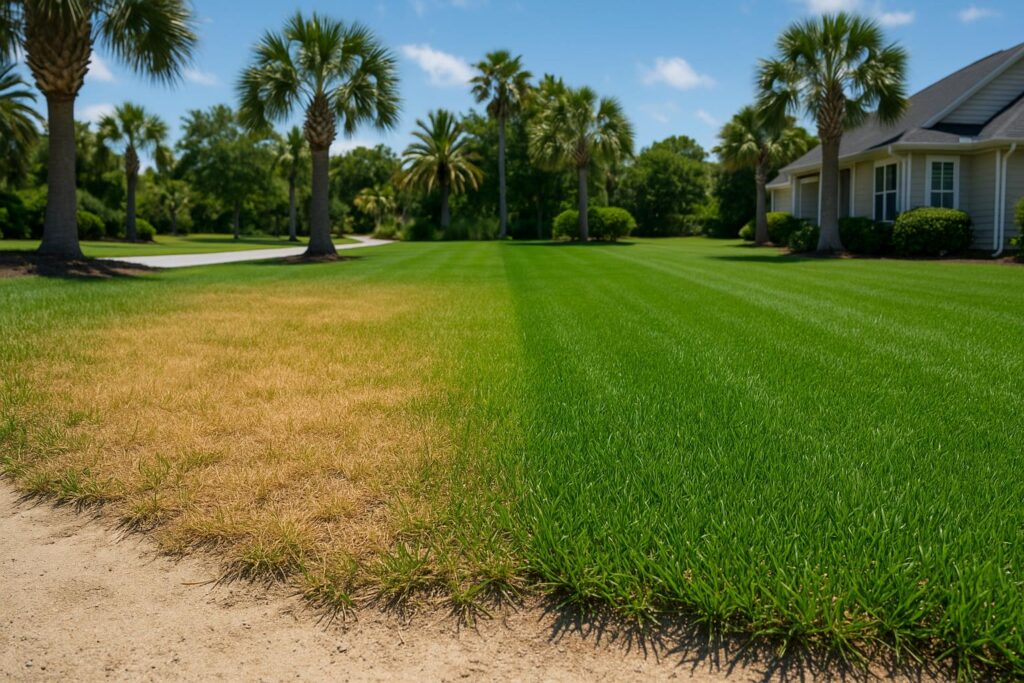
Walk through enough North Myrtle Beach yards in July and you will find two groups of stressed lawns that look almost identical: one group is being drowned by too much irrigation, and the other is slowly dying of thirst. The symptoms — yellowing, wilting, thinning turf — overlap so closely that homeowners routinely make the wrong diagnosis and apply the wrong solution, making a bad situation worse.
Getting this diagnosis right matters because overwatering and underwatering require opposite responses. Knowing which problem you have is the single most important step toward fixing it. At KeckCo Turf and Ornamental Services, we walk through this diagnostic process on properties across the Grand Strand every summer, and we put the key differences here so you can work through it yourself.
Signs Your Lawn Is Overwatered
Overwatered lawns in coastal SC often show a distinctive combination of yellow or light green color combined with spongy texture underfoot. The grass may feel soft and wet even hours after the last irrigation cycle. You will often see fungal growth — mushrooms popping up overnight, slimy patches, or the early signs of brown patch in circular patterns. Weeds that love wet conditions, particularly sedges and dollar weed, proliferate rapidly in overwatered lawns.
One of the counterintuitive signs of overwatering is that the grass still wilts during peak afternoon heat despite being soggy. When roots are sitting in saturated, oxygen-depleted soil, they cannot absorb water effectively even when surrounded by it — a condition called oxygen starvation. The plant is dying of effective drought while physically submerged.
Signs Your Lawn Is Underwatered
Underwatered centipede and St. Augustine grass first shows stress by folding its blades lengthwise — a self-protective curl to reduce surface area and slow moisture loss. The lawn takes on a blue-gray or grayish cast rather than its normal green. Footprints remain visible long after you walk across it, because stressed turf lacks the turgor pressure to spring back. In advanced underwatering, the grass goes dormant and browns out beginning at the tips of individual blades.
In North Myrtle Beach’s sandy soil, underwatering can progress extremely quickly. Sandy soil has very low water-holding capacity, and during a heat wave with daily highs above 95°F, a lawn can go from mildly stressed to dormant within 48–72 hours without sufficient irrigation. The transition is faster here than in lawns growing in clay-based soils further inland.
How to Test Which Problem You Actually Have
1The screwdriver test. Push a standard 6-inch screwdriver straight into the soil in a stressed area. If it sinks easily to the handle, your soil is saturated — overwatering. If it resists or stops at 2–3 inches, your soil is dry — underwatering.
2The squeeze test. Grab a handful of soil from about 2 inches deep. Squeeze it firmly and open your hand. If it holds a ball shape and feels wet or muddy, you are overwatered. If it falls apart immediately and feels dry and loose, you are underwatered.
3Look at weed types. Dollar weed, sedges, and algae = overwatered. Crabgrass, spurge, and sandbur proliferating in thin, bare areas = underwatered stress causing turf loss and weed invasion.
4Check your irrigation run times and schedule. If you are running irrigation more than 3 times per week for 20+ minutes per zone, overwatering is likely. If you are running once a week or less during July heat, underwatering is the probable cause.
How Coastal Sandy Soil Changes the Equation
Clay soils hold water for days. Sandy soils used throughout North Myrtle Beach, Myrtle Beach, and Little River drain within hours. This means that overwatering in coastal SC requires you to consistently add water faster than sandy soil can drain it — which typically means running irrigation too frequently, not too long per session. You can over-water sandy soil by running your system every day even if each zone only runs for 10 minutes.
Conversely, underwatering in sandy coastal soil happens quickly and deeply. Once the top several inches of sandy soil dry out, there is very little capillary action pulling moisture up from below — the grass roots simply cannot reach it. This is why infrequent deep watering is far more effective in coastal SC than frequent shallow watering: you want to wet the soil to 4–6 inches and then let it partially dry before watering again.
How to Fix an Overwatered Lawn
The first step is to stop all irrigation for 48–72 hours and let the soil drain. Once it has partially dried, reset your irrigation controller to reduce both frequency and per-zone run times. Address any fungal disease that developed during the overwatered period with an appropriate fungicide before resuming irrigation. If compaction is contributing to poor drainage, aeration in spring or fall will help long-term. For persistent low areas that hold water, a drainage solution such as a French drain or regrading may be the real fix.
How to Fix an Underwatered Lawn
Do not attempt to revive a severely underwatered lawn all at once with a single massive watering — this can cause root shock in stressed turf. Instead, increase irrigation gradually over 3–4 days. Water deeply in the early morning and allow time for the soil to partially dry between cycles. Dormant centipede grass will generally green back up within 7–14 days once consistent moisture returns, provided the heat stress was not severe enough to damage the crown of the plant.
Frequently Asked Questions
How often should I water my centipede grass lawn in North Myrtle Beach in July?
In North Myrtle Beach’s sandy coastal soil, centipede grass generally needs water 2–3 times per week during July, enough to deliver about 0.5 inches per session. Run irrigation in the early morning (5–7 AM) and avoid watering daily, which promotes shallow roots and fungal conditions.
Why does my lawn look wilted even though I water it every day?
Daily watering in sandy coastal soil often leads to overwatering, where roots sit in oxygen-depleted saturated soil and cannot function properly. Counterintuitively, reducing irrigation frequency while increasing depth per session typically produces healthier, less wilted turf than daily shallow watering.
What does dollar weed in my lawn mean?
Dollar weed (Hydrocotyle umbellata) is a very reliable indicator of chronically overwatered or poorly draining soil. If dollar weed is spreading in your North Myrtle Beach lawn, scaling back irrigation frequency is usually the most effective first step before any herbicide treatment.
Can I damage my lawn permanently by overwatering?
Yes, particularly if overwatering promotes extended fungal disease like brown patch. The fungus itself can kill turf even after irrigation is corrected. Severe root oxygen starvation in heavy clay amendments or low-lying areas can also cause root dieback that requires recovery time and sometimes reseeding or sodding.
My lawn looks dry but the screwdriver goes in easily — what does that mean?
This is a classic overwatering scenario where the surface appears dry because the sun has dried the top inch, but the soil below is still saturated. Trust the screwdriver test at depth over the surface appearance. In this case, hold off on irrigation until the soil dries to a few inches down.
Does KeckCo help with irrigation scheduling and adjustments?
Yes. KeckCo Turf and Ornamental Services provides irrigation system audits, schedule adjustments, and repairs throughout North Myrtle Beach, Little River, and Myrtle Beach. We can evaluate your current setup and dial in the timing and run rates for coastal SC’s sandy soil conditions.
The difference between overwatering and underwatering is not always obvious to the eye, but the screwdriver and squeeze tests give you reliable answers without needing any special equipment. Get the diagnosis right first, then apply the correct response — that sequence saves lawns and water bills throughout the Grand Strand every summer.
Not sure if your lawn is getting too much or too little water?
KeckCo Turf and Ornamental Services offers irrigation audits and lawn diagnostics throughout North Myrtle Beach and the Grand Strand. Let us help you get the balance right.