
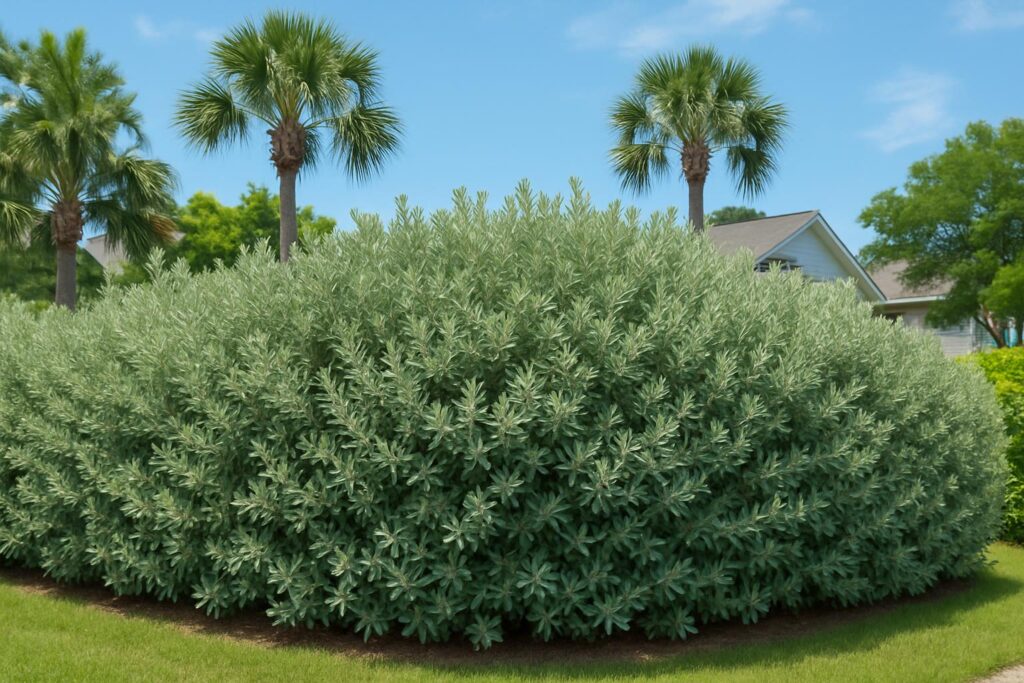
If you are looking for a privacy hedge in North Myrtle Beach that actually belongs on the coast — one that will not need constant irrigation once established, will not burn from salt spray, will grow fast enough to provide real screening within a few seasons, and will not demand the kind of ongoing maintenance that keeps a non-native hedge alive in spite of the coastal environment — there is one plant that answers every one of those requirements: wax myrtle (Morella cerifera).
At KeckCo Turf and Ornamental Services, wax myrtle is one of the most frequently recommended plants we incorporate into North Myrtle Beach landscape designs, and it is consistently among the plants we most wish more homeowners were using. It is a native coastal Carolina plant that genuinely thrives here rather than merely surviving, and it outperforms the non-native alternatives that fill most nursery lots in almost every meaningful category for coastal SC conditions.
- What wax myrtle is and why it belongs on the coast
- Growth rate and what to expect in North Myrtle Beach
- Wax myrtle vs. common hedge alternatives
- How to plant wax myrtle for a privacy hedge
- Pruning and maintenance to keep hedge form
- Other landscape uses beyond privacy hedging
- Frequently Asked Questions
What Wax Myrtle Is and Why It Belongs on the Coast
Wax myrtle is a native evergreen shrub or small tree found naturally along the Atlantic and Gulf coasts from New Jersey to Texas and throughout the southeastern coastal plain. It grows abundantly in the maritime thickets and coastal scrub environments that border the beaches, marshes, and waterways throughout the Grand Strand — including in some of the most salt-exposed, nutrient-poor, waterlogged conditions that would kill most planted ornamentals within a season. This is not a plant that has been adapted to survive coastal conditions; it is a plant that evolved specifically for them.
Its aromatic silvery-green leaves are evergreen, providing year-round screening without the bare-winter problem of deciduous hedges. The plant produces small, waxy, gray-blue berries in fall and winter that are a critical food source for yellow-rumped warblers and dozens of other bird species that winter along the Grand Strand. As a hedge plant, it provides dense, full screening from the base to the top when maintained with regular pruning — and as a natural form, it develops into an attractive multi-stem large shrub or small tree with interesting gnarled branching structure.
Growth Rate and What to Expect in North Myrtle Beach
Wax myrtle is one of the fastest-growing native shrubs available for coastal SC landscapes. Under good conditions — well-drained sandy soil, full sun to part shade, and adequate irrigation during the first growing season — it grows 2 to 3 feet per year. A 3-gallon nursery plant installed in fall or early spring can reach 8 to 10 feet of height within 3 to 4 growing seasons, providing meaningful privacy screening far faster than slower-growing alternatives like American holly, cherry laurel, or photinia.
The growth rate is something to plan for as well as celebrate. Left unpruned, wax myrtle grows into a 15 to 20-foot multi-stem large shrub or small tree — beautiful as a specimen or naturalized screen, but too large for most residential hedgerow applications without regular management. Annual or twice-annual pruning is the maintenance commitment required to keep wax myrtle at hedge scale, and it responds to shearing very well, filling in quickly after each cut.
Wax Myrtle vs. Common Hedge Alternatives
Vs. Leyland cypress: Leyland cypress grows fast but is extremely susceptible to several fungal diseases (Seiridium canker, Cercosporidium blight) that cause branch dieback and death in the humid coastal SC climate. It also does not tolerate salt spray well and frequently fails in exposed coastal locations. Wax myrtle has no comparable disease vulnerabilities and handles salt with ease.
Vs. cherry laurel: Cherry laurel grows moderately fast, tolerates shade, and provides good screening, but it suffers from shot hole fungal disease in the humid coastal climate and requires more soil moisture than wax myrtle. It is not as salt-tolerant and needs considerably more supplemental water during establishment and drought periods.
Vs. arborvitae: Arborvitae is not well-adapted to coastal SC heat and humidity, struggles with spider mites during hot summers, and has poor salt tolerance. It is frequently planted in North Myrtle Beach landscapes and frequently declines — a mismatch between plant and environment that wax myrtle simply does not have.
Vs. ligustrum (privet): Privet grows fast and tolerates poor conditions, but it is an invasive non-native in coastal SC that spreads aggressively into natural areas and crowds out native vegetation. Wax myrtle provides comparable or superior performance without the ecological cost.
How to Plant Wax Myrtle for a Privacy Hedge
1Choose the right spacing. For a dense, full hedge that fills in within 2 to 3 seasons, plant wax myrtle on 4 to 6-foot centers. Wider spacing produces a more open, naturalistic screen that fills in more slowly. For a formal, tightly clipped hedge, 4-foot spacing works best.
2Plant in fall for best establishment. Fall planting in North Myrtle Beach gives wax myrtle a full mild season to establish roots before facing its first summer. Spring planting is also effective but requires more attentive irrigation management through the first summer heat.
3Dig wide, not deep. Plant at the same depth as the nursery container — do not bury the root flare. Dig the hole two to three times as wide as the container to allow lateral root expansion into the surrounding soil.
4Mulch immediately after planting. Apply 2 to 3 inches of mulch from the drip line inward, pulled back from the stem. Mulch dramatically reduces water demand during establishment and keeps the root zone cooler during the first summer.
5Do not fertilize at planting. Wax myrtle fixes its own nitrogen and does not need fertilization at installation. A starter fertilizer can be counterproductive, stimulating top growth before roots are established to support it.
Pruning and Maintenance to Keep Hedge Form
Keeping wax myrtle at hedge scale requires pruning, but not an excessive amount — one to two sessions per year maintains a neat, dense hedge form on most properties. The primary pruning window is late winter, just before spring growth begins — typically late February or early March in coastal Horry County. This timing removes the previous season’s growth and shapes the hedge before the new flush pushes out, producing the densest possible response. A second light pruning in mid-summer after the first growth flush of the season fine-tunes the shape and keeps the hedge from getting ahead of itself.
Wax myrtle tolerates hard pruning well if a hedge has gotten significantly out of scale. Cutting mature plants back to 2 to 3 feet above the ground produces vigorous regrowth and allows a full restart of the hedge form, though this approach sacrifices a season or two of screening while the plant recovers. This resilience to hard pruning is one of the practical advantages over alternatives like Leyland cypress or arborvitae, which do not recover well from severe cutback.
Other Landscape Uses Beyond Privacy Hedging
Wax myrtle’s versatility makes it useful in multiple landscape roles beyond the straight-line privacy hedge. As a specimen plant allowed to develop its natural multi-stem form, it creates a beautiful 12 to 15-foot ornamental tree with attractive bark and wildlife value in any season. Planted in masses on a slope or in a naturalized area, it provides erosion control, habitat, and low-maintenance coverage that survives drought, flooding, salt, and the full range of coastal conditions without intervention.
It also works well as a transitional plant between the maintained lawn and a less formal landscape zone at the property’s edges, or as a backdrop for perennial and ornamental grass plantings that need a taller, evergreen backdrop for visual structure. Any role that requires a tough, fast-growing, evergreen, wildlife-supporting native plant in coastal SC — wax myrtle can fill it.
Frequently Asked Questions
How fast does wax myrtle grow in North Myrtle Beach?
Wax myrtle grows 2 to 3 feet per year under good conditions in North Myrtle Beach, making it one of the fastest-establishing privacy hedge options in coastal SC. A 3-gallon nursery plant can achieve 8 to 10 feet of height within three to four growing seasons without growth supplements beyond appropriate irrigation during establishment.
How do you keep wax myrtle as a hedge rather than a tree?
Regular shearing once in late winter before spring growth and again in mid-summer after the first growth flush keeps wax myrtle at hedge scale. Without pruning, it naturally grows into a multi-stem small tree reaching 15 to 20 feet. Annual pruning maintains the dense, full hedge form most homeowners prefer for privacy screening.
Does wax myrtle need a lot of water once established?
No. Once established — typically after the first full growing season — wax myrtle in North Myrtle Beach survives on natural rainfall through all but the most extreme droughts. It is one of the most genuinely drought-tolerant shrubs available for coastal SC landscapes, requiring supplemental irrigation only during extended dry periods after its first year in the ground.
Will wax myrtle survive salt spray in North Myrtle Beach?
Yes. Wax myrtle is among the most salt-tolerant shrubs available for coastal SC planting — it grows naturally in maritime thickets immediately adjacent to beach environments with direct salt spray exposure. It handles the salt air conditions of North Myrtle Beach residential properties, including those close to the ocean or Intracoastal Waterway, without damage.
Is wax myrtle invasive in South Carolina?
No. Wax myrtle (Morella cerifera) is a native plant throughout coastal SC and the southeastern United States. It spreads naturally through bird-distributed seeds, but it is a native component of the local ecosystem rather than an invasive species. It does not crowd out native plants the way non-native invasives like privet or Chinese tallow tree do.
Does KeckCo install wax myrtle hedges in North Myrtle Beach?
Yes. KeckCo Turf and Ornamental Services designs and installs native coastal landscape plantings including wax myrtle privacy hedges for residential properties throughout North Myrtle Beach, Little River, and the Grand Strand. We can incorporate wax myrtle into new landscape designs or as a replacement for failing non-native hedges. Call 843-273-0735.
Wax myrtle is not an exotic or unusual choice — it is the plant that has been thriving in the coastal Carolina environment for thousands of years, doing exactly what North Myrtle Beach homeowners need a hedge plant to do: growing fast, staying green year-round, tolerating everything the coast throws at it, and doing it all without demanding significant ongoing care. If you are planting a new hedge or replacing a failing one, it belongs at the top of your list.
Want a privacy hedge that thrives on the coast without constant maintenance?
KeckCo Turf and Ornamental Services designs and installs native coastal landscapes including wax myrtle hedges throughout North Myrtle Beach and the Grand Strand.