
Core aeration is one of those lawn care practices that delivers disproportionate returns relative to its cost and simplicity — and yet it is consistently skipped or delayed by homeowners who either assume their sandy coastal soil does not need it or are uncertain about the right timing window. In North Myrtle Beach, the fall aeration window opening in late August is one of the most valuable maintenance opportunities of the year, setting up the root system for stronger recovery from summer stress and better establishment heading into the cooler months.
At KeckCo Turf and Ornamental Services, fall aeration is a core part of our seasonal maintenance programs throughout the Grand Strand. Here is why it matters even in sandy coastal soil, when to do it, and what you can expect from a properly timed aeration on your centipede or St. Augustine lawn.
- What core aeration actually does to your lawn
- Does sandy coastal soil really need aeration?
- The optimal aeration window for North Myrtle Beach
- What to expect during and after aeration
- What to pair with aeration for maximum benefit
- How often should a coastal SC lawn be aerated?
- Frequently Asked Questions
What Core Aeration Actually Does to Your Lawn
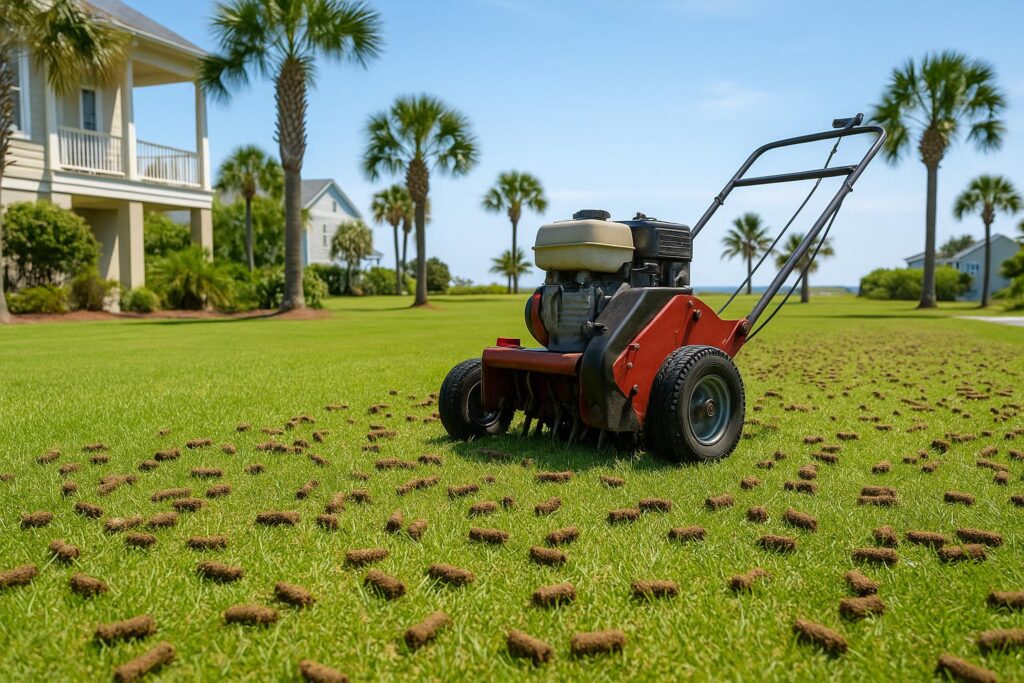
Core aeration uses hollow tines to remove small plugs of soil and thatch from the lawn, typically at a spacing of 2 to 4 inches. These plugs are deposited on the surface, where they break down over 1 to 2 weeks and return their material to the lawn. The holes left behind — typically 2 to 3 inches deep — accomplish several things simultaneously: they relieve surface compaction, allow water and nutrients to penetrate more directly to the root zone, reduce thatch by stimulating microbial activity at the soil surface, and give roots new pathways to expand into less compacted soil.
For warm-season grasses like centipede and St. Augustine, core aeration in late summer and early fall coincides with a natural root development period. As air temperatures begin to moderate from summer peaks in September and October, grass root systems actively grow and expand — and the channels created by aeration give roots direct pathways into the soil that persist for months, improving the lawn’s drought resilience and nutrient uptake capacity for the following season.
Does Sandy Coastal Soil Really Need Aeration?
This is a common question from North Myrtle Beach homeowners, and the answer is yes — though the reason differs from why clay soils benefit from aeration. Clay soils develop deep structural compaction that is the primary target of core aeration. Sandy soils do not compact the same way at depth, but they develop significant surface compaction from foot traffic and the physical impact of rainfall and irrigation, and they often develop the very problem that matters most in coastal SC: excessive thatch accumulation.
Centipede grass produces thatch rapidly in North Myrtle Beach’s warm, humid climate — particularly on properties where nitrogen fertilization has been higher than centipede’s low nutritional requirements. A thatch layer above half an inch is a real and documented impediment to lawn health in coastal SC properties, and core aeration is the most effective mechanical intervention for managing it. The soil plugs brought to the surface by aeration contain beneficial microorganisms that colonize the thatch and break it down significantly faster than would otherwise occur.
The Optimal Aeration Window for North Myrtle Beach
The correct aeration window for centipede and St. Augustine in North Myrtle Beach is late August through early October — specifically when soil temperatures are between 65°F and 80°F and the grass is still in active growth. Aerating while the lawn is actively growing allows the grass to recover the holes and fill in within 3 to 4 weeks. Aerating too early in summer — during peak July and August heat stress — causes unnecessary physical stress to already-taxed turf. Aerating too late — after the grass has entered dormancy in November — delays recovery until spring and leaves the holes exposed over the dormant period.
Late August and September represent the sweet spot in coastal Horry County: soil temperatures have moderated from peak summer but remain warm, the worst of pest pressure has passed, and the lawn typically has 4 to 6 weeks of active growth remaining before dormancy slows recovery. This is also the window that coordinates best with fall pre-emergent timing — aerating before pre-emergent application is the standard sequence, as aerating after pre-emergent disrupts the chemical barrier it creates in the soil.
What to Expect During and After Aeration
Immediately after core aeration, your lawn will look rough — soil plugs scattered across the turf surface, holes visible throughout the lawn, a temporarily less-manicured appearance. This is completely normal and temporary. Do not attempt to clean up or remove the plugs; leave them on the surface to break down naturally. Most plugs dissolve and disappear within 1 to 2 weeks with normal irrigation and rainfall.
The lawn will show visible improvement over the 3 to 6 weeks following aeration — improved water penetration (puddles disappear faster after irrigation or rain), more uniform color as fertilizer reaches the root zone more efficiently, and in the following spring, noticeably more vigorous early-season growth. Properties with heavy thatch typically see the most dramatic improvement in the season following aeration, as the disrupted thatch layer has broken down substantially by the time spring growth resumes.
What to Pair with Aeration for Maximum Benefit
Core aeration opens the most direct window to the root zone that exists on a lawn, and the two to three week period after aeration is the best possible time to apply certain inputs. A soil pH amendment (elemental sulfur for lawns trending too alkaline, as discussed in our article on iron deficiency) moves into the root zone far more efficiently through freshly aerated holes than through the thatch layer of an unaeated lawn. Similarly, if soil test results indicate the need for any nutrient adjustment, the post-aeration window maximizes uptake efficiency.
Fall pre-emergent weed control should be applied after aeration, not before. Aeration physically disrupts the pre-emergent barrier in the soil, so the correct sequence is always: aerate first, then apply pre-emergent within a few days. Some lawn programs also incorporate a light fall fertilization — low in nitrogen, appropriate for centipede’s modest nutritional needs — in the post-aeration window to support root development heading into the cooler months.
How Often Should a Coastal SC Lawn Be Aerated?
Annual aeration is appropriate for most North Myrtle Beach centipede and St. Augustine lawns with moderate to heavy use, traffic, or thatch accumulation history. Properties with very low foot traffic on loose, naturally well-structured sandy soil may do well with aeration every other year. Properties with heavily compacted areas, persistent thatch above half an inch, or a history of waterlogging and poor infiltration benefit most from annual aeration and may warrant core aerating twice per year — once in early summer and once in fall — for a period of two to three years to address significant accumulated thatch.
One useful indicator: pour a glass of water directly onto the lawn surface in a spot that is not in the path of a sprinkler head. If it puddles and takes more than 30 seconds to absorb into the soil, your lawn has a compaction or thatch issue that warrants aeration as part of the response. Good soil structure and healthy thatch management produce a lawn where water disappears into the surface almost immediately upon contact.
Frequently Asked Questions
When should I aerate my lawn in North Myrtle Beach?
The optimal aeration window for North Myrtle Beach centipede and St. Augustine lawns is late August through early October, while soil temperatures are still warm for active root recovery but air temperatures have moderated from peak summer heat. Avoid aerating during peak summer heat stress or after the grass has entered dormancy.
Does sandy coastal soil still need aeration?
Yes, though the primary benefit in sandy coastal SC soil is thatch disruption and improved root development pathways rather than breaking up clay compaction. Centipede grass produces thatch rapidly in North Myrtle Beach’s climate, and core aeration is the most effective mechanical intervention for managing thatch accumulation in coastal lawns.
Should I leave the soil plugs on the lawn after aeration?
Yes. Do not rake up or remove soil plugs after aeration — leave them on the surface to break down naturally over 1 to 2 weeks with normal irrigation and rainfall. The plugs contain beneficial microorganisms from the soil that colonize the thatch layer and significantly accelerate its decomposition when left in place.
Can I apply pre-emergent weed control before or after aeration?
Always aerate before applying pre-emergent, not after. Core aeration physically disrupts the chemical barrier created by pre-emergent products in the soil. The correct sequence is: aerate first, then apply pre-emergent within a few days to establish a new barrier in the freshly aerated soil.
How long does it take for a lawn to recover from core aeration?
In late summer and early fall conditions, most lawns show the holes filling in within 3 to 4 weeks as the grass grows into the aeration channels. The soil plugs on the surface break down within 1 to 2 weeks. The performance improvements from aeration — better water penetration, improved fertilizer uptake, reduced thatch — develop more gradually over the following 2 to 3 months.
Does KeckCo provide core aeration services in North Myrtle Beach?
Yes. KeckCo Turf and Ornamental Services provides core aeration for residential properties throughout North Myrtle Beach, Little River, and the Grand Strand. Fall aeration slots fill quickly — contact us at 843-273-0735 to get on the schedule before the optimal window passes.
Core aeration in late August and September is one of the simplest high-return investments you can make in your North Myrtle Beach lawn heading into fall. The window is short, the service slots fill fast, and the improvement to root health, thatch management, and nutrient uptake efficiency carries forward into the next full growing season. If you have not aerated this year, now is the time to schedule it.
Ready to schedule fall aeration for your North Myrtle Beach lawn?
KeckCo Turf and Ornamental Services provides core aeration throughout North Myrtle Beach, Little River, and the Grand Strand. Fall slots fill quickly — call us now to get on the schedule.