
Summer Weeds in North Myrtle Beach: What’s Sprouting Now and How to Stop It
Summer in North Myrtle Beach is peak season for more than just beach traffic — it’s also when the most aggressive warm-season weeds move into coastal SC lawns with the most speed and force. Crabgrass spreading across a thin patch of centipede. Doveweed threading through turf that looks healthy from a distance. Dollar weed popping up in low spots where irrigation or rain keeps the soil consistently moist. These weeds don’t wait for a convenient time to deal with them, and they don’t slow down in the heat — they thrive in it.
The challenge for North Myrtle Beach homeowners is that summer weed control requires a different approach than the pre-emergent strategy that works in late winter and early spring. You’re now dealing with weeds that have already germinated and are actively growing. The window for preventing them has closed. What’s left is identifying exactly what you’re dealing with, choosing the right post-emergent approach for your turf type, and acting before the weeds set seed and make next year’s problem worse than this one.
The Most Common Summer Weeds in North Myrtle Beach Lawns
Not all summer weeds are the same, and identifying what you’re actually dealing with matters before you reach for any treatment. The wrong herbicide applied to the wrong weed — or the wrong turf type — wastes money at best and damages your lawn at worst. Here are the weeds most likely to show up in a North Myrtle Beach centipede or St. Augustine lawn in July and August.
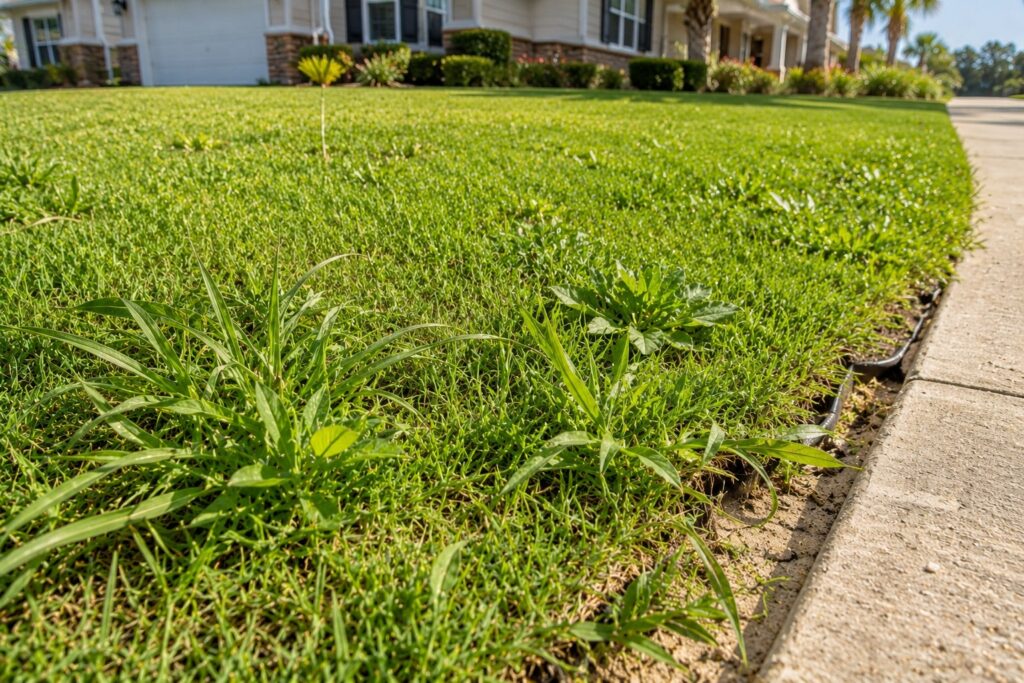
Crabgrass is the most widespread summer annual weed in coastal SC and the one most homeowners recognize. It germinates when soil temperatures reach 55–60°F in late winter and grows aggressively through summer, producing a low, spreading mat of coarse grass with distinctive finger-like seed heads. In sandy Horry County soil it establishes quickly and is most visible in thin turf areas, along edges, and near driveways where soil heats fastest. Once established, it won’t respond to pre-emergent herbicides — only post-emergent treatments or physical removal will address it.
Doveweed is the summer weed that catches the most North Myrtle Beach homeowners off guard. Its narrow, glossy leaves look remarkably similar to centipede grass when young, so it often goes unnoticed until it has spread widely. It produces small purple flowers in summer that make mature plants identifiable, but by then the infestation is typically significant. Doveweed thrives in moist, overwatered areas and is particularly common in neighborhoods where irrigation systems run more than necessary.
Dollar weed (also called pennywort) is instantly recognizable by its round, bright green leaves with scalloped edges that look like small lily pads. It appears most aggressively in low, moist areas of the lawn — near downspouts, in irrigation over-spray zones, and in spots where water collects after rain. Dollar weed is a reliable indicator of overwatering or poor drainage.
Chamberbitter is a broadleaf annual that appears in late spring and builds through summer, producing fernlike branches lined with small oval leaflets. It sets seed prolifically and is commonly found in landscape beds, lawn edges, and thin turf areas. It’s easier to control when young but becomes woody and more resistant as it matures through summer.
Torpedograss is the most difficult summer weed on this list to control and the one that causes the most long-term damage if allowed to establish. It’s a perennial grass weed that spreads through both seed and aggressive rhizomes, meaning pulling or mowing it only redistributes it. Once established in a centipede lawn, torpedograss requires repeated targeted applications of fluazifop-containing herbicides over multiple seasons to fully eliminate.
Why Summer Weeds Win When Turf Is Stressed
Healthy, dense turf is the most effective weed suppression tool available. Centipede grass that’s growing at the right height, getting the right amount of water, and isn’t under pest or disease pressure forms a canopy that shades the soil surface and prevents weed seeds from getting the light they need to germinate. When that canopy opens up — from drought stress, pest damage, disease, scalping from mowing too low, or anything else that thins the turf — weeds move in fast.
This is why summer weed pressure tends to be highest in the areas of a lawn that are already struggling. The spots where chinch bugs damaged turf in August become crabgrass patches by September. The thin strip along a driveway that dries out fastest fills with doveweed. The soggy low spot near a downspout becomes a dollar weed colony. Weeds aren’t causing the problem in those areas — they’re exploiting a problem that already exists. Treating the weed without addressing the underlying turf issue produces temporary results at best.
In coastal SC sandy soil, mowing height plays a particularly important role in weed suppression. Centipede grass mowed at the correct height of one-and-a-half to two inches maintains a dense enough canopy to compete with most annual weeds. Centipede mowed shorter — a common mistake when homeowners set mowing height too low for aesthetics — produces a thinner, more open turf that is significantly more vulnerable to weed invasion through the summer months.
Post-Emergent Herbicide Options Safe for Centipede Grass
Choosing the right herbicide for summer weed control in centipede grass requires matching the product to both the weed type and the turf. Centipede is more herbicide-sensitive than bermuda or St. Augustine, and several products that work well in other grass types can cause significant injury to centipede — particularly when applied in summer heat. The categories below cover the most commonly used and effective options for coastal SC summer conditions.
For broadleaf weeds (dollar weed, chamberbitter, clover, and similar): Products containing triclopyr or a three-way mix of 2,4-D, MCPP, and dicamba are effective on most broadleaf species. Read the label carefully for centipede compatibility and dilution rates — centipede-safe formulations exist, but concentration matters. Apply when weeds are actively growing and temperatures are below 90°F.
For crabgrass and other annual grassy weeds: Post-emergent crabgrass control requires products containing quinclorac or fenoxaprop. Quinclorac is generally considered safer on centipede than fenoxaprop and is widely available in consumer-grade products. Apply when crabgrass is young — fewer than five tillers — for best results. Mature crabgrass in August is harder to control and may require repeat applications.
For doveweed: This is the most treatment-resistant weed on this list. Products containing halosulfuron or carfentrazone provide the best control, but results are variable and timing is critical — treat when plants are small and actively growing. Multiple applications are usually needed for meaningful suppression. This is one weed where professional application pays off more than most, because the margin between effective rates and injury rates on centipede is narrow.
For torpedograss: Fluazifop-P-butyl (sold under brand names like Fusilade) is the primary selective option for torpedograss in centipede. It must be applied multiple times across multiple seasons to achieve meaningful long-term control of an established infestation. There are no quick fixes for torpedograss — consistent management over time is the only reliable approach.
When and How to Apply Summer Weed Treatments
Timing and technique make a significant difference in summer weed control outcomes in coastal SC. The biology of the weeds, the sensitivity of the turf, and the climate conditions all converge in ways that narrow the effective treatment window during July and August — but that window exists, and hitting it correctly produces much better results than treating at the wrong time.
-
1Treat in early morning. Apply herbicides before 9 a.m. when temperatures are below 85°F. Midday or afternoon applications in coastal SC summer heat increase phytotoxicity risk and reduce herbicide efficacy as products volatilize faster in high temperatures.
-
2Water the lawn normally two days before treating. Herbicides work best when weeds are actively growing and not under stress. A well-hydrated weed takes up and translocates herbicide more effectively than a drought-stressed one. Don’t water immediately before application — wet foliage dilutes contact herbicides.
-
3Don’t mow for 48 hours before or after application. Mowing before treatment removes leaf surface area that the herbicide needs to contact. Mowing immediately after treatment removes treated tissue before the product has translocated to the roots. A 48-hour window on each side gives most post-emergent herbicides time to work.
-
4Extend the treatment zone beyond visible weeds. Weeds at the visible edge of an infestation have neighboring seedlings you can’t yet see. Treating two to three feet beyond the visible boundary reduces the chance of retreating the same area next month.
-
5Hold off irrigation for 24 hours after liquid applications. Rain or irrigation within 24 hours of a liquid herbicide application washes the product off leaf surfaces before it’s been absorbed. Check the forecast before treating and skip application if afternoon thunderstorms are likely — a common scenario on the Grand Strand in summer.
How to Prevent Summer Weeds From Coming Back Next Year
The most effective summer weed control strategy isn’t post-emergent treatment — it’s the pre-emergent herbicide application that happens in late January and February in coastal SC, before soil temperatures hit the germination threshold for crabgrass and other summer annuals. If pre-emergent went down at the right time this past winter, much of your current summer weed pressure would likely be significantly lower. Getting that timing right next year is the single highest-leverage weed prevention step available.
Pre-emergent herbicides for summer annual weeds in the North Myrtle Beach area should go down when soil temperatures reach 50–55°F — typically between late January and mid-February along the Grand Strand. Products containing pendimethalin, prodiamine, or dithiopyr are the most commonly used options for centipede lawns. A second application six to eight weeks later extends the barrier window and catches late-germinating seeds. Our article on pre-emergent timing for North Myrtle Beach lawns covers this in detail.
Beyond pre-emergent timing, the best thing you can do for next summer’s weed pressure is address whatever turf issue is allowing weeds to establish now. Thin, stressed centipede is the underlying cause of most summer weed invasions in North Myrtle Beach. Getting the mowing height right, resolving any irrigation inefficiencies, treating active pest or disease issues, and entering next season with a denser, healthier turf canopy will reduce weed pressure more reliably than any herbicide program.
Related Reading from the KeckCo Blog
- Pre-Emergent Timing for North Myrtle Beach Lawns
- Chinch Bug Season Peak: Why August Is the Worst Month in North Myrtle Beach
- Summer Mowing Mistakes That Stress Centipede Grass in North Myrtle Beach
- How to Spot and Stop Drought Stress on Coastal SC Lawns
- Fertilizing Centipede Grass in North Myrtle Beach: A Seasonal Guide
Frequently Asked Questions
What are the most common summer weeds in North Myrtle Beach?
The most common summer weeds in North Myrtle Beach lawns include crabgrass, doveweed, chamberbitter, torpedograss, and dollar weed (also called pennywort). Crabgrass and doveweed are the two most frequently seen in centipede grass lawns during July and August. Sandy soil throughout Horry County drains quickly and stays warm, creating conditions where warm-season annual weeds thrive and spread rapidly if not addressed early.
Is it safe to use weed killer on centipede grass in summer?
Some herbicides are safe on centipede grass and some are not — and the risk of damage increases when grass is already heat-stressed in July and August. Products containing atrazine or sethoxydim can injure centipede if applied during peak heat or drought stress. Always read the label for centipede compatibility, apply in the early morning when temperatures are below 85°F, and avoid applications within 48 hours of a forecast heat event. When in doubt, a professional application is safer than guessing.
Why do I have more weeds this summer than last year?
Summer weed pressure typically increases when pre-emergent herbicide wasn’t applied at the right time in late winter or early spring, when turf density has declined due to pest damage, drought, or disease, or when mowing height has been too low. Thin or stressed turf is the single biggest invitation for summer weeds — healthy, dense centipede grass at the right height crowds out most weed competition on its own. If your weed pressure seems higher than usual, a lawn health assessment can identify the underlying turf issue driving it.
What is doveweed and why is it so hard to control?
Doveweed is a warm-season annual that looks deceptively similar to centipede grass when young, making it easy to overlook until it has established widely. It thrives in moist, compacted soil and spreads aggressively in summer heat. Most standard broadleaf herbicides have limited effect on doveweed, and the options that do work — products containing carfentrazone or halosulfuron — must be applied carefully to avoid injuring centipede. It’s one of the trickier summer weeds to manage, and early identification is critical.
Can I pull summer weeds by hand instead of using herbicide?
Hand-pulling works well for isolated weeds or small patches caught early, especially for weeds like dollar weed and chamberbitter that pull out relatively cleanly. For grassy weeds like crabgrass and torpedograss that have established root systems, hand-pulling is less effective because fragments left in the soil can resprout, and disturbing the soil can bring dormant weed seeds to the surface. For large infestations, targeted herbicide applications are more reliable and less labor-intensive.
Will summer weeds go away on their own when it cools down?
Annual weeds like crabgrass and doveweed will die with the first frost — but not before they drop thousands of seeds into your soil that will germinate next spring and summer. Allowing summer annuals to complete their lifecycle and set seed dramatically increases weed pressure the following year. Treating or removing weeds before they go to seed is one of the highest-leverage things you can do for next season’s lawn, even if the current season is already partly compromised.
Does KeckCo offer weed control services in North Myrtle Beach?
Yes. KeckCo Turf and Ornamental Services provides weed identification, targeted herbicide applications, and seasonal weed control programs across North Myrtle Beach, Little River, Myrtle Beach, and the Grand Strand. We tailor every application to the turf type and weed species present — so your centipede grass stays protected while the weeds don’t. Call 843-273-0735 or visit keckcoturf.com to schedule a consultation.
Summer weeds in North Myrtle Beach are aggressive, fast-moving, and well-adapted to the heat and sandy soil conditions of coastal SC. But they’re not unbeatable — they just require the right identification, the right product, and the right timing to manage effectively without damaging the centipede grass you’ve worked to maintain. Act before weeds set seed, address the turf conditions that gave them an opening, and start planning your pre-emergent program for next winter now. That combination does more for long-term weed control than any single summer treatment ever will.
Dealing With Summer Weeds in Your North Myrtle Beach Lawn?
KeckCo Turf and Ornamental Services identifies and treats summer weeds across North Myrtle Beach, Little River, Myrtle Beach, and the Grand Strand — with applications tailored to your specific turf type and weed species. Don’t let this season’s weeds become next season’s seed bank. Call us and we’ll get the right treatment plan in place.