
Chinch Bug Season Peak: Why August Is the Worst Month in North Myrtle Beach
If you’ve ever watched a section of your lawn turn yellow, then brown, then straw-colored over the course of a few weeks in late summer — and assumed it was drought stress — there’s a real chance chinch bugs were the actual culprit. They’re one of the most destructive lawn pests along the Grand Strand, they time their peak activity for the hottest, most stressful weeks of the year, and their damage looks almost identical to drought stress until the grass is already dead. By the time most North Myrtle Beach homeowners realize what’s happening, a small infestation has expanded into a significant repair project.
August is peak chinch bug season in coastal South Carolina. Populations that built through June and July hit their highest numbers as temperatures peak, and heat-stressed centipede and St. Augustine grass is far less able to defend itself or recover. Understanding what chinch bugs are, how to confirm their presence, and how to stop them before they destroy large sections of turf is one of the most valuable things a coastal SC homeowner can know heading into the back half of summer.
What Chinch Bugs Are and Why Coastal SC Lawns Are Vulnerable
Chinch bugs are tiny insects — adults reach only about one-fifth of an inch in length — that feed by piercing grass blades and stems and extracting plant fluids. As they feed, they inject a toxin that disrupts the plant’s ability to move water through its vascular system. The grass doesn’t just lose moisture; it loses the ability to absorb or transport it at all. This is why chinch bug damaged turf doesn’t recover when you water it. The damage is physiological, not hydration-related.
The southern chinch bug, Blissus insularis, is the species that causes problems in coastal South Carolina. It thrives in warm, sunny conditions and reproduces rapidly in heat — populations can cycle through a full generation in as little as six weeks during a hot coastal summer. A small infestation that goes unnoticed in late June can produce enough offspring to damage hundreds of square feet by early August.
Coastal SC lawns are particularly vulnerable for several reasons. Centipede grass and St. Augustine — the two most common turf types in North Myrtle Beach — are both preferred hosts for southern chinch bugs. The sandy, fast-draining soil throughout Horry County can create drought-stressed conditions in the top inch of the soil profile even when irrigation is running, which weakens grass and makes it less able to tolerate feeding pressure. And thick thatch layers, which build up quickly in warm coastal conditions, provide ideal habitat where chinch bugs shelter, reproduce, and hide from contact treatments.
How to Identify Chinch Bug Damage vs. Drought Stress
The most dangerous thing about chinch bugs is how well their damage mimics drought stress. Both produce yellowing turf that progresses to brown. Both tend to appear during the hottest weeks of the year. Both are often noticed first in the most sun-exposed parts of the lawn. Treating what is actually a chinch bug infestation as though it were drought stress — by increasing irrigation — delays proper treatment while the insects continue feeding and expanding their territory.
There are several distinctions that separate chinch bug damage from drought stress, and learning them can save a lawn:
Response to watering. This is the most reliable field test. Drought-stressed grass will show visible improvement within one to three days of adequate irrigation — color improves, blades stand up straighter, and the turf begins to recover. Chinch bug damaged grass will not respond to watering at all, or will continue to deteriorate despite irrigation. If you’ve watered a brown patch thoroughly for several days with no improvement, chinch bugs move to the top of the suspect list.
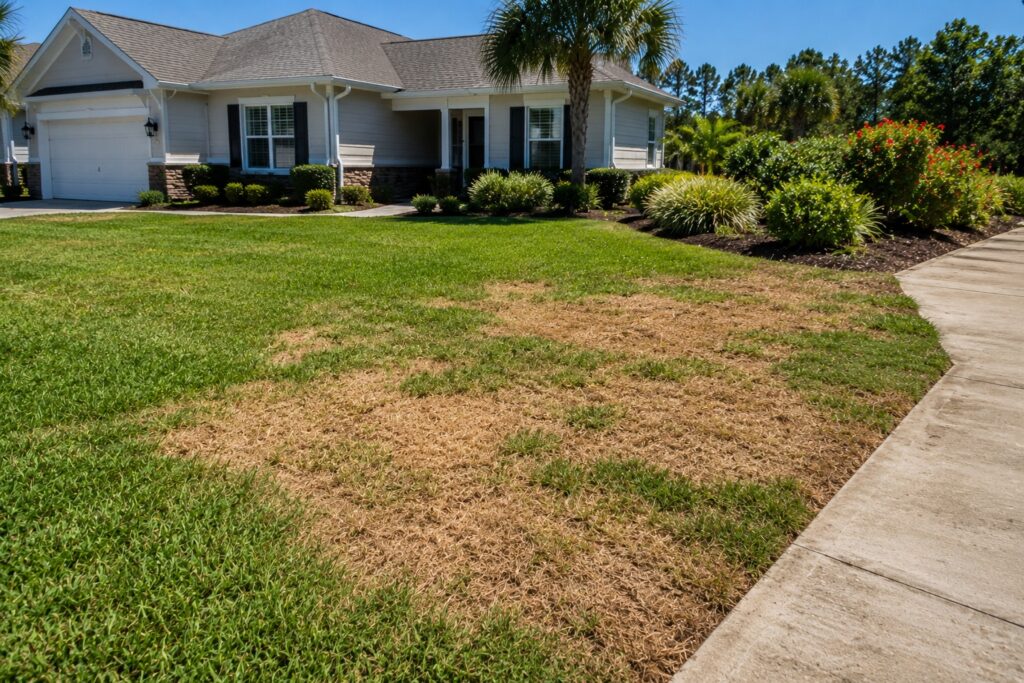
Pattern and spread. Drought stress tends to affect the entire lawn somewhat evenly, with the most exposed areas browning first. Chinch bug damage typically starts in defined patches — often near pavement or in full sun — and expands outward in an irregular but spreading pattern as the population moves to fresh turf. The leading edge of the damage is usually the most telling: you’ll see a sharp transition from healthy green to yellowing to dead, with insects concentrated at that actively-feeding margin.
Season timing. While drought stress can occur any time moisture is insufficient, chinch bug damage peaks in July and August in coastal SC. If unexplained browning appears in August specifically, and it doesn’t respond to water, the timing alone should raise strong suspicion.
How to Confirm a Chinch Bug Infestation With a Field Test
Chinch bugs are small enough that casual observation won’t find them — you have to look specifically and know where to look. There are two reliable field tests that any homeowner can perform without special equipment. Both work best done at the border between healthy and damaged turf, where active feeding is occurring and insect populations are densest.
The float test is the most reliable method. Remove both ends of a large metal coffee can or similar cylinder. Press one end firmly into the soil at the edge of the damaged area, pushing it two to three inches deep to create a seal. Fill the cylinder with water and maintain the water level for about five minutes. Chinch bugs float. If you have an active infestation, you’ll see small insects rising to the water surface within a few minutes — nymphs are reddish-orange, adults are black with white wings. More than ten to fifteen insects per square foot indicates a population level that warrants treatment.
The part-the-thatch method is faster but requires a trained eye. Get down close to the soil at the boundary between healthy and damaged turf and part the thatch layer with your fingers or a knife. Look for movement — chinch bugs are fast and will try to retreat from light. Adults are distinctive: small, black, with white wings folded flat across their backs. Nymphs are smaller and reddish. If you find them in numbers, you’ve confirmed the infestation.
-
1Identify the damage boundary. Find the line between healthy green turf and the yellowing or brown damaged area. This is where active chinch bug feeding is occurring and where your inspection should focus.
-
2Set up the float test cylinder. Press a bottomless coffee can or PVC pipe section two to three inches into the soil right at the damage boundary. The seal doesn’t need to be perfect, but it should hold water for several minutes.
-
3Fill with water and observe for five minutes. Maintain the water level as it soaks in. Watch for small insects floating to the surface — the reddish nymphs and black-and-white adults are distinctive once you know what you’re looking for.
-
4Count and assess. Ten or more insects per cylinder confirms an active infestation that warrants treatment. Fewer than five per cylinder may indicate a low-level population that bears monitoring but may not require immediate chemical intervention.
-
5Test in multiple locations. Run the float test in two or three spots around the damage perimeter to get a sense of infestation density and spread. This also helps define the treatment area, which should extend several feet beyond the visible damage boundary.
Treatment Options: What Works and What Doesn’t
Once a chinch bug infestation is confirmed, speed matters. Each day without treatment is another day the population feeds, reproduces, and expands into healthy turf. The treatment area should always extend at least two to three feet beyond the visible damage boundary, because that’s where the active insects are — the dead zone they’ve left behind is already past saving from insecticide.
Granular insecticides containing bifenthrin or imidacloprid are the most widely available consumer-grade options and can be effective on moderate infestations when applied correctly. Granulars need to be watered in immediately after application to activate the insecticide and move it into the thatch layer where chinch bugs live. Dry application without irrigation follow-up delivers minimal results in our climate.
Liquid insecticide applications — particularly bifenthrin or clothianidin applied as a spray — penetrate the thatch layer more effectively than granulars in many situations and are the preferred approach for professional treatment. Coverage uniformity matters significantly with liquid applications; gaps in coverage leave refuges where surviving insects repopulate the treated area within weeks.
What doesn’t work: Soap and water flushes, home remedies, and general-purpose insect sprays marketed for perimeter pest control provide little to no meaningful reduction in chinch bug populations at infestation levels. Neem oil has some efficacy as a preventive deterrent but performs poorly against established infestations. And as noted above, irrigation alone never addresses chinch bugs — it only delays proper treatment while the damage spreads.
Long-Term Prevention Strategies for Grand Strand Lawns
Treating an active infestation stops the current damage, but it doesn’t prevent the next one. Chinch bugs overwinter in thatch and leaf litter and re-emerge each spring as temperatures rise — a lawn that had a severe infestation in August is likely to face elevated pressure again the following summer unless underlying conditions that favor the pest are addressed.
Thatch management is the single most effective long-term prevention strategy. Thatch thicker than half an inch insulates chinch bug populations from contact insecticides, protects them from natural predators, and creates ideal egg-laying habitat. Centipede grass lawns in North Myrtle Beach should be dethatched every one to two years — either mechanically with a dethatcher, or through controlled mowing at the correct height over time — to keep thatch at manageable levels.
Proper fertilization reduces chinch bug pressure in a counterintuitive way: over-fertilized lawns with excessive nitrogen produce the lush, succulent growth that chinch bugs prefer. Centipede grass in coastal SC is a low-fertilizer grass by nature — it doesn’t need or benefit from heavy nitrogen applications, and over-feeding it creates conditions more favorable to pest pressure. Following a calibrated fertilization schedule appropriate for centipede on sandy coastal soil keeps the turf healthy without making it a more attractive target.
Monitoring from July onward is the most practical early-warning system available. Walk the lawn weekly during July and August, paying particular attention to hot spots along driveways, road frontage, and full-sun areas. Early-stage infestations covering a few square feet are far less costly and labor-intensive to treat than established infestations that have spread across an entire lawn section. If you’ve had chinch bugs before, proactive monitoring and potentially a preventive insecticide application in late June gives you a meaningful head start.
Related Reading from the KeckCo Blog
- Chinch Bugs in North Myrtle Beach: A Complete Homeowner’s Guide
- How to Spot and Stop Drought Stress on Coastal SC Lawns
- Why Your Lawn Goes Dormant in August Heat and What to Do About It
- Summer Mowing Mistakes That Stress Centipede Grass in North Myrtle Beach
- Fertilizing Centipede Grass in North Myrtle Beach: A Seasonal Guide
Frequently Asked Questions
How do I know if I have chinch bugs or drought stress?
The key difference is how the grass responds to water. Drought-stressed turf will recover — often greening back up within a day or two of a good soaking. Chinch bug damage will not recover with irrigation because the insects have physically destroyed the grass tissue. If you water a brown patch thoroughly and it still looks the same or worse three to four days later, chinch bugs are the more likely cause. The float test or a direct visual inspection of the thatch layer confirms it.
What does chinch bug damage look like on a lawn?
Chinch bug damage typically appears as irregularly shaped patches of yellowing grass that progress to brown and straw-colored turf. The damage often starts in the hottest, sunniest parts of the lawn — near driveways, along south-facing edges, or in open areas with no shade — and expands outward as the population grows. The border between healthy and damaged grass is usually fairly sharp, and the damaged areas do not recover with watering, which helps distinguish chinch bugs from drought stress.
When is chinch bug season in North Myrtle Beach?
Chinch bugs are active from late spring through early fall in coastal South Carolina, but populations peak in July and August when temperatures are hottest and turf is already under heat stress. August is typically the worst month along the Grand Strand — the combination of peak chinch bug numbers, high heat, and drought-stressed grass creates conditions where infestations can destroy large areas of turf in a matter of weeks if not caught early.
Can I treat chinch bugs myself or do I need a professional?
Small, early-stage infestations can sometimes be managed with consumer-grade bifenthrin or permethrin-based granular insecticides applied according to label directions. However, large or established infestations — particularly in centipede grass, which is more sensitive to chemical damage than St. Augustine — are better handled by a licensed applicator. Misapplication of insecticides during heat stress can damage turf further, and professional treatment typically uses more effective formulations not available at retail.
Does thatch make chinch bug infestations worse?
Yes, significantly. Thick thatch provides ideal habitat for chinch bugs — it insulates them from heat, hides them from predators, and keeps populations protected from contact insecticides that can’t penetrate the layer effectively. Centipede grass lawns that haven’t been dethatched in several years are disproportionately vulnerable to chinch bug infestations. Keeping thatch under half an inch through annual dethatching or controlled mowing height is one of the best long-term preventive measures.
Will chinch bug damaged grass grow back?
It depends on the severity and how quickly treatment occurred. If the infestation is caught early and treated before the grass crowns are fully destroyed, centipede and St. Augustine can often recover through lateral spreading over the following weeks and into fall. Severe damage that kills the grass down to the roots may require overseeding or sod installation to fully repair, particularly if large patches are involved. A professional assessment after treatment will tell you whether recovery is likely or whether restoration is needed.
Does KeckCo treat chinch bugs in North Myrtle Beach?
Yes. KeckCo Turf and Ornamental Services provides chinch bug identification, treatment, and follow-up care across North Myrtle Beach, Little River, Myrtle Beach, and the Grand Strand area. If you’re seeing unexplained brown patches in your lawn this summer, call 843-273-0735 or visit keckcoturf.com to schedule an evaluation before the damage spreads.
Chinch bugs are a predictable threat in North Myrtle Beach every August — but predictable means preventable, or at least catchable before significant damage occurs. Know what the damage looks like, know how to tell it apart from drought stress, and take ten minutes to run the float test if something looks off in your lawn this summer. Catching a chinch bug infestation at ten square feet is a very different problem than catching it at a thousand. The earlier you act, the less turf you lose — and the less repair work you’re facing when fall arrives.
Seeing Brown Patches That Won’t Respond to Watering?
KeckCo Turf and Ornamental Services identifies and treats chinch bug infestations across North Myrtle Beach, Little River, Myrtle Beach, and the Grand Strand. Don’t wait until the damage spreads — early treatment is always faster, less expensive, and more effective than trying to recover a lawn that’s been extensively damaged. Call us and we’ll come out and assess what’s happening before it gets worse.