
Every spring, North Myrtle Beach homeowners watch their neighbors’ lawns green up clean and weed-free while their own fills in patchy and overrun with crabgrass. The difference usually isn’t effort — it’s a single application that went down in late January or early February, quietly doing its job underground while the lawn was still dormant. That application is pre-emergent herbicide, and if you’ve never timed it right, this guide will change how you think about lawn care forever.
Pre-emergent is the most time-sensitive product in any lawn care program. Apply it correctly and you’ll spend the summer enjoying your turf instead of fighting it. Apply it wrong — too late, too early, or to the wrong conditions — and you’ve wasted product and handed weeds a season-long head start. Here’s exactly how to get it right in coastal South Carolina.
What pre-emergent actually does (and what it doesn’t)
Pre-emergent herbicide doesn’t kill weeds. That distinction matters more than most homeowners realize. What it does is create a chemical barrier in the top layer of soil that disrupts the germination process of weed seeds — preventing them from developing into seedlings in the first place. Once that barrier is in place, the vast majority of annual grassy weeds simply cannot establish.
What pre-emergent cannot do is affect weeds that have already sprouted. The moment a seed cracks open and sends a root into the soil, pre-emergent is irrelevant to that plant. This is why so many homeowners try it and feel like it didn’t work — they applied it after the germination window had already opened. The product worked exactly as intended; it just had nothing left to prevent.
It also has no effect on perennial weeds like nutsedge or dollarweed that spread through underground rhizomes rather than seeds. Pre-emergent is specifically a tool for annual grassy and broadleaf weeds that germinate from seed each season. Understanding this scope is what separates a homeowner who uses it effectively from one who feels perpetually let down by it.
The North Myrtle Beach timing window
Timing pre-emergent in North Myrtle Beach is different from timing it further inland or in colder climates. Our coastal position means the ground warms earlier than most of South Carolina, and the mild winters mean weed seeds can begin their germination process weeks ahead of what a national lawn care schedule would suggest. Following a generic February or March date you read online is one of the most common reasons pre-emergent fails in the Grand Strand.
The correct trigger is soil temperature, not the calendar. For the weeds that cause the most damage in coastal SC lawns — primarily crabgrass and goosegrass — germination begins when soil temperatures at a 2–3 inch depth hold consistently at or above 55°F for several consecutive days. In North Myrtle Beach, that threshold is typically reached between late January and mid-February in most years, though a warm December or January can push it earlier.
Your pre-emergent needs to be in the ground before that threshold is hit — not the same day, and certainly not after. A useful rule of thumb for coastal Horry County is to target application in the last two weeks of January. That gives the product time to activate with rainfall and form its barrier before the soil warms into the germination zone.
How to track soil temperature on the coast
Sandy coastal soil behaves differently from the clay and loam soils found further inland. It warms faster when the sun hits it directly, but it also releases that heat quickly at night. This means that in North Myrtle Beach, soil temperatures in open, sunny lawn areas can reach the 55°F threshold days or even weeks ahead of shaded areas or properties further from the coast. A single property can have meaningful variation between the front yard and a shaded back bed.
The most reliable method is a simple soil thermometer — available at any garden center for under $15. Push the probe 2–3 inches into the soil in the morning, before the sun has had time to warm the surface layer. Take readings in multiple spots across the lawn, particularly in the areas with the most sun exposure, since those will warm first. When you’re seeing consistent readings at or approaching 50°F across several mornings, it’s time to apply.
If you don’t have a thermometer, the NC State Extension soil temperature map is a useful free resource — it tracks real-time soil temps across the Carolinas and is updated regularly during the early spring season. Myrtle Beach area readings are generally representative of conditions across coastal Horry County, though properties in Cherry Grove or the waterway areas may run slightly warmer than inland neighborhoods.
The weeds pre-emergent stops in coastal SC
Not all weeds germinate at the same time, and pre-emergent doesn’t stop all of them equally. In North Myrtle Beach lawns, the primary targets for a late-January or early-February pre-emergent application are the warm-season annual grassy weeds that explode through June, July, and August if left unchecked.
Crabgrass is the most widespread and damaging. It germinates in great numbers across coastal SC lawns, thrives in the sandy soil and full sun that many Grand Strand properties offer, and produces thousands of seeds per plant before dying in the fall — guaranteeing next year’s problem if not intercepted this year. Goosegrass behaves similarly and often follows crabgrass into compacted or thin turf areas along driveways and walkways. Spurge, a low-growing broadleaf weed with small leaves and a milky sap, is also effectively controlled by most pre-emergent products.
What pre-emergent applied in January and February will not control are the cool-season weeds already present — henbit, chickweed, and annual bluegrass that germinated in the fall. Those require either a fall pre-emergent application or post-emergent treatment in late winter. A complete weed management program addresses both windows; the late-January application is specifically the warm-season defense.
How to apply it correctly
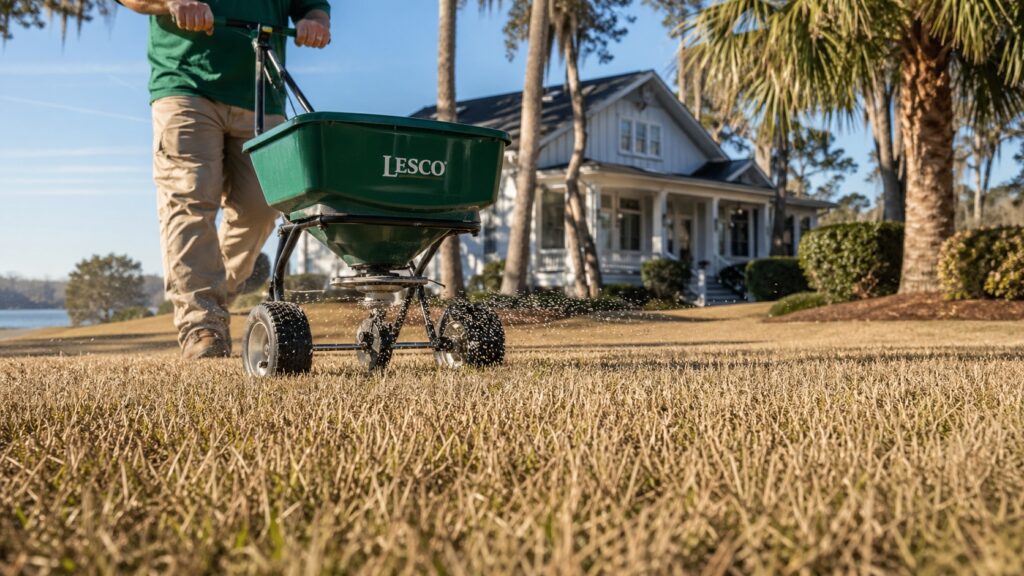
Pre-emergent comes in two forms — granular and liquid — and both work well when applied properly. Granular products are more forgiving for homeowners applying without professional equipment: spread evenly with a broadcast spreader, water in immediately with at least a quarter inch of irrigation or rainfall, and the product activates into the soil. Liquid products require a sprayer and more precise calibration but distribute more evenly across the surface.
The most important step after application is watering in. Pre-emergent must move from the surface down into the soil to form its barrier — a product sitting on dry ground is doing nothing. Apply it just before a forecasted rain event if possible, or run your irrigation immediately after spreading. In coastal SC’s sandy soil, which drains quickly, half an inch of water is usually sufficient to activate the barrier without pushing it below the effective zone.
Do not aerate, dethatch, or heavily rake your lawn after applying pre-emergent. These activities physically disrupt the barrier layer in the soil and create gaps where weed seeds can germinate unimpeded. If aeration is on your spring schedule, it needs to happen either before pre-emergent application or at least eight to ten weeks after, once the active ingredient has broken down enough that the disruption is less damaging.
What to do if you missed the window
If it’s past mid-February and you haven’t applied pre-emergent yet, the honest answer is that the primary window has closed for the season. Applying pre-emergent after soil temperatures have crossed 55°F and weed seeds have begun germinating won’t prevent the weeds that have already started. Some seeds will still be germinating, and a late application may reduce the total population, but it won’t deliver the clean season you’d get from perfect timing.
The right strategy at that point shifts to damage control. A post-emergent herbicide selected for your specific grass type can treat actively growing weeds without harming your turf — but it must be applied carefully, as most post-emergents have grass-type restrictions and can cause significant damage to centipede or St. Augustine if misapplied. Spot treating is safer than broadcast spraying when in doubt.
The more important step is to note the miss and plan for next January. One season of good pre-emergent timing dramatically reduces the seed bank in your soil, making the following season easier to manage. Conversely, one missed season replenishes that seed bank and compounds the problem. The best thing you can do today for next spring is mark your calendar for the third week of January and set a reminder to check soil temperatures.
Common pre-emergent mistakes in North Myrtle Beach
The most widespread mistake is following a national lawn care schedule. Products marketed across the Southeast often suggest February or March application dates based on average regional soil temperatures. In coastal Horry County, those dates are frequently two to four weeks too late. The coast warms earlier, and homeowners who follow national timing are often applying into an already-open germination window without realizing it.
A close second is skipping the water-in step. Homeowners who apply granular pre-emergent on a sunny day and don’t irrigate afterward often feel the product failed — when in reality it never activated. Pre-emergent sitting on dry soil is inert. It needs moisture to move into the zone where germinating seeds encounter it. If you can’t water in within 24 hours of application, wait for a rain event to apply.
Over-applying is another common mistake, particularly with centipede grass. Higher rates of pre-emergent don’t provide better control — they can actually damage centipede turf, slow spring green-up, and harm the fine root system of this already-sensitive grass. Always calibrate to the label rate for your grass type. When in doubt, the lower end of the recommended rate range is safer for centipede than the upper end.
Frequently Asked Questions
Common pre-emergent questions from North Myrtle Beach and coastal SC homeowners.
Prodiamine and pendimethalin are the two most widely used and effective active ingredients for coastal SC lawns, and both are available in granular and liquid formulations. For centipede grass specifically, always confirm the product is labeled safe for centipede before applying — some formulations cause significant damage to this sensitive turf type. Dithiopyr (sold under the brand name Dimension) is another strong option and has some post-emergent activity on very young crabgrass seedlings, giving a slightly wider effective window.
Most granular pre-emergent products provide 8–12 weeks of residual control under normal conditions. In North Myrtle Beach’s sandy soil, which drains quickly and has heavy spring rainfall, the effective period tends to be on the shorter end. Many lawn care programs apply a second application in April or May to extend coverage through the peak crabgrass germination period, which in coastal SC can stretch well into June.
No — pre-emergent works by preventing seed germination, which means it will also prevent newly seeded grass from establishing. If you’ve recently seeded bermuda or any other turf type, skip the pre-emergent until the lawn is fully established and has been mowed at least three times. For sodded lawns, you can generally apply pre-emergent four to six weeks after installation once the sod has rooted in, but check the product label for specific waiting periods.
Yes — this is non-negotiable for granular formulations. Pre-emergent must move from the soil surface down into the germination zone to be effective. At least a quarter inch of water — from irrigation or rain — within 24 to 48 hours of application is required. In North Myrtle Beach’s sandy soil, which absorbs water quickly, this activation step is usually straightforward. Apply just before a forecasted rain event whenever possible for the most even activation.
Standard pre-emergent products have no effect on weeds that have already germinated and are actively growing. For visible weeds, you need a post-emergent herbicide appropriate for your grass type. The one partial exception is dithiopyr (Dimension), which has limited post-emergent activity on very young crabgrass — but only in the earliest stages, before the plant has developed its first tiller. Once crabgrass is visible and established, post-emergent treatment is the only option.
Always aerate before applying pre-emergent, not after. Core aeration physically disrupts the chemical barrier pre-emergent forms in the soil, creating gaps where weed seeds can germinate unimpeded. If you haven’t aerated yet and it’s approaching your pre-emergent window, aerate first and apply pre-emergent immediately after — ideally the same day or within 24 hours. If you’ve already applied pre-emergent, wait at least eight to ten weeks before aerating.
Most granular pre-emergent products are considered low-risk once watered in and dried, but you should keep children and pets off the treated area until it has been thoroughly irrigated and the lawn surface is dry — typically a few hours. Always follow the specific label instructions for the product you use, as formulations vary. If you have concerns about specific products and child or pet safety, a professional applicator can advise on the least-risk options for your situation.
Yes — pre-emergent timing and application is one of the core elements of KeckCo’s seasonal lawn care programs for North Myrtle Beach and surrounding communities. We monitor soil temperatures throughout January and February and apply at the optimal moment for each property’s grass type and conditions. Call 843-273-0735 or visit keckcoturf.com to ask about our seasonal weed control programs.
Pre-emergent herbicide is the closest thing to a sure bet in lawn care — but only when the timing is right. In North Myrtle Beach, that means watching your soil temperature in January, not waiting for a national lawn care calendar to tell you it’s time. Get the application down before that 55°F threshold hits, water it in, and you’ll spend the rest of the summer with the cleanest lawn on the street.
One well-timed application in late January can save you dozens of hours of weeding, multiple post-emergent treatments, and a season of frustration. It’s the highest-return task in the entire spring lawn care program — and it’s over in an afternoon.
Never miss the pre-emergent window again.
KeckCo Turf and Ornamental Services monitors soil temperatures across North Myrtle Beach every January and applies pre-emergent at the optimal moment for each property and grass type. No guesswork, no missed windows — just a clean lawn all season long. Serving North Myrtle Beach, Little River, Myrtle Beach, and the Grand Strand.