
Yellow grass in August in North Myrtle Beach gets blamed on drought almost automatically — and sometimes that diagnosis is correct. But there is a category of yellowing that looks exactly like drought stress, does not respond to irrigation, and will continue getting worse until its actual cause is addressed: iron deficiency caused by soil pH imbalance. It is one of the most commonly misdiagnosed lawn problems on the Grand Strand, and understanding it can save homeowners significant money spent on the wrong treatments.
At KeckCo Turf and Ornamental Services, soil health is foundational to everything we do. A lawn that is yellowing because of pH-driven nutrient lockout will not respond to fertilizer, more water, or pest management — because the problem is a chemistry issue in the soil, not a deficiency of water or a presence of pests. Here is how to identify it and what to do about it.
- What iron chlorosis looks like and how to recognize it
- The soil pH connection: why coastal SC properties are vulnerable
- What drives pH up in North Myrtle Beach lawns
- How to test your soil pH
- Correcting iron deficiency and pH imbalance
- Why centipede grass is especially sensitive
- Frequently Asked Questions
What Iron Chlorosis Looks Like and How to Recognize It
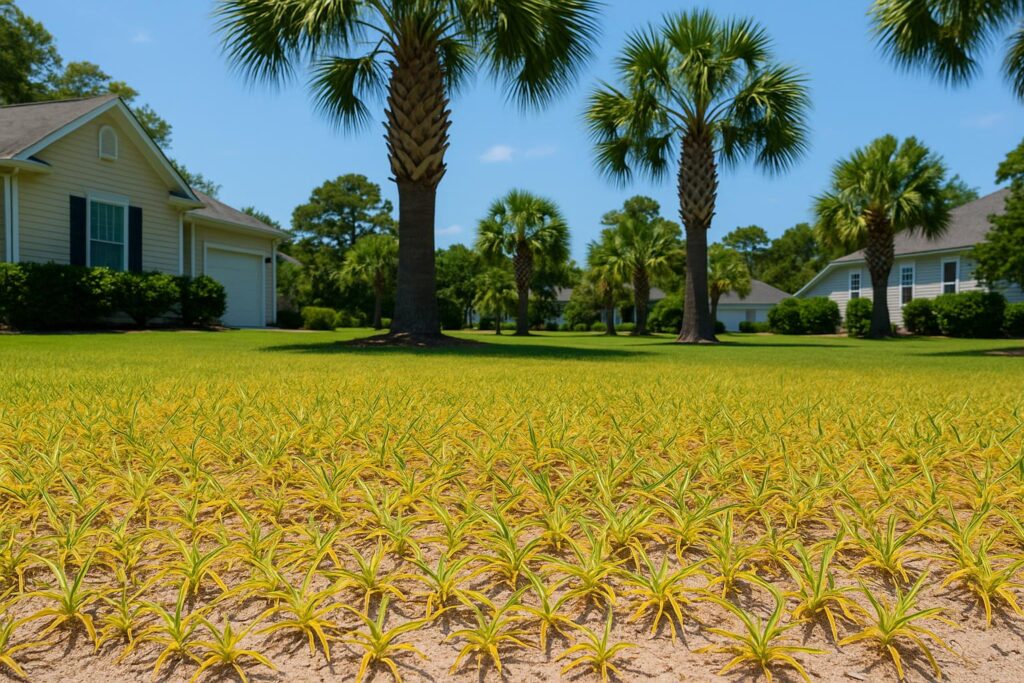
Iron chlorosis has a diagnostic visual pattern that separates it from drought stress, disease, and other yellowing causes: the grass blades turn yellow while the veins running through each blade remain green. This interveinal chlorosis — green veins in a yellow blade — is the hallmark of iron deficiency and is rarely seen in drought stress (which causes uniform yellowing without preserved green veins) or chinch bug damage (which follows a distinct spatial pattern along lawn edges).
The yellowing from iron chlorosis typically appears somewhat uniformly across the lawn or concentrates in specific areas without the edge-pattern of pest damage or the coverage-gap pattern of irrigation failure. New growth is often more yellow than older growth because iron is not mobile within the plant — established older leaves retain their iron while new growth cannot access adequate iron for chlorophyll production, making the newest tissue the most visibly affected.
The Soil pH Connection: Why Coastal SC Properties Are Vulnerable
Iron does not disappear from soil — coastal South Carolina’s sandy soil actually contains meaningful amounts of iron. The problem is availability. At soil pH above 6.5, iron becomes chemically bound in forms that grass roots cannot absorb, even when iron is physically present in the soil. The grass starves for an element that is technically there but locked away by soil chemistry. This condition — iron present in soil but unavailable to roots — is called iron deficiency chlorosis, and it occurs on lawns with elevated soil pH regardless of how much iron may be in the ground.
Centipede grass is specifically adapted to the acidic, low-pH soils that naturally dominate coastal Carolina’s sand-based soil profiles. When pH rises above the grass’s preferred range of 5.0 to 6.0, iron availability drops sharply. This is not a theoretical concern for North Myrtle Beach homeowners — it is a common, documented problem that affects a meaningful percentage of properties in the area.
What Drives pH Up in North Myrtle Beach Lawns
Several common factors gradually raise soil pH in coastal SC lawns. Irrigation water with high bicarbonate content — common in the Grand Strand’s groundwater supply — deposits alkalinity into the soil with every irrigation cycle, slowly raising pH over years. Concrete driveways, walkways, and foundations release calcium hydroxide into adjacent soil, raising pH in a zone extending several feet from the concrete surface. Calcium-containing fertilizers and lime applications intended for other purposes can also elevate pH beyond the ideal range for centipede grass.
Over-fertilization with high-phosphorus products is another contributing factor. Excess phosphorus in soil binds with iron and makes it less available to grass roots, producing iron deficiency symptoms even at appropriate pH levels. Many homeowners who fertilize heavily in hopes of achieving a greener lawn inadvertently contribute to the yellowing problem they are trying to solve.
How to Test Your Soil pH
1Purchase an inexpensive soil pH test kit from any garden center or home improvement store. Simple colorimetric tests cost under $10 and provide a reliable general reading within minutes.
2Collect soil samples from multiple areas — particularly from the yellowing zones and adjacent healthy green areas for comparison. Sample from 2 to 4 inches depth, avoiding the thatch layer at the surface.
3Consider a professional soil test through Clemson University’s cooperative extension service for a comprehensive analysis that includes pH, nutrient levels, and specific amendment recommendations for your soil conditions. Professional soil tests cost under $20 and provide far more actionable data than basic color-change test kits.
4Compare results to centipede’s target range. The ideal soil pH for centipede grass in coastal SC is 5.0 to 6.0. pH above 6.5 in centipede lawns almost always produces iron availability problems.
Correcting Iron Deficiency and pH Imbalance
For immediate visual improvement while the underlying pH issue is being addressed, a foliar iron spray — iron sulfate or chelated iron applied directly to the grass blades — provides fast greening without changing soil chemistry. The effect is temporary (4 to 6 weeks) but can improve lawn appearance quickly while a longer-term pH correction program takes effect.
For lasting correction, the goal is to lower soil pH back into the 5.0 to 6.0 range through sulfur applications. Elemental sulfur is the standard soil acidifier for lawns: it is slow-acting (typically taking 3 to 6 months to show significant pH shift), inexpensive, and safe for turf when applied at label rates. Do not attempt to correct pH too rapidly — dramatic pH swings cause additional nutrient disruption. Work toward the target range gradually over one to two seasons based on your soil test results.
Why Centipede Grass Is Especially Sensitive
Centipede grass evolved in the acidic, nutrient-poor soils of southeastern Asia and coastal North America. Its low fertility requirements — often cited as an advantage because it needs less fertilizer than other warm-season grasses — are directly related to its adaptation to acidic soil conditions where nutrients are present but not in the abundant, highly available forms found in neutral or alkaline soils. When soil pH rises, centipede loses access to not just iron but also manganese and other micronutrients that it depends on from its naturally acidic native soil environment.
This sensitivity means that the management choices that benefit bermudagrass or St. Augustine — heavy nitrogen feeding, lime applications for pH adjustment, high-phosphorus fertilizers — can actively harm a centipede lawn. Centipede management requires a distinctly different nutritional approach that respects the grass’s low-nutrient, acidic-soil adaptations rather than trying to push it toward the performance standards of higher-maintenance grass types.
Frequently Asked Questions
Why is my centipede grass turning yellow in summer?
Summer yellowing in centipede grass in coastal SC can be caused by drought stress, iron deficiency from high soil pH, overwatering, chinch bug feeding, or fungal disease. Iron chlorosis is identifiable by yellow blades with green veins remaining — a pattern unique to iron deficiency. A soil pH test and visual inspection of blade pattern are the first diagnostic steps.
What is the ideal soil pH for centipede grass in North Myrtle Beach?
Centipede grass performs best at a soil pH between 5.0 and 6.0, with 5.5 being the sweet spot for most coastal SC properties. Above pH 6.5, iron becomes chemically unavailable to centipede roots even when iron is physically present in the soil, causing iron chlorosis.
How quickly does iron sulfate spray green up a yellow centipede lawn?
Foliar iron sulfate applications typically produce visible greening within 7 to 14 days of application. The effect is temporary — lasting 4 to 6 weeks — and should be considered a symptomatic treatment while the underlying pH issue is addressed through soil acidification with elemental sulfur.
Can I add lime to my centipede grass lawn?
No. Lime raises soil pH and is harmful to centipede grass, which requires acidic soil conditions. Many common lawn maintenance recommendations include lime for other grass types, but applying lime to a centipede lawn makes iron deficiency significantly worse and damages the lawn’s long-term health.
How do I lower soil pH in my North Myrtle Beach lawn?
Elemental sulfur is the standard soil acidifier for lawns. Apply it at rates based on your soil test results and current pH, and expect gradual change over 3 to 6 months rather than immediate results. Acidifying fertilizers containing ammonium sulfate also contribute to pH reduction over time. Do not attempt to lower pH too rapidly — gradual correction is more effective and less disruptive to the lawn.
Does KeckCo diagnose and treat soil pH problems?
Yes. KeckCo Turf and Ornamental Services provides soil pH assessment, iron deficiency diagnosis, and nutrient management programs for North Myrtle Beach and Grand Strand residential properties. We can identify whether yellowing is pH-related, drought-related, or caused by another factor and recommend the correct correction. Call 843-273-0735.
Yellow centipede grass in August does not always mean the lawn is thirsty — and if the cause is soil pH and iron deficiency, all the watering in the world will not fix it. A $10 soil pH test can tell you in minutes whether your yellowing problem is a chemistry issue rather than a moisture issue. Get the diagnosis right first, and the correction becomes straightforward.
Is your North Myrtle Beach lawn yellow despite adequate watering?
KeckCo Turf and Ornamental Services diagnoses and corrects soil pH and nutrient deficiency problems throughout the Grand Strand. Let us find the real cause.