
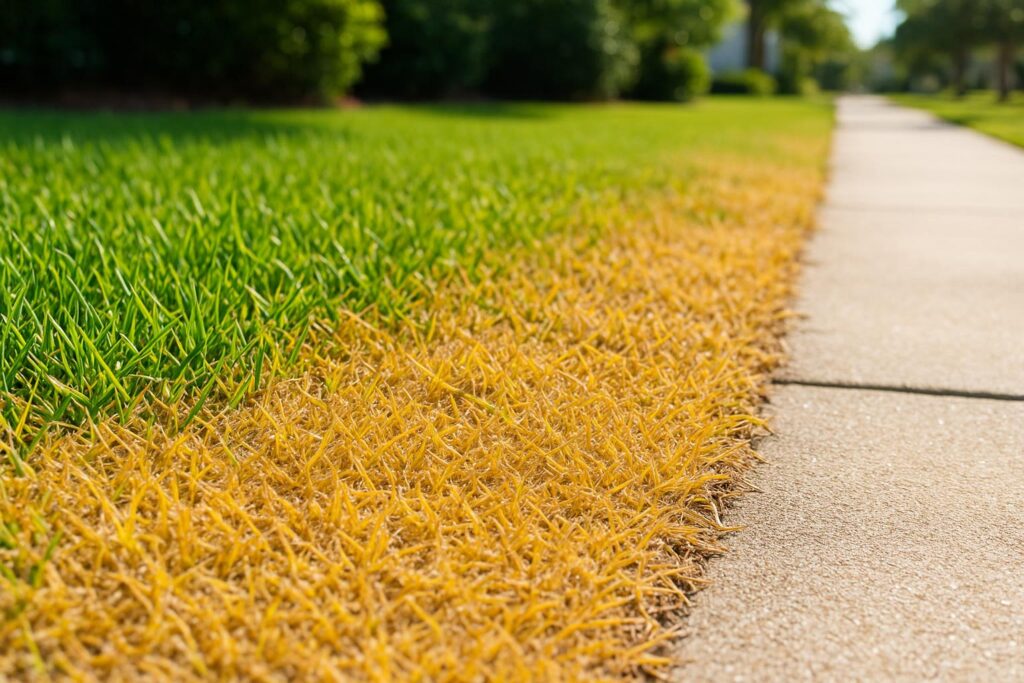
If there is one pest that defines August lawn care in North Myrtle Beach, it is the chinch bug. These tiny, fast-moving insects reach their peak population and their most aggressive feeding behavior right now — when lawns are already under maximum heat and drought stress and have the least capacity to recover from additional damage. What starts as a small yellow patch at the edge of a sunny lawn area can expand into a dead zone the size of a car within three weeks if chinch bugs are left untreated.
At KeckCo Turf and Ornamental Services, we treat more chinch bug infestations in August than any other month of the year. Understanding why this pest is so destructive in our coastal climate — and what actually stops it — is the difference between catching a manageable infestation and losing significant sections of turf heading into fall.
Why August Is the Peak Damage Month on the Grand Strand
Chinch bugs (Blissus insularis) thrive in hot, dry, sunny conditions — exactly what August delivers in North Myrtle Beach. Their reproductive cycle, which has been running since late spring, peaks in late July and August, meaning population densities are at their highest point of the year precisely when temperatures are their most extreme. High populations combined with heat-stressed, drought-weakened turf create the conditions where chinch bug feeding damage accelerates dramatically.
The pest is most destructive in open, full-sun areas of the lawn — along sidewalks, driveways, and south or west-facing exposures where the turf already runs the hottest. Centipede grass, the dominant turf type across most of North Myrtle Beach’s residential properties, is among the most susceptible warm-season grasses to chinch bug feeding. The combination of our grass type, climate, and August conditions makes this a predictable annual problem that rewards preparation and early detection.
How to Identify an Active Chinch Bug Infestation
Chinch bug damage presents as irregularly shaped yellow patches that appear first in the hottest, sunniest parts of the lawn — typically along southern or western exposures, next to heat-absorbing hardscape surfaces like sidewalks, driveways, and concrete borders. The yellowing begins at the margin between healthy green grass and a heat-stressed or thin area, then expands outward as the population moves toward unaffected turf.
The definitive identification method is the flotation test or direct visual inspection at the turf margin. Part the grass blades at the boundary between yellow and green turf and look at the thatch and soil surface. Chinch bug nymphs are tiny and red-orange with a white band; adults are black with white wings folded across their backs. They move quickly when disturbed. You can also press a bottomless coffee can 2–3 inches into the soil at the damage margin, fill it with water, and watch for chinch bugs floating to the surface within 5–10 minutes.
How Fast Chinch Bug Damage Spreads in Coastal SC Heat
In August’s conditions, a chinch bug infestation can be genuinely alarming in its rate of expansion. A patch that is 3 feet wide on Monday can reach 8–10 feet by the end of the week as the population depletes food in the infested zone and the bugs move outward into adjacent healthy turf. Unlike soil-based pests that stay relatively contained, chinch bugs walk actively through the lawn surface, making rapid spread in multiple directions the norm rather than the exception.
This pace of spread is why inspection frequency matters so much in August. A lawn that looked fine during a check two weeks ago may now have an established infestation well into the damaging phase. For properties with a history of chinch bug pressure — which includes most North Myrtle Beach neighborhoods that experienced infestations in previous summers — a weekly visual inspection of the lawn perimeter in August is the standard practice that catches problems before they become expensive.
Treatment Options That Actually Work
1Confirm the infestation with the coffee can or flotation test before purchasing any product. Misidentification leads to wasted treatment and continued damage.
2Select an appropriate insecticide. Bifenthrin, imidacloprid, and clothianidin are all effective against chinch bugs. Bifenthrin is a fast-acting contact insecticide that knocks down active populations quickly. Imidacloprid is systemic and provides longer residual protection. Many professional programs combine a contact product for immediate knockdown with a systemic for sustained control.
3Apply to the damage margin, not just the dead center. The bugs are not in the yellow dead zone — they have already moved to the expanding front. Treatment focused on the yellow area misses the active population. Target the boundary between damaged and healthy turf and extend treatment 3–4 feet into the healthy grass.
4Water lightly after application to move granular products into the thatch, where chinch bugs live. Do not irrigate heavily enough to wash liquid applications off the turf surface before they dry.
5Inspect again in 7–10 days. A second application is often warranted for large infestations or where populations were high at the time of first treatment.
Lawn Conditions That Make Chinch Bugs Worse
Thick thatch is the primary lawn condition that amplifies chinch bug pressure. Chinch bugs live and reproduce in the thatch layer, and a thatch depth of more than half an inch creates an ideal protected habitat that insecticide treatments have difficulty penetrating effectively. Centipede grass lawns that have been over-fertilized with nitrogen develop heavy thatch rapidly, and these thatch-heavy lawns consistently support larger chinch bug populations than well-managed, lower-thatch lawns.
Drought stress is the second major amplifying factor. Heat-stressed turf has reduced capacity to tolerate the feeding damage that a healthy lawn might partially recover from, and stressed grass produces chemical signals that actually attract chinch bugs. Keeping your irrigation schedule appropriate for August’s demands — not over-watering, which causes its own problems, but ensuring the lawn does not enter severe drought stress — reduces the attractiveness of your turf to actively foraging chinch bug populations.
Prevention for Next Season
If your lawn has had chinch bug damage in August 2026, it will almost certainly face pressure again in summer 2027 unless the conditions that supported the infestation are addressed. Thatch reduction through core aeration and avoiding excess nitrogen fertilization is the most impactful cultural practice for reducing chinch bug habitat. Some lawn care programs include a preventive insecticide application in late spring before populations build — this approach significantly reduces peak August populations on properties with a history of recurring infestations.
Selecting more chinch-bug-resistant turf varieties is worth considering for properties that lose significant turf to this pest annually. Some St. Augustine and zoysiagrass cultivars show better field tolerance to chinch bug pressure than standard centipede, and a lawn renovation with a more resistant variety may be worth evaluating as a long-term strategy.
Frequently Asked Questions
When is chinch bug season in North Myrtle Beach?
Chinch bug pressure on the Grand Strand peaks from July through September, with August typically being the most damaging month due to maximum heat stress on turf combined with peak chinch bug population levels. Light activity can begin as early as May and persist into October in warm years.
How do I know if my lawn has chinch bugs or just heat stress?
The key distinction is location pattern. Heat stress and drought appear relatively uniformly or follow irrigation gaps. Chinch bug damage concentrates specifically in the hottest, sunniest edges of the lawn — along pavement, near walls, in south or west-facing exposures. The coffee can flotation test confirms live bugs at the damage margin within minutes.
Can I treat chinch bugs myself with store-bought products?
Consumer products containing bifenthrin are available at most garden centers and are effective against chinch bugs when applied correctly to the damage margin (not the dead center). However, professional products typically provide faster knockdown and longer residual protection, and proper application technique — specifically targeting the active feeding margin — is critical to efficacy.
Will chinch bug-damaged lawn grow back on its own?
In North Myrtle Beach, chinch bug-damaged turf that still has intact root systems and crowns can recover as temperatures moderate in fall, provided the infestation is eliminated and irrigation is maintained. Areas with severe damage where the crowns were killed typically require sodding — centipede does not spread fast enough to cover large bare areas before winter weed colonization occurs.
How do I prevent chinch bugs next summer?
The most effective preventive strategies are reducing thatch depth through core aeration, avoiding excess nitrogen fertilization that drives thatch accumulation, maintaining appropriate irrigation rather than allowing severe drought stress, and considering a preventive insecticide application in late spring before populations build on properties with recurring infestation history.
Does KeckCo treat chinch bugs?
Yes. KeckCo Turf and Ornamental Services diagnoses and treats chinch bug infestations throughout North Myrtle Beach, Little River, and Myrtle Beach. We use professional-grade products and target treatment correctly at the active damage margin for effective control. Contact us at 843-273-0735.
August is not the month to take a wait-and-see approach to lawn yellowing in North Myrtle Beach. If you are seeing expanding patches concentrated in the sunny edges of your yard, get out there with the coffee can test this week. The difference between a caught-early chinch bug problem and a significant turf loss is almost always measured in days, not weeks.
Seeing yellow patches spreading across your North Myrtle Beach lawn?
KeckCo Turf and Ornamental Services diagnoses and treats chinch bug infestations throughout the Grand Strand. August damage spreads fast — call us today.