
Walk through enough North Myrtle Beach yards in August and you will encounter fire ant mounds — sometimes many of them, sometimes one you stumble into barefoot before you realize it is there. Red imported fire ants (Solenopsis invicta) are deeply established throughout Horry County and coastal South Carolina, thriving in the warm sandy soil and humid climate of the Grand Strand. They are not going away, but they can absolutely be managed effectively with the right approach.
At KeckCo Turf and Ornamental Services, fire ant management is a standard part of integrated pest care for residential properties throughout North Myrtle Beach. This article covers what actually works — and why the most common DIY approaches often make the problem worse rather than better.
Why Fire Ants Are Most Active in Summer
Fire ant colonies are year-round residents in North Myrtle Beach, but their activity levels and mound visibility change dramatically with season. In summer heat, colonies move upward in the soil profile to stay closer to the surface where temperatures are warm but not extreme — which is why mound numbers appear to explode between June and September. The same colony that was 18 inches underground in February is now creating a visible dome just below the surface, making it more likely to be stepped on, mowed over, or disturbed by foot traffic.
Summer is also peak reproductive season for fire ant colonies. Winged reproductive ants — called alates — swarm from established colonies during summer months to start new colonies, which is why properties that had manageable fire ant pressure in spring can seem overrun by August. A new mound appearing overnight is typically the result of colony expansion or a new satellite colony establishing nearby rather than a colony that migrated from another yard.
Identifying Fire Ant Mounds in Your Lawn
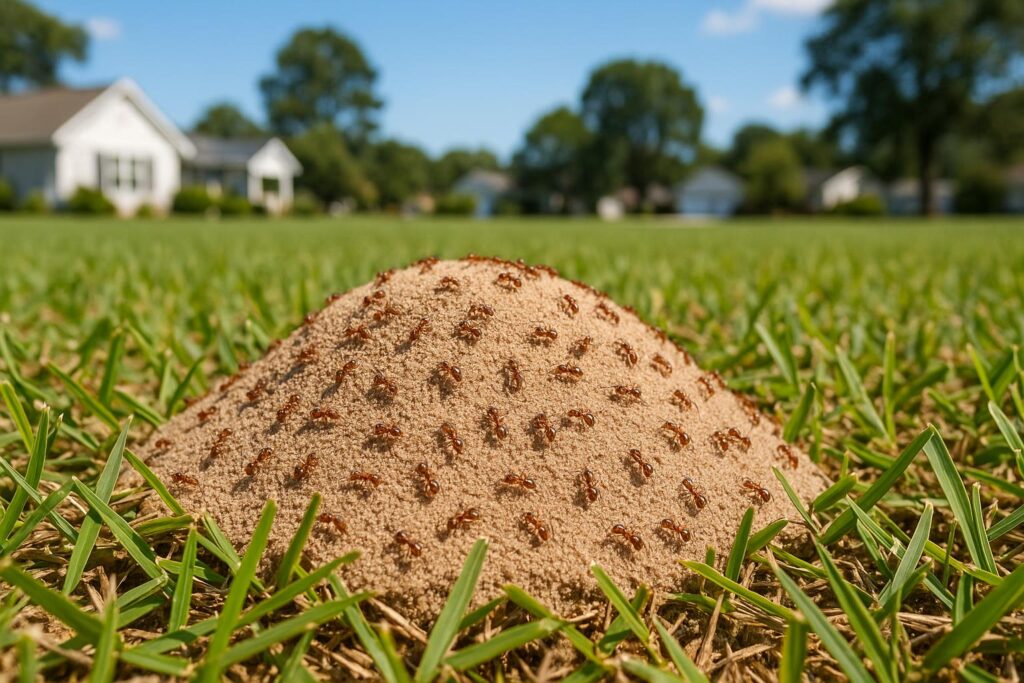
Fire ant mounds in North Myrtle Beach lawns are distinctive: dome-shaped mounds of loose, fluffy soil without a visible opening at the top. Unlike many other ant species that build mounds with a central entry hole, fire ants enter and exit through underground tunnels that extend well beyond the visible mound. Mounds range from a few inches to over a foot in height and diameter in established colonies, and they are particularly common in open sunny lawn areas, along irrigation lines, near electrical junction boxes, and around the bases of ornamental plants.
Fire ants themselves are reddish-brown, roughly 1/8 to 1/4 inch long, and extremely aggressive when disturbed. Disturbing a mound even slightly triggers a rapid defensive swarming response — hundreds of ants emerge within seconds and begin stinging immediately. Their sting produces a burning sensation followed by a white pustule that forms within 24 hours — the combination of burning pain and the characteristic blister is essentially diagnostic for fire ant stings.
The Two-Step Method: The Most Effective Treatment Approach
The two-step method recommended by university extension programs across the South is the most effective approach for fire ant management in residential lawns — it addresses both visible mounds and the satellite colonies that are not yet producing visible surface mounds.
1Step One — Broadcast bait. Apply a fire ant bait product across the entire lawn rather than treating mounds individually. Bait products (containing active ingredients like spinosad, indoxacarb, or hydramethylnon) are collected by foraging workers and carried back to the queen, providing colony-level control rather than just killing surface workers. Apply bait when ants are actively foraging — typically in the morning or late afternoon during summer, never in the heat of midday when foraging stops. Do not water the lawn for 24 hours after baiting.
2Step Two — Treat individual mounds. Apply a contact insecticide directly to active mounds 3 to 5 days after baiting. Drench treatment with a liquid insecticide penetrates the mound and tunnels, targeting workers and queens that bait may have missed. Apply in the morning when the colony is closer to the surface, and use enough volume to penetrate the mound — typically one to two gallons of diluted product per mound.
Why Common DIY Treatments Fail
The most common DIY fire ant treatment — pouring boiling water on mounds — kills some workers on contact but rarely reaches the queen, which is located deep in the tunnel system. Without eliminating the queen, the colony recovers within weeks. The same limitation applies to gasoline, household vinegar, club soda, and other home remedies that get passed around social media: they may kill surface workers but do not achieve colony elimination.
Individual mound treatments alone, without broadcast baiting, also have limited effectiveness on properties with multiple colonies. Treating the visible mounds only addresses what is on the surface — the satellite colonies that are not yet producing visible mounds continue to develop and create new mounds within weeks of treatment. The two-step approach addresses the total property fire ant population rather than just the visible symptoms.
Safety Around Fire Ants for Families and Pets
Fire ant stings are painful for healthy adults and can be medically significant for young children and people with ant venom allergies. Children and pets are the highest-risk household members because they are most likely to sit, play, or lie on the lawn without noticing a mound nearby. Educating children to recognize fire ant mounds and avoid them is an important safety measure for any North Myrtle Beach family with a yard.
Most bait and contact insecticide products used for fire ant treatment are safe for pets and children once dry, which typically takes 30 to 60 minutes for liquid products and occurs immediately for granular products once they have settled into the turf. Always read product labels for specific re-entry intervals, and treat mounds in the evening so overnight time allows products to dry before morning foot traffic from children and pets.
Long-Term Prevention and Population Management
Fire ants cannot be permanently eliminated from a North Myrtle Beach property given the density of surrounding infested areas, but the population can be kept at a manageable level through consistent treatment. Properties that receive two scheduled bait applications per year — one in spring and one in fall, before and after peak summer activity — consistently maintain lower mound counts than properties that respond reactively only when mounds appear.
Keeping the lawn healthy reduces fire ant pressure modestly: compacted soil and bare areas provide easier excavation for new colonies. Healthy, dense turf with good root depth is somewhat more resistant to fire ant colonization than thin, stressed lawn with open soil between grass plants. This is one more reason why overall lawn health management connects directly to pest pressure outcomes.
Frequently Asked Questions
What is the best fire ant treatment for North Myrtle Beach lawns?
The two-step method is the most effective approach: broadcast a fire ant bait product across the entire lawn to reduce the overall colony population, then treat individual active mounds with a contact insecticide three to five days later. This combination addresses both visible mounds and satellite colonies not yet showing surface mounds.
Are fire ants dangerous to pets and children?
Yes. Fire ant stings are painful and can cause allergic reactions ranging from localized swelling to, in rare cases, anaphylaxis. Children and pets are particularly vulnerable because they are more likely to disturb mounds unknowingly. Mounds in play areas, pet runs, and high-traffic lawn areas should be treated promptly.
Why do I keep getting new fire ant mounds after treating them?
Individual mound treatment alone without broadcast baiting only addresses visible colonies. Satellite colonies developing underground continue to grow and eventually produce new mounds. A property-wide bait application in addition to mound treatment is required to reduce the total fire ant population rather than just eliminating individual visible mounds.
Does boiling water kill fire ant colonies?
Boiling water kills workers on contact but rarely penetrates deep enough to eliminate the queen, which is located well below the surface in the colony’s tunnel system. Without killing the queen, the colony recovers within weeks. Boiling water also risks scalding yourself and killing surrounding turf — it is not a recommended treatment method.
How long does it take fire ant bait to work?
Fire ant bait products typically take one to three weeks to achieve full effect as workers collect and transport the bait to the queen. Do not judge bait effectiveness in the first week — results are gradual. If mound activity is still significant after three weeks, a second bait application or direct mound treatment is warranted.
Does KeckCo provide fire ant treatment in North Myrtle Beach?
Yes. KeckCo Turf and Ornamental Services provides fire ant treatment using the two-step method for residential properties throughout North Myrtle Beach, Little River, and Myrtle Beach. We can also incorporate fire ant management into a complete seasonal pest control program. Call 843-273-0735.
Fire ants are a permanent part of life on the Grand Strand, but a managed part. The two-step method, applied consistently twice a year with individual mound treatment as needed in between, keeps most North Myrtle Beach yards at a level where the lawn is usable and safe without constant battle. The goal is not eradication — it is control, and that goal is very achievable with the right approach.
Dealing with fire ants in your North Myrtle Beach yard?
KeckCo Turf and Ornamental Services provides professional fire ant treatment and integrated pest management throughout the Grand Strand. Safe for families and pets when dry.