
There is a point in the decline of a centipede grass lawn when the honest assessment becomes: this is no longer a maintenance problem, it is a renovation problem. Fertilizing, treating pests, adjusting irrigation, and managing weeds can only do so much when the fundamental turf density has dropped below a level where recovery through cultural care is realistically achievable. Recognizing that threshold — and planning around it rather than continuing to spend on interventions that cannot close the gap — is one of the most important decisions a North Myrtle Beach homeowner can make about their property.
At KeckCo Turf and Ornamental Services, we evaluate lawn renovation candidates throughout the Grand Strand and help homeowners understand when patching and maintenance can succeed versus when a fresh start will produce a better outcome at a lower total cost. Here is the assessment framework we use.
- Understanding centipede decline: how lawns get here
- The coverage threshold: maintenance vs. renovation
- Identifying and fixing underlying causes before renovating
- Best timing for lawn renovation in coastal SC
- The renovation process step by step
- Sod vs. plugs vs. seed for centipede renovation
- Frequently Asked Questions
Understanding Centipede Decline: How Lawns Get Here
Centipede decline is a recognized phenomenon in coastal SC turf management — a gradual, multi-year thinning of centipede grass that often has no single dramatic cause but results from an accumulation of management practices that push centipede outside its preferred conditions. Over-fertilization is the leading contributor: excess nitrogen drives heavy thatch accumulation, produces shallow root systems, and creates the dense leaf growth that is attractive to chinch bugs and fungal diseases. Year after year of high-nitrogen fertilization thins a centipede lawn even as the homeowner believes they are helping it.
Soil pH creep, recurring pest pressure that thins turf over multiple seasons, shade from maturing trees that eventually exceeds centipede’s tolerance, and persistent drainage issues that keep roots in anaerobic conditions are the other common contributors. By the time a lawn has thinned to the point where weeds have filled more than half the lawn area, the underlying conditions have usually been building for three to five years or more.
The Coverage Threshold: Maintenance vs. Renovation
The practical decision point between continued maintenance and renovation is turf coverage density. A centipede lawn with 60 percent or more healthy centipede coverage — even if currently weedy, thin, and stressed — can typically be recovered through cultural improvements without full renovation. The grass has enough viable plant material present that, with the right conditions and management corrections, it can fill back in and crowd out weeds over one to two growing seasons.
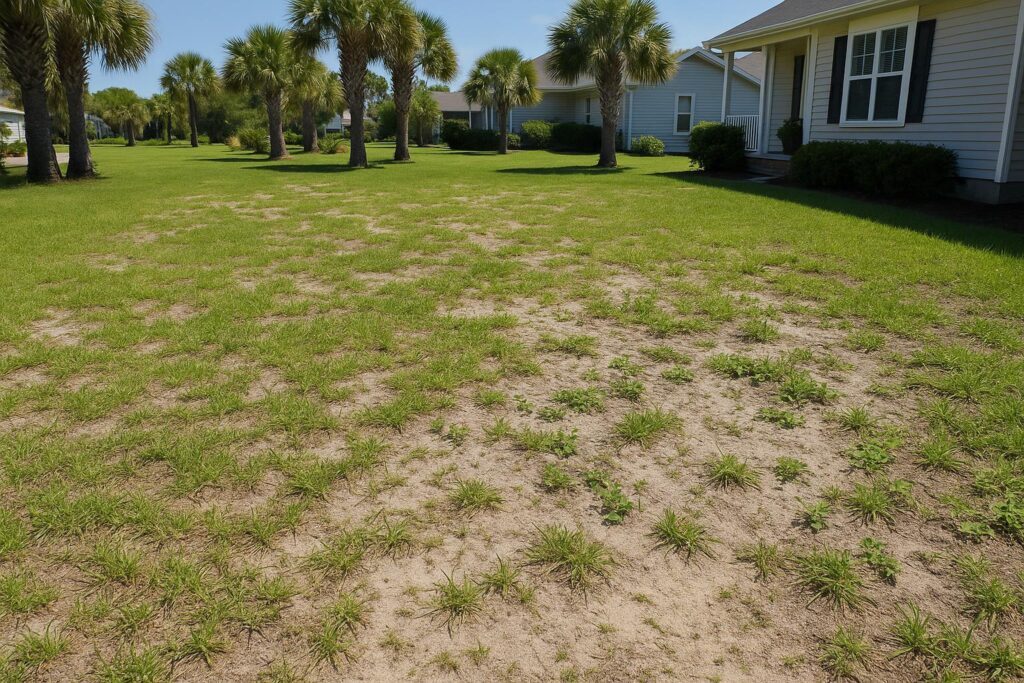
Below 50 percent centipede coverage, the math shifts. Weeds have occupied too much of the lawn area, the centipede that remains is too dispersed to effectively compete and expand, and the cultural inputs required to nurse the remaining grass while fighting the weed population become more expensive and uncertain than simply starting fresh with new sod over properly prepared soil. If your lawn looks more like a weedy field than a grass lawn, renovation is likely the more economical path.
Identifying and Fixing Underlying Causes Before Renovating
The most important step before any lawn renovation is identifying and correcting the conditions that caused the lawn to thin in the first place. Installing new sod over the same soil pH, drainage problem, or shade condition that destroyed the previous lawn will produce the same outcome on a shorter timeline. A renovation that does not address underlying causes is a temporary cosmetic fix, not a lasting solution.
Before committing to renovation, complete a soil pH test, evaluate drainage patterns across the property, assess shade from tree canopies that may have grown significantly since the lawn was installed, and review the fertilization history for evidence of centipede decline patterns like nitrogen over-application. For each identified underlying cause, have a correction plan in place before the new sod goes down — not after.
Best Timing for Lawn Renovation in Coastal SC
The optimal renovation window for centipede sod installation in North Myrtle Beach is late September through mid-October. Soil temperatures during this period — typically 68°F to 75°F — are warm enough for active root development while air temperatures have moderated significantly from summer’s extremes. New centipede sod installed in this window has four to six weeks of active rooting before growth slows as winter approaches, giving it far better establishment than summer-installed sod fighting 95°F heat and peak pest pressure.
August renovation is possible but challenging. Summer heat, high pest pressure, and the irrigation demands of newly installed sod all make August a more difficult establishment month than fall. If your lawn assessment this summer confirms renovation is needed, late September is a better target than trying to rush a renovation in August heat — use the remaining summer weeks to complete soil correction, finalize sod sourcing, and clear the renovation area.
The Renovation Process Step by Step
1Kill existing vegetation. Apply a non-selective herbicide (glyphosate) to the renovation area and allow 10 to 14 days for complete kill-down. A second application may be needed for heavy weed populations. Do not mow or disturb the area during kill-down — the herbicide needs contact with living plant tissue to be effective.
2Remove dead vegetation and thatch. Dethatch or verticut the dead material from the soil surface. For heavily thatched areas, scalp-mow first and bag clippings before dethatching. Removing dead organic matter gives new sod direct contact with the soil, which is essential for rapid rooting.
3Amend the soil. Based on your soil test results, apply any needed pH amendments (elemental sulfur for pH reduction), light topdressing of quality sandy loam if soil structure is poor, and a starter fertilizer low in nitrogen and higher in phosphorus to support root development of new sod.
4Install sod promptly. Order sod to arrive the day of or day before installation. Install sod pieces tightly, staggering joints like brickwork, and roll after installation to ensure firm soil contact. Water immediately and deeply after installation.
5Establish a rigorous post-installation irrigation schedule. New sod requires daily irrigation for the first 2 weeks, gradually tapering to every-other-day in weeks 3 and 4, then to the normal lawn irrigation schedule once sod is rooted and resists gentle tugging.
Sod vs. Plugs vs. Seed for Centipede Renovation
For full lawn renovation in North Myrtle Beach, sod is almost always the right choice over plugs or seed for centipede grass. Sod provides immediate ground cover that suppresses weeds from day one, establishes far faster than seed or plugs, and produces a usable lawn surface within 3 to 4 weeks of installation. The higher upfront cost of sod compared to seed is typically offset by lower weed control costs during establishment and a significantly shorter waiting period to full lawn use.
Centipede seed is an option for budget-conscious renovations, but it requires a longer establishment period — typically an entire growing season to achieve full coverage — during which weed suppression is difficult and the lawn surface is not usable for normal activity. Plugs fall between sod and seed in cost and establishment time but are most appropriate for partial repairs rather than full renovation. For a North Myrtle Beach property where aesthetics and quick return to use matter, sod delivers the most reliable outcome.
Frequently Asked Questions
When is the best time to renovate a centipede grass lawn in North Myrtle Beach?
Late September through mid-October is the optimal renovation window for coastal SC centipede lawns. Soil temperatures are still warm enough for root establishment while air temperatures have dropped from summer extremes, giving new turf the best establishment conditions before winter dormancy.
Can a thin centipede lawn recover without full renovation?
A centipede lawn with at least 50 to 60 percent healthy turf coverage and no persistent underlying problems can often recover through cultural improvements — aeration, pH correction, appropriate fertilization, and pest management — without full sod replacement. Below 50 percent coverage with heavy weed encroachment, renovation is usually the more economical path.
How much does lawn renovation cost in North Myrtle Beach?
Lawn renovation costs vary based on property size, preparation requirements, and sod type. Rough ranges for a complete renovation including kill-down, preparation, and centipede sod installation run from $0.60 to $1.20 per square foot for the sod itself plus preparation labor. KeckCo provides detailed quotes based on individual property assessment.
How long does it take for new sod to fully establish in coastal SC?
New centipede sod installed in fall in North Myrtle Beach typically achieves firm rooting within 3 to 4 weeks of installation, at which point the lawn can withstand normal foot traffic. Full establishment — where the sod has knitted completely and is spreading actively — generally occurs over the following full growing season.
Should I renovate my entire lawn or just patch the bad areas?
For lawns with relatively isolated damage areas (less than 30 percent of total lawn area) surrounded by healthy centipede, targeted patching is usually more cost-effective than full renovation. For lawns where damage and thin coverage are widespread throughout the property, full renovation typically produces a better and more uniform long-term result than patching multiple large areas separately.
Does KeckCo perform lawn renovation and sod installation in North Myrtle Beach?
Yes. KeckCo Turf and Ornamental Services provides complete lawn renovation services including vegetation kill-down, soil preparation, sod installation, and post-installation irrigation guidance throughout North Myrtle Beach, Little River, and the Grand Strand. Contact us at 843-273-0735 to schedule a renovation assessment.
A lawn renovation is an investment in a reset — a chance to correct the underlying conditions and management patterns that led to decline and start fresh with the right foundation. For North Myrtle Beach properties where centipede has thinned beyond what maintenance can fix, planning that renovation now for a fall installation is the most productive use of the remaining summer.
Think your North Myrtle Beach lawn may need renovation?
KeckCo Turf and Ornamental Services evaluates lawn health, identifies renovation candidates, and installs sod throughout the Grand Strand. Let us help you plan a fresh start this fall.