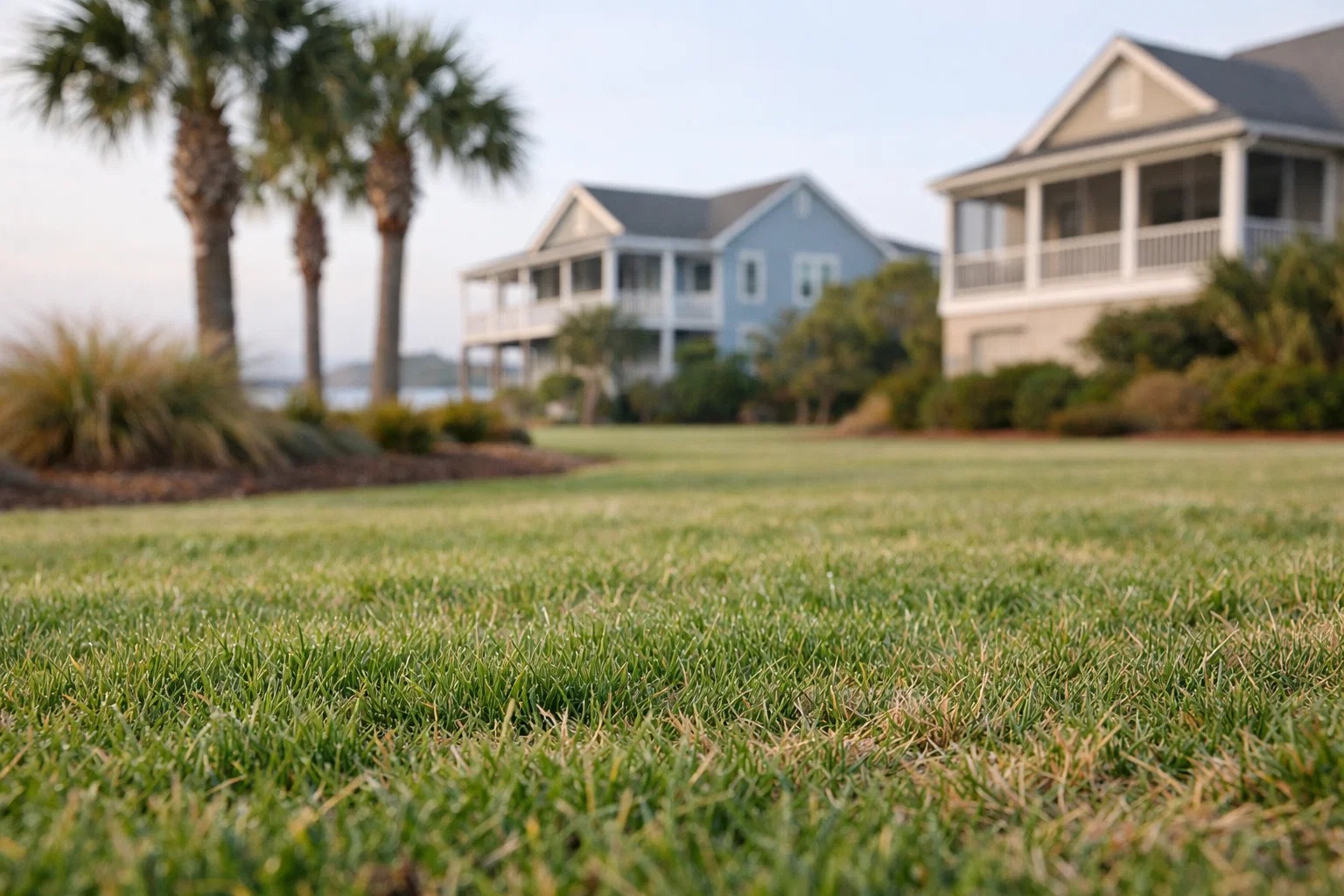

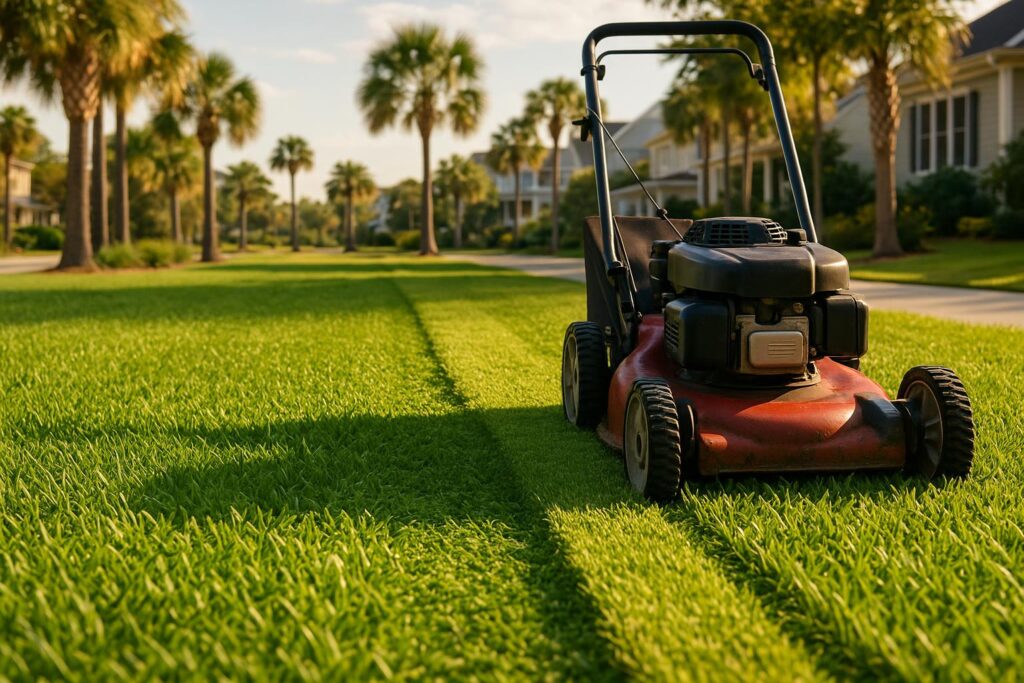
The last few mowings before a coastal SC lawn enters winter dormancy are not the same as any other mowing of the season, and treating them that way is a mistake that shows up clearly the following spring. How you leave your centipede or St. Augustine lawn going into dormancy — the final mowing height, the timing of that last cut, and what you do and do not do around that final mowing — has a measurable effect on how cleanly the lawn enters dormancy, how well it withstands winter, and how quickly and evenly it breaks dormancy and greens up in spring.
At KeckCo Turf and Ornamental Services, this is one of those details that distinguishes a well-managed lawn from one that simply gets through winter. Here is what the final mows of the season should look like for North Myrtle Beach’s primary grass types.
- When is the actual last mow in North Myrtle Beach?
- The right final mowing height for centipede and St. Augustine
- Why the final mowing height matters for winter performance
- The scalping question: should you cut short before dormancy?
- What to do and not do immediately after the last mow
- End-of-season equipment care
- Frequently Asked Questions
When Is the Actual Last Mow in North Myrtle Beach?
Centipede and St. Augustine in North Myrtle Beach slow their growth significantly in late October and typically stop requiring mowing by mid to late November, when active growth has ceased and the grass is transitioning into dormancy. The actual last mowing of the season falls when growth has become negligible — typically when two weeks have passed without the lawn showing any meaningful increase in height. For most North Myrtle Beach properties, this falls somewhere in the November 1 to November 20 window depending on the year’s specific weather pattern.
Watching the lawn’s actual growth rate rather than the calendar is the correct approach. In a warm fall — which is common on the Grand Strand — active growth can continue into early November, and mowing when needed through that period is appropriate. In a cool fall following an early cold front, growth may stop in October. The lawn tells you when it is done growing; your job is to pay attention and give it one final cut at the right height before it does.
The Right Final Mowing Height for Centipede and St. Augustine
For centipede grass, the correct final mowing height is 1.5 to 2 inches — the same as the standard summer mowing range. Do not deviate from this range in either direction on the final mow. For St. Augustine, the final mowing height is 3 to 3.5 inches, consistent with its standard mowing range through the growing season. Maintaining normal mowing height on the final cut is the correct approach for both grass types.
The key practice is ensuring the lawn enters dormancy at the correct height — neither too tall nor too short. A lawn that goes into dormancy too tall (above 3 inches for centipede) accumulates dead leaf material through winter, creates conditions favorable for fungal disease activity in late winter, and produces a thatchy, matted surface in spring that slows green-up and requires additional cleanup work. A lawn going into dormancy too short (below 1.5 inches for centipede) stresses the crown unnecessarily and reduces the plant’s cold hardiness and energy reserves heading into winter.
Why the Final Mowing Height Matters for Winter Performance
The relationship between final mowing height and winter lawn performance is primarily about cold hardiness and crown protection. The leaf blades remaining on the plant going into dormancy do not photosynthesize during winter, but they do provide some thermal buffering for the crown — the growing point at or just below the soil surface that must survive winter intact for the plant to recover in spring. Leaving adequate leaf blade height — but not excessive height — heading into winter gives the crown a modest physical buffer during the rare hard freeze events that occur in coastal Horry County.
The other dimension of final height is its relationship to the spring green-up appearance. Lawns that enter dormancy at the correct height emerge from dormancy more cleanly and evenly, with a more uniform transition from tan to green, than lawns that went into winter too tall or were scalped aggressively before dormancy. The spring green-up pattern mirrors the distribution and density of the viable crown tissue coming out of winter, and that tissue is better protected at the correct height than at extremes in either direction.
The Scalping Question: Should You Cut Short Before Dormancy?
Scalping before dormancy is one of the most persistent myths in warm-season lawn management — the belief that cutting the grass very short just before it goes dormant will produce a cleaner, faster spring green-up. The reality is the opposite. Scalping stresses the plant at precisely the moment it is trying to direct resources to root carbohydrate storage for winter survival, removes the physical buffering that remaining leaf blades provide for the crown, and produces a lawn that enters winter more vulnerable to cold damage, not less.
The single scenario where a shorter-than-normal pre-dormancy cut is appropriate is ryegrass overseeding preparation — where cutting the warm-season grass short before broadcasting ryegrass seed improves seed-to-soil contact and reduces competition with the establishing ryegrass. Even in this case, the cut is made specifically as part of the overseeding process, not as a standalone pre-dormancy practice. Outside of overseeding preparation, maintain normal mowing height through the last mow of the season without deviation.
What to Do and Not Do Immediately After the Last Mow
The period immediately following the final mow of the season is the last practical window to make adjustments that will carry over to spring performance. If your fall pre-emergent application has not been made, the period just after the final mow is the last opportunity — apply within a week or two of the last cut, before soil temperatures drop below the 70°F threshold that makes pre-emergent less effective and before the lawn’s dormancy is fully established. If you have identified nutsedge in the lawn through fall, a post-emergent sedge herbicide application before dormancy can reduce the tuber population before it goes through the winter, though efficacy is reduced compared to mid-season application when plants are more actively growing.
What not to do: do not apply nitrogen fertilizer after the last mow. This timing is past the appropriate fertilization window for both centipede and St. Augustine, and any nitrogen applied now serves no purpose — the grass is not growing, cannot use the fertilizer, and may carry excess nitrogen into spring in a form that creates problems rather than benefits when growth resumes. Late-season nitrogen also delays the hardening-off process, increasing cold injury risk from winter freeze events.
End-of-Season Equipment Care
The period following the last mow of the season is also the right time to service mowing equipment before it sits through winter. A dull blade going into spring means the first mows of the new season will tear rather than cut the recovering grass, slowing green-up and opening the lawn to disease. Remove the blade, sharpen or replace it, and reinstall it properly torqued before storing the mower for winter. If your mower uses ethanol-blended fuel, run the fuel system dry or add a fuel stabilizer product before long-term storage to prevent carburetor and fuel system degradation from ethanol separation and oxidation over winter.
Clean the mower deck thoroughly after the final mowing — accumulated organic material on the deck corrodes metal components and harbors fungal disease spores that can transfer to the lawn surface on the first spring mowing. In the salt-air coastal environment, a light spray of corrosion-inhibiting lubricant on deck hardware, blade spindle bearings, and adjustment mechanism points after cleaning extends equipment life significantly compared to storing it without any protective treatment.
Frequently Asked Questions
When is the last mow of the season for centipede grass in North Myrtle Beach?
The last mow for centipede in North Myrtle Beach typically falls in the November 1 to November 20 window, when active growth has ceased and two weeks have passed without meaningful height increase. Watch the lawn’s actual growth rate rather than the calendar — a warm fall may require mowing into early November; a cool fall may end mowing in late October.
Should I cut my centipede grass short before it goes dormant?
No. Pre-dormancy scalping is a persistent myth that actually stresses the lawn by removing crown buffering and depleting the plant’s carbohydrate reserves heading into winter. Maintain your normal mowing height — 1.5 to 2 inches for centipede — through the final mow of the season. The only exception is ryegrass overseeding preparation, where a shorter cut improves seed germination conditions.
What height should my St. Augustine lawn be at when it goes dormant?
St. Augustine should enter dormancy at its standard mowing height of 3 to 3.5 inches. Do not deviate from this range on the final mow — the same correct mowing height that produces the best summer results also produces the best winter dormancy and spring recovery outcomes.
Can I fertilize after the last mow of the season?
No. Do not apply nitrogen fertilizer after the final mow of the season in North Myrtle Beach. The grass is entering dormancy and cannot use nitrogen productively; late-season nitrogen delays the hardening-off process and increases cold injury risk from winter freeze events. The appropriate fertilization window for centipede ended in early September at the latest.
Should I apply pre-emergent before or after the last mow?
Apply fall pre-emergent before the last mow if possible, but within the soil temperature window of the third week of September for optimal timing. If that window has passed, applying after the last mow in early to mid-October is better than skipping the application entirely, though efficacy decreases as soil temperatures continue to fall below 70°F.
Does KeckCo handle end-of-season lawn mowing services in North Myrtle Beach?
Yes. KeckCo Turf and Ornamental Services provides fall lawn mowing and maintenance through the end of the growing season for residential properties throughout North Myrtle Beach and the Grand Strand. Our seasonal programs manage the mowing frequency transition from summer through fall dormancy appropriately for each grass type. Call 843-273-0735.
The final mows of the season deserve the same attention and technique as any other mowing — they are not an afterthought to get through before winter. Getting the height right, timing the last cut to the lawn’s actual growth rather than a calendar date, and following the correct practices in the days around that final mowing sets up a cleaner winter, a lower spring disease risk, and a more even and vigorous green-up when March arrives on the Grand Strand.
Let KeckCo manage your fall lawn transition in North Myrtle Beach
KeckCo Turf and Ornamental Services handles mowing, pre-emergent, and fall lawn care throughout the growing season and through the transition into dormancy across the Grand Strand.