
Pre-emergent herbicide is one of the most cost-effective investments in any North Myrtle Beach lawn care program — and one of the most timing-dependent. Apply it correctly and you prevent an entire population of winter annual weeds from ever germinating. Apply it two weeks late and those same seeds have already sprouted, rendering the product ineffective and leaving you to fight a weed population through hand-pulling or post-emergent herbicides for the entire fall and winter season. The difference between these two outcomes is not product selection or application technique — it is simply the calendar and soil temperature.
At KeckCo Turf and Ornamental Services, fall pre-emergent timing is one of our most frequently asked-about topics in late August and September, and with good reason. Here is the complete how-to for North Myrtle Beach’s specific timing, soil conditions, and target weed populations.
What Pre-Emergent Herbicide Actually Does
Pre-emergent herbicides do not kill existing plants — they create a chemical barrier in the soil that prevents germinating seeds from successfully establishing their root systems. The active ingredient is absorbed by the emerging root tip of a germinating seed, disrupting cell division before the seedling can push out of the soil. Once a weed seed has fully germinated and pushed above the soil surface, pre-emergent herbicides have no effect on it whatsoever. This is why timing is everything: the barrier must be in place before germination begins, not after it has already occurred.
Understanding this mechanism explains why pre-emergent applications that miss the timing window are not simply less effective — they are completely ineffective against weeds that have already germinated, while also potentially complicating subsequent management. A missed fall pre-emergent window means fighting a fully established winter weed population for months rather than preventing it with a single application.
The Soil Temperature Trigger for North Myrtle Beach
The soil temperature threshold for winter annual weed germination in coastal SC is 70°F — when soil temperatures drop to and below this level, target weed seeds begin germinating actively. The pre-emergent barrier needs to be in place several days before soil temperatures reach that threshold, not after. In North Myrtle Beach and coastal Horry County, soil temperatures typically cross the 70°F threshold between mid-September and early October, depending on year-to-year weather patterns.
The practical target application window for fall pre-emergent in North Myrtle Beach is mid-September through the last week of September. Applying in early September — before soil temperatures begin dropping toward the threshold — still provides effective protection because most pre-emergent products remain active in the soil for 60 to 90 days after application. Applying in October risks being late as soil temperatures can cross 70°F rapidly after a cold front arrives. The conservative and reliable approach is to apply by the third week of September regardless of what the weather looks like at the time.
The Fall Weeds You Are Targeting
Fall pre-emergent applications in North Myrtle Beach target winter annual weeds — plants that germinate in fall, grow through winter, and die in spring as temperatures rise. The most problematic of these on the Grand Strand is annual bluegrass, known as poa annua, which germinates aggressively once soil temperatures drop and forms dense patches of coarse-textured, light green grass that looks dramatically different from centipede or St. Augustine and is extremely difficult to control post-emergence. Poa annua is the primary reason fall pre-emergent is such a high-value application.
Other target weeds include common chickweed, henbit (a purple-flowering mint-family winter annual), hairy bittercress, and various annual sedge species. All of these germinate in fall, establish through winter, and can significantly diminish the appearance of a lawn by late winter and early spring when they reach mature size. A single successful fall pre-emergent application prevents all of them from establishing, making it one of the simplest high-return investments in the lawn management calendar.
Product Selection: What Works in Coastal SC
Prodiamine (sold under the Barricade brand name and in various generic formulations) is the most widely used and reliably effective active ingredient for fall pre-emergent in warm-season lawns across the Southeast. It provides excellent control of poa annua and most common winter annual weeds, has a strong residual duration of 60 to 90 days, and is safe for use on centipede and St. Augustine at labeled rates. Both granular and liquid formulations are available; granular is more practical for residential application with a broadcast spreader.
Pendimethalin (sold as Pendulum and in generic formulations) and dithiopyr (sold as Dimension) are also effective alternatives with slightly different spectrums of control and residual durations. For North Myrtle Beach centipede lawns with a history of heavy poa annua pressure, prodiamine at the higher end of the labeled rate range provides the most robust protection through the full winter germination season. Always check the product label to confirm it is labeled for use on your specific grass type — application rates that are safe for bermudagrass may be too aggressive for centipede.
Application Technique and Common Errors
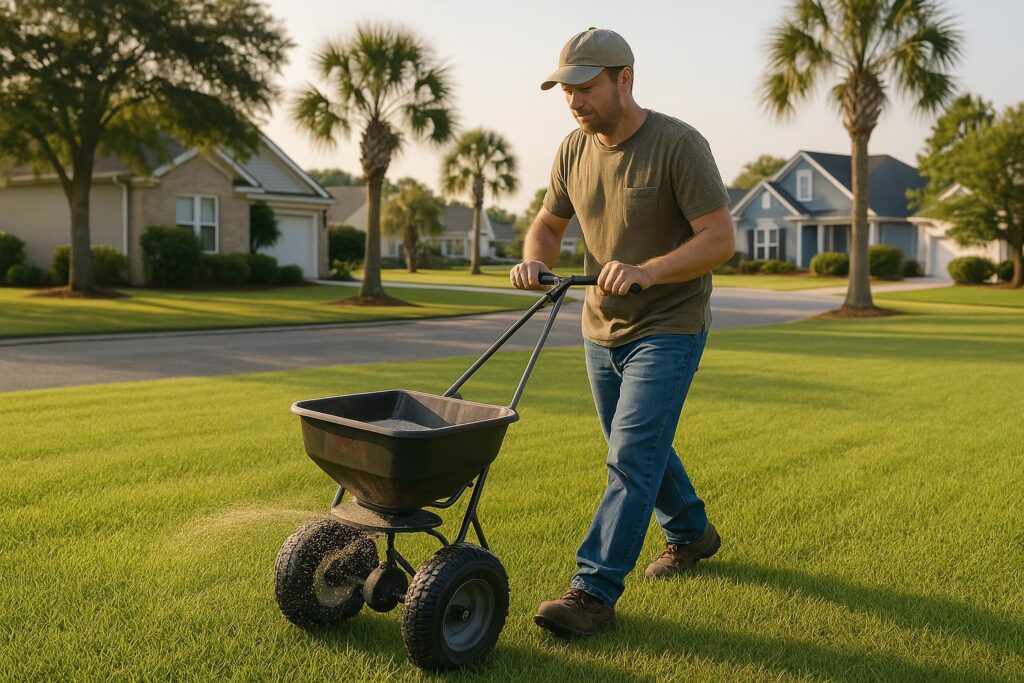
1Calibrate your spreader. Granular pre-emergent applied at the wrong rate is either ineffective (under-applied) or damaging to desirable turf (over-applied). Use the spreader settings printed on the product bag, calibrated for your specific spreader model, and verify with a catch test before applying across the lawn.
2Apply in overlapping passes. Walk at a consistent pace in straight, parallel passes across the lawn, with each pass overlapping the previous by about 30 percent to ensure complete coverage without gaps. Uneven application produces a striped result where weed-free bands alternate with weedy bands following the spreader pattern.
3Water in immediately. Granular pre-emergent needs water to move it from the turf surface into the soil where the barrier is effective. Apply when rain is forecast within 24 hours, or irrigate with at least 0.25 to 0.5 inches immediately after application. Pre-emergent sitting on the surface without water activation provides no protection.
4Treat edges and bed borders. Winter annual weeds germinate aggressively in the gap between lawn edges and beds, along sidewalk cracks, and in areas where turf is thin. Give these transitional zones extra attention rather than letting them become re-infestation sources.
Coordinating with Aeration and Sod Installation
If you are doing fall aeration and sod installation in addition to pre-emergent application — the complete fall renovation sequence — the correct order matters significantly. Aerate first. Then install any sod. Then apply pre-emergent. Applying pre-emergent before sod installation inhibits the new sod’s root establishment just as it would inhibit a germinating weed seed. The pre-emergent should go down after new sod is in place and has received its first establishment irrigation, not before or during the installation.
For properties doing only pre-emergent without sod installation, the coordination is simply with aeration — aerate, then pre-emergent within 48 hours. For properties with neither aeration nor sod work planned, the pre-emergent can be applied independently according to soil temperature timing without coordination with other activities.
Frequently Asked Questions
When should I apply fall pre-emergent in North Myrtle Beach?
Apply fall pre-emergent by the third week of September in North Myrtle Beach. The target soil temperature trigger is 70°F — when soil temperatures fall to this level, winter annual weeds including poa annua begin germinating actively. Applying by mid-to-late September ensures the barrier is in place before germination begins, which is the only way pre-emergent provides effective protection.
What weeds does fall pre-emergent prevent in North Myrtle Beach?
Fall pre-emergent in coastal SC primarily targets annual bluegrass (poa annua), which is the most damaging and visually disruptive winter annual weed in residential lawns on the Grand Strand. It also prevents chickweed, henbit, hairy bittercress, and various annual sedge species from germinating and establishing through the fall and winter season.
Is fall pre-emergent safe for centipede grass?
Yes, when applied at labeled rates for centipede. Prodiamine, pendimethalin, and dithiopyr are all labeled for safe use on centipede grass at appropriate rates. Always confirm the product label lists centipede as an approved turf type and follow the rate range specified for centipede — some products have different rate recommendations for different grass species.
Should I apply pre-emergent before or after aerating?
Always aerate first, then apply pre-emergent. Core aeration physically disrupts the chemical barrier created by pre-emergent products in the soil. The correct sequence every fall is: aerate, then apply pre-emergent within 24 to 48 hours, so a new barrier forms in the freshly aerated soil.
Can I apply pre-emergent if I just installed new sod?
Wait until new sod has been watered in and received its first establishment irrigation before applying pre-emergent. The product inhibits root cell division, which can interfere with new sod establishing roots into the prepared soil. Apply after installation, not before or during, and use the lower end of the labeled rate range on recently installed turf.
Does KeckCo apply fall pre-emergent in North Myrtle Beach?
Yes. KeckCo Turf and Ornamental Services applies fall pre-emergent as part of seasonal lawn care programs throughout North Myrtle Beach, Little River, and the Grand Strand. We coordinate timing with aeration and any sod installation work to ensure the correct sequence and soil temperature targeting. Call 843-273-0735 to schedule your fall weed prevention application.
Fall pre-emergent is one of the rare lawn care applications where timing precision directly determines whether you get the full benefit or essentially none at all. Understanding the soil temperature trigger, having your product and equipment ready before September’s third week, and following the correct application and water-in sequence is all it takes to prevent poa annua and a roster of winter annual weeds from touching your North Myrtle Beach lawn this fall and winter.
Want professional fall pre-emergent application for your North Myrtle Beach lawn?
KeckCo Turf and Ornamental Services applies pre-emergent at the correct soil temperature window throughout the Grand Strand. We coordinate with your aeration and sod schedule for the right sequence every time.