
Landscape lighting is one of the most impactful investments a North Myrtle Beach homeowner can make in their outdoor property — it extends the usable hours of outdoor living spaces into the evening through most of the year, dramatically improves curb appeal and property presence at night, and adds a dimension of security and safety that daytime-only landscaping cannot provide. Fall is the time of year when interest in landscape lighting peaks, as shorter days and longer evenings suddenly make the absence of nighttime illumination very apparent. It is also an excellent installation season — moderate temperatures, dry soil conditions, and the transition out of the peak lawn growing season make fall a practical window for running conduit and placing fixtures without the complications of active turf establishment.
At KeckCo Turf and Ornamental Services, landscape lighting is part of what we design and install as an integral component of outdoor living and landscape projects throughout the Grand Strand. Here is what works, what lasts, and what to avoid specifically for the coastal SC salt-air environment.
- The salt-air challenge: why coastal lighting is different
- Low-voltage LED vs. line-voltage: which is right for residential use
- Fixture types and where each belongs
- Design principles for coastal SC landscapes
- Installation considerations for North Myrtle Beach yards
- Maintenance to keep coastal lighting performing
- Frequently Asked Questions
The Salt-Air Challenge: Why Coastal Lighting Is Different
Salt air is corrosive to metals, seals, and electrical contacts in ways that are not immediately apparent but compound dramatically over time. Landscape lighting fixtures rated for standard outdoor use but not specifically for coastal salt-air exposure will show visible corrosion, finish degradation, and fixture failure significantly sooner on a North Myrtle Beach property than the same fixtures would on an inland installation. Brass and bronze fixtures develop surface patina that is generally considered aesthetically acceptable; aluminum fixtures with poor sealing develop corrosion that infiltrates connection points and causes premature failure; plastic composites perform inconsistently depending on the UV-resistance quality of the specific materials used.
Proximity to the ocean, the Intracoastal Waterway, and tidal marshes meaningfully increases the corrosion exposure rate — a property on the ocean front or directly on the Waterway faces significantly more aggressive salt-air conditions than an inland neighborhood five miles from the coast. The practical implication is that fixture quality selection should be calibrated to your specific property’s salt exposure level: marine-grade brass or high-quality cast brass fixtures for highly exposed coastal locations, quality powder-coated aluminum with sealed connections for less exposed residential neighborhoods further from the water.
Low-Voltage LED vs. Line-Voltage: Which Is Right for Residential Use
Low-voltage LED systems — operating at 12 volts DC through a transformer connected to a standard 120-volt household circuit — are the overwhelming choice for residential landscape lighting on the Grand Strand, and for compelling reasons. They are far safer to install and maintain than line-voltage (120-volt) systems; code requirements are significantly simpler, allowing homeowners and landscapers to install them without the licensed electrician requirements that line-voltage installations mandate. The operating cost of LED fixtures is a fraction of halogen or incandescent alternatives. And the variety of fixture styles, beam angles, and color temperatures available in low-voltage LED has expanded dramatically over the past decade, producing lighting quality that rivals line-voltage systems at a fraction of the installation and operating cost.
Line-voltage systems are appropriate for specific high-intensity applications — large commercial properties, high-output flood lighting for security, or architectural lighting of large structures — where the power demands exceed what a low-voltage system can deliver practically. For typical North Myrtle Beach residential landscape applications including path lighting, uplighting of ornamental trees and palms, accent lighting of beds and water features, and outdoor living area illumination, low-voltage LED is the appropriate and recommended technology.
Fixture Types and Where Each Belongs
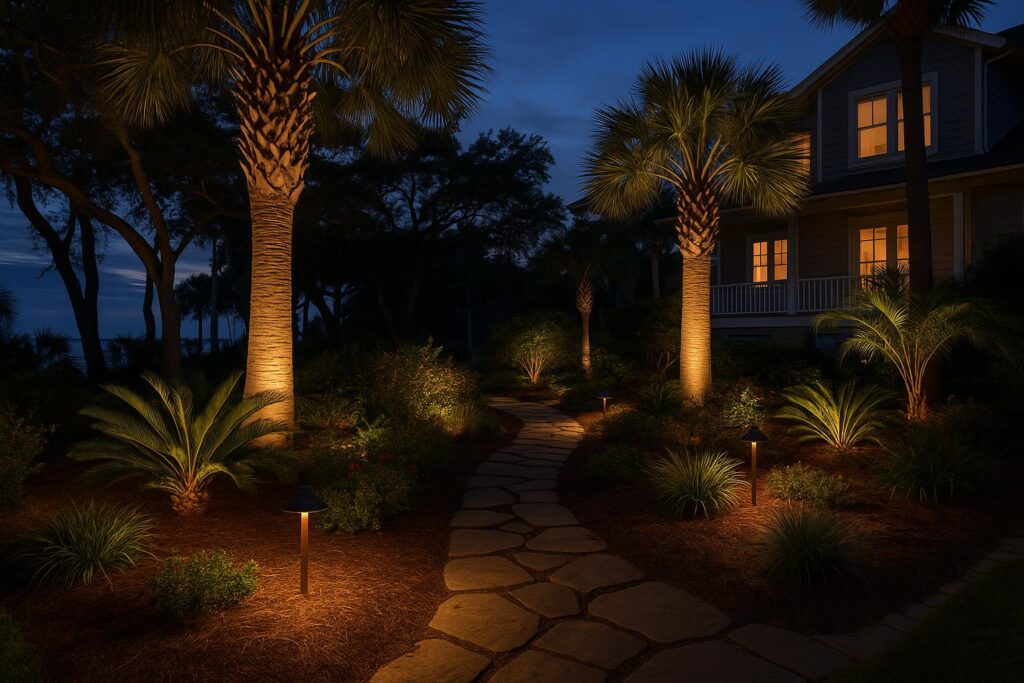
Path lights line walkways, bed edges, and transitions between outdoor living areas and lawn zones. They define pathways visually at night, provide safety by illuminating changes in grade and surface material, and create the warm, welcoming quality that makes a residential property look cared for from the street. Spacing of 6 to 10 feet between path lights, with enough wattage to illuminate the path surface without creating harsh bright spots, produces a natural, pleasing effect. Fixtures with full cut-off optics that direct light downward rather than outward reduce light trespass onto neighbors and prevent the hot-spot, glare-heavy look of poorly aimed path lights.
Uplights directed at specimen trees, palms, and structural ornamental plants create the dramatic visual depth that makes a residential landscape look genuinely designed rather than simply planted. A well-placed uplight on a mature live oak or a row of Sabal palms transformed the same plants that are invisible at night into prominent, beautiful features. Aim uplights to illuminate the trunk and canopy structure without creating the “searchlight from below” effect that harsh, over-powerful uplights produce. Adjustable spike fixtures allow angle fine-tuning after installation as the illuminated plant grows and changes.
Wash and spread fixtures provide broad, low-angle illumination across ground cover, ornamental grass plantings, and low-profile bed areas, creating a visual floor layer that complements the vertical lighting from uplights and path fixtures. They are particularly effective for illuminating muhly grass and ornamental grasses whose texture and movement are highlighted beautifully by low-angle light.
Design Principles for Coastal SC Landscapes
The most common residential landscape lighting mistake is over-lighting — installing too many fixtures at too high a wattage, producing a lawn that looks like a stadium at night rather than a beautifully illuminated home. The goal of residential landscape lighting is to create depth, shadow, and drama using the contrast between lit and unlit areas, not to flood every surface with even, flat light. Less is consistently more in residential outdoor lighting design.
Focus lighting on the three to five most important features of your landscape — the live oak with interesting structure, the front entry pathway, the planting beds that frame the house — and let the areas between them remain in natural shadow. This selective approach produces dramatically better results than evenly spacing path lights every four feet and uplighting every plant in the bed. In coastal SC landscapes, the natural vertical elements are exceptional lighting subjects: mature palms with clean trunk lines, live oaks with sweeping canopy architecture, crape myrtles with distinctive branching — any of these uplighted well becomes a nighttime landscape feature that defines the character of the property.
Installation Considerations for North Myrtle Beach Yards
North Myrtle Beach’s sandy soil is generally easy to trench for low-voltage cable — much easier than clay-based soils in other regions. However, the same sandy structure that makes trenching simple also means cables buried at minimal depth can shift, expose, or be disturbed by landscaping activities more readily than in firmer soils. Bury low-voltage cable at a minimum of 6 inches in sandy coastal soil — deeper than the minimum code requirement in many jurisdictions — to reduce the risk of cable damage from future landscape maintenance, aeration equipment, and edging tools.
Transformer placement and capacity planning are the two technical decisions that most affect system expandability and reliability. Size the transformer with 30 to 40 percent capacity headroom above the initial load — a transformer running at or near capacity produces voltage drop that dims fixture output and accelerates transformer component wear. Place the transformer in a location that provides some protection from direct weather exposure while remaining accessible for zone circuit management and timer adjustments.
Maintenance to Keep Coastal Lighting Performing
Landscape lighting in salt-air coastal environments requires annual maintenance that inland systems can often defer for longer periods. At minimum, an annual inspection and maintenance visit should include: cleaning salt deposits from fixture exteriors and lens surfaces that reduce light output over time; checking and tightening all cable connections at fixtures and the transformer, as salt air and temperature cycling loosens connections that can cause flickering or outage; adjusting fixture aim as plants grow and the lighting subjects change in size and shape; and replacing any failed lamps, seals, or fixtures before the failure creates gaps in the system’s coverage.
Transformer timer and daylight-sensor adjustments are needed twice a year as daylight hours change — late September when days shorten significantly is the primary timing adjustment window, and again in late March after the spring time change. Modern smart transformers with WiFi control eliminate the manual timer adjustment requirement and allow remote scheduling management, which is a practical convenience for North Myrtle Beach vacation property owners who are not on-site to make seasonal adjustments manually.
Frequently Asked Questions
What type of landscape lighting lasts longest in North Myrtle Beach’s salt air?
Solid brass and solid bronze fixtures provide the best long-term performance in coastal SC salt-air environments, resisting corrosion far better than aluminum or composite fixtures. While more expensive upfront, they outlast lower-cost alternatives by decades in coastal conditions and represent a lower total cost over a 15 to 20-year installation lifespan.
How many landscape lights do I need for my North Myrtle Beach yard?
Less is more in residential landscape lighting — the goal is selective illumination of your three to five most important landscape features, not uniform coverage of every surface. A typical North Myrtle Beach residential front landscape might use 8 to 15 fixtures strategically placed, while the backyard adds another 10 to 20 depending on outdoor living area extent. An over-lit yard looks staged and harsh; a selectively lit yard looks designed and welcoming.
Should I use warm white or cool white LEDs for landscape lighting?
Warm white (2700K to 3000K color temperature) is the correct choice for residential landscape lighting. It enhances the warmth of natural materials and plants without the clinical, institutional quality of cool white (4000K+) LEDs. Cool white looks harsh in residential landscape applications regardless of fixture quality.
Can I install landscape lighting myself in North Myrtle Beach?
Low-voltage (12V) landscape lighting systems can be DIY-installed without an electrician license — the transformer connects to a standard 120V outdoor outlet, and the low-voltage side does not require licensed electrical work. Line-voltage (120V) landscape lighting requires a licensed electrician for installation per South Carolina electrical code. Most residential landscape lighting projects use low-voltage systems that are homeowner-installable.
How deep should landscape lighting cable be buried in North Myrtle Beach?
Bury low-voltage landscape cable at a minimum of 6 inches in North Myrtle Beach’s sandy soil — deeper than the minimum code requirement in many jurisdictions. Sandy soil’s loose structure allows shallowly buried cables to shift, expose, or be disturbed by landscaping activities more easily than firmer soils, making deeper burial a practical necessity for protection.
Does KeckCo design and install landscape lighting in North Myrtle Beach?
Yes. KeckCo Turf and Ornamental Services designs and installs low-voltage LED landscape lighting systems for residential properties throughout North Myrtle Beach, Little River, and the Grand Strand. We specify salt-air appropriate fixtures and integrate lighting design with the overall landscape plan. Call 843-273-0735 to discuss your project.
Landscape lighting is the single landscape investment that delivers the greatest transformation per dollar spent in North Myrtle Beach’s mild year-round climate — it adds hours to the usable day, creates curb appeal at the time of day when your home is most visible from the street, and turns the landscape you have already invested in into a feature that performs even when you are not outdoors in it. Get the fixture quality right for the coastal environment, design selectively rather than comprehensively, and the result is a yard that looks as good at 8 PM as it does at noon.
Ready to add landscape lighting to your North Myrtle Beach property?
KeckCo Turf and Ornamental Services designs and installs low-voltage LED landscape lighting throughout the Grand Strand, using salt-air-appropriate fixtures selected for the coastal SC environment.