
September in North Myrtle Beach marks the beginning of a new weed germination cycle that most homeowners do not notice until it is already well established. While the warm-season lawn is winding down and heading toward dormancy, a roster of cool-season annual weeds is germinating and positioning itself to take over the lawn through fall and winter — particularly in any thin or stressed turf areas where soil is exposed and there is no dense grass canopy to compete. Knowing which weeds you are dealing with, what they look like before they become obvious, and what controls them is the difference between a lawn that stays clean through winter and one that greens up in spring and then has to fight through a massive weed population to recover.
At KeckCo Turf and Ornamental Services, fall weed management is among the most consequential services we provide on Grand Strand lawns. This is the identification guide for the species you are most likely to encounter right now.
- Annual bluegrass (poa annua) — the most damaging fall weed
- Common chickweed — the carpet-forming winter annual
- Henbit — the purple-flowering winter annual
- Hairy bittercress — the explosive spreader
- Yellow nutsedge — the year-round problem weed
- Control strategies: pre-emergent, post-emergent, and cultural
- Frequently Asked Questions
Annual Bluegrass (Poa annua) — The Most Damaging Fall Weed
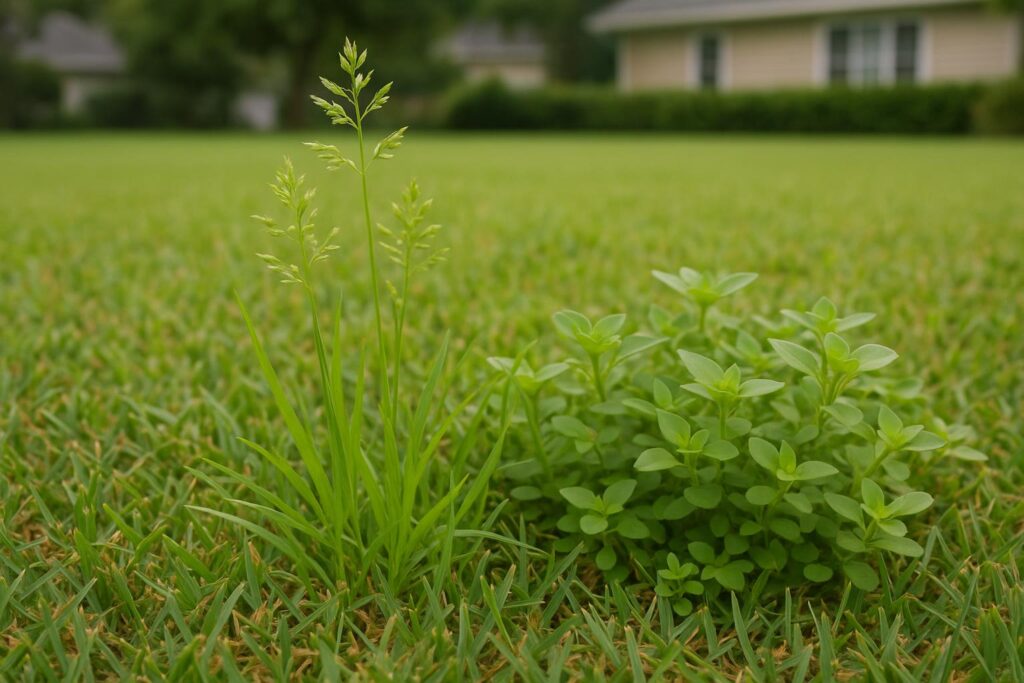
Annual bluegrass, universally known by its botanical name poa annua among lawn care professionals, is the most problematic fall-germinating weed in North Myrtle Beach residential lawns. It germinates prolifically when soil temperatures drop below 70°F — typically mid-September through October on the Grand Strand — and forms dense, spreading patches of coarse-textured, lime-green grass that looks dramatically different from centipede or St. Augustine. It produces seed heads in late winter and early spring that release thousands of seeds per plant, guaranteeing its return the following fall without control intervention.
Early identification of poa annua is the key to successful management. In its seedling stage, it resembles a lighter-colored, slightly coarser grass blade with a boat-shaped tip and a distinctive folded (not rolled) vernation visible if you look closely at how the leaf blade is folded in the bud. By the time it has developed into the clumping, light-green patches most homeowners recognize, it has already grown large enough that post-emergent control is significantly more difficult and visible lawn disruption from treatment is greater. Pre-emergent applied before germination is dramatically more effective than post-emergent treatment of established plants.
Common Chickweed — The Carpet-Forming Winter Annual
Common chickweed (Stellaria media) is a low-growing, spreading winter annual that forms dense, flat mats of succulent green foliage in thin or bare lawn areas and in ornamental beds through fall and winter. Its leaves are small, oval, and bright green; its stems are somewhat translucent and prone to breaking easily; and it produces tiny white flowers with five deeply notched petals that appear from late fall through spring. The white flowers are usually the first sign homeowners notice, by which point the plant has already spread significantly from its germination point.
Chickweed thrives in moist, shaded, or disturbed areas and is a reliable indicator of overwatered turf, compacted soil, or thin lawn coverage from other stress factors. Areas of the yard that consistently develop heavy chickweed infestations are telling you something about the underlying conditions — excessive moisture, insufficient sun, or turf density problems — that will continue producing chickweed until those conditions are corrected along with the weed management.
Henbit — The Purple-Flowering Winter Annual
Henbit (Lamium amplexicaule) is a member of the mint family that is recognizable from late winter and spring by its purple tubular flowers emerging from whorls of rounded leaves on square stems. In fall and early winter, before it flowers, it is a lower-growing plant with scalloped, rounded leaves in pairs along slightly hairy stems — less visually distinct than its flowering stage but already establishing the root system and spread that will make it conspicuous by February. It is common in lawn edges, ornamental beds, and thin turf areas throughout North Myrtle Beach.
Henbit germinates slightly later in fall than poa annua and chickweed, typically after soil temperatures have been below 65°F for a sustained period. It tolerates the mild coastal SC winters well and overwinters in a vegetative state, resuming active growth and flowering in late winter as temperatures begin to moderate. Pre-emergent applications timed for poa annua control will also prevent henbit germination when applied at the appropriate soil temperature window.
Hairy Bittercress — The Explosive Spreader
Hairy bittercress (Cardamine hirsuta) is a low-growing winter annual in the mustard family that is notable for its explosive seed dispersal mechanism — when its seed pods mature in spring, they open explosively and can project seeds several feet in every direction, dramatically multiplying the following year’s seed bank with each plant that escapes control before seed set. Early identification and removal before flowering and seed pod maturation is particularly important for bittercress management.
Bittercress forms a flat rosette of small, rounded leaflets arranged along a central stem. It is most easily identified in late fall and winter by its distinctive leaf structure and its preference for ornamental beds, container plantings, and the margins between beds and lawn edges rather than in established turf density. It is often the weed that appears in freshly mulched beds within weeks of mulch application, having germinated from seeds in the mulch material or from the seed bank in the soil below.
Yellow Nutsedge — The Year-Round Problem Weed
Yellow nutsedge (Cyperus esculentus) is not a true winter annual — it is a perennial weed that persists year-round in North Myrtle Beach through underground tubers (nutlets) that survive through winter and re-sprout in spring. It is included here because September and early October is an important management window: nutsedge shoots are still visible and actively growing, making identification and targeted herbicide application possible before the above-ground growth dies back in winter and the tubers become the only remaining target.
Yellow nutsedge is identifiable by its triangular stem cross-section — true grasses have round or oval stems, while nutsedge stems have three visible sides that you can feel by rolling them between your fingers. The leaves are bright yellow-green, slightly waxy in appearance, and arranged in sets of three rather than the two-ranked arrangement of grasses. It grows faster than surrounding turf in warm weather, making it easily visible as tufts that protrude above the mowed lawn surface. Sedge-specific herbicides containing halosulfuron or sulfentrazone are required for control — standard broadleaf or grass herbicides are ineffective against nutsedge.
Control Strategies: Pre-Emergent, Post-Emergent, and Cultural
For poa annua, chickweed, henbit, and hairy bittercress, pre-emergent herbicide applied at the correct soil temperature threshold — below 70°F in North Myrtle Beach, typically mid to late September — is the most effective and least disruptive control method. A single well-timed pre-emergent application prevents all four species from establishing, requiring no post-emergent intervention and no visible disruption to the lawn or ornamental beds through the fall and winter season.
When pre-emergent was not applied or was applied late and these weeds have already germinated, post-emergent options include three-way broadleaf herbicide mixtures containing 2,4-D, MCPP, and dicamba for chickweed and henbit in warm-season turf; metsulfuron for more difficult broadleaf and grass weeds; and pronamide for poa annua post-emergence where label permits. Always verify that any post-emergent herbicide is labeled for safe use on your specific grass type before application — some broadleaf herbicides that are safe on bermudagrass can damage centipede or St. Augustine at standard rates.
Cultural control — maintaining dense, healthy, well-fed warm-season turf — is the most durable weed suppression strategy. Thin or bare areas from summer pest or disease damage that were not repaired before fall are the primary entry points for the winter weed population. Repairing damaged areas with sod or seed before weeds establish is both the best weed prevention and the best lawn recovery investment of the fall season.
Frequently Asked Questions
How do I identify poa annua in my North Myrtle Beach lawn?
Annual bluegrass appears as lighter-colored, coarser-textured patches in centipede or St. Augustine lawns in fall and winter. Look for a lime-green color distinctly lighter than the surrounding turf, a slightly boat-shaped leaf tip, and clusters of small whitish seed heads that appear from late winter through spring. In early stages, look for lighter-colored, slightly coarser seedlings in the two to three weeks after the first significant soil temperature drop below 70°F.
What is the best herbicide for poa annua in a centipede lawn?
Pre-emergent herbicide containing prodiamine or pendimethalin, applied before soil temperatures reach 70°F in mid-September, is the most effective control — it prevents germination entirely. For established poa annua, post-emergent options include pronamide where labeled, or metsulfuron in centipede lawns. Always verify label safety for centipede before applying any post-emergent product.
Is nutsedge a grass or a broadleaf weed?
Neither — nutsedge is a sedge, a distinct plant family from true grasses and broadleaf weeds. This distinction matters for herbicide selection: standard broadleaf herbicides do not control nutsedge, and standard grass herbicides are also ineffective. Sedge-specific products containing halosulfuron (sold as Sedgehammer) or sulfentrazone are required for effective nutsedge control.
Why do I have chickweed every winter in the same areas?
Recurring chickweed in the same lawn areas indicates a persistent combination of conditions that favor it — typically excessive moisture, compaction, shade, or thin turf coverage. The conditions attracting chickweed back each year will continue producing it until the underlying issues are addressed alongside weed management. Improving turf density through fertilization, drainage correction, or sod repair in those areas provides the most durable long-term solution.
When does henbit flower in North Myrtle Beach?
Henbit flowers in February and March in coastal SC, after overwintering as a vegetative rosette from its fall germination. The purple tubular flowers are the most recognizable stage of the plant, but by the time they appear the plant has been established for three to four months and is producing seed. Controlling henbit before flowering in late winter is critical to preventing seed set and the following year’s infestation.
Does KeckCo provide fall weed control in North Myrtle Beach?
Yes. KeckCo Turf and Ornamental Services provides pre-emergent and post-emergent weed management as part of seasonal lawn care programs throughout North Myrtle Beach, Little River, and the Grand Strand. Fall weed prevention is one of the highest-value services we provide for maintaining lawn quality through winter. Call 843-273-0735.
The fall weed control window is brief and consequential. The weeds germinating in North Myrtle Beach lawns right now — poa annua, chickweed, henbit, and the others — are small enough today that they are easily prevented and difficult to see. In December and January, they will be large, established, and spreading. The difference between those two outcomes is a pre-emergent application and three weeks of timing. Act now, and winter lawn management becomes a non-issue. Wait, and it becomes a season-long battle.
Need fall weed control for your North Myrtle Beach lawn?
KeckCo Turf and Ornamental Services applies pre-emergent at the correct fall timing window throughout the Grand Strand — preventing the winter weed population before it establishes.