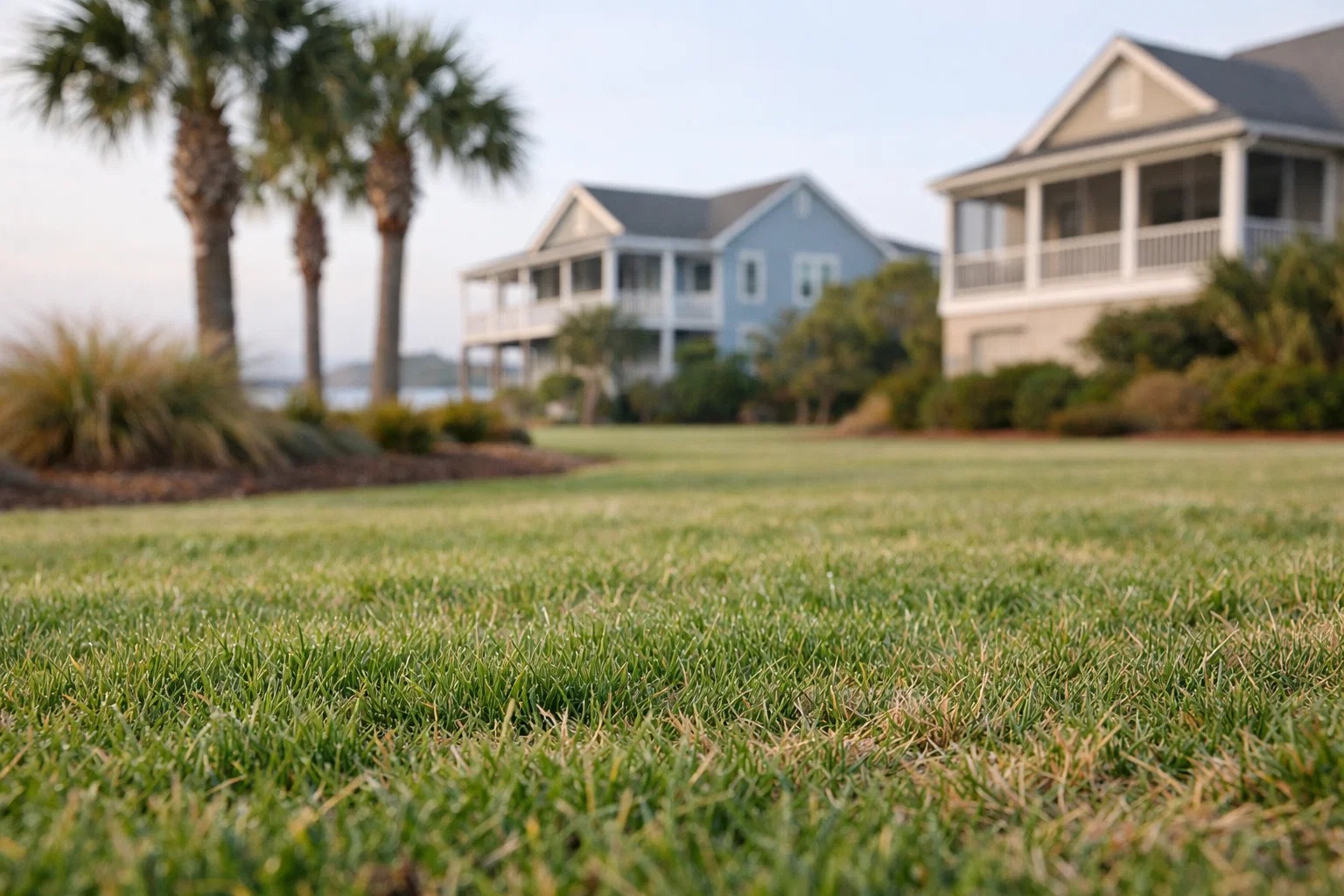

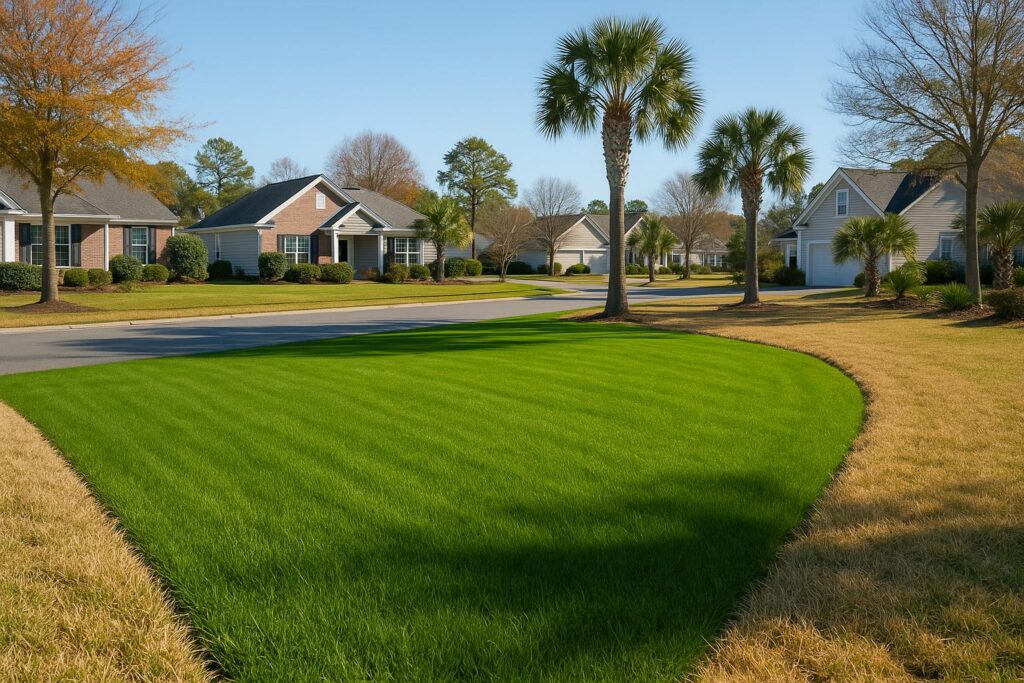
Every fall in North Myrtle Beach, the question comes up among homeowners who want their yard to stay green through winter: should I overseed with ryegrass? It is a genuinely popular practice on the Grand Strand — particularly on properties used for holiday entertaining, vacation rentals that continue through winter, or simply by homeowners who find the tan dormant lawn unappealing for four to five months of the year. Done correctly and at the right time, ryegrass overseeding works well. Done at the wrong time, with the wrong variety, or without understanding the trade-offs, it creates more problems than it solves.
At KeckCo Turf and Ornamental Services, ryegrass overseeding is a service we provide and consult on throughout the Grand Strand. Here is the complete picture — the benefits, the trade-offs, the timing, and the technique — so you can decide whether it makes sense for your property this fall.
- What ryegrass overseeding actually is
- Timing: when to overseed in North Myrtle Beach
- Variety selection: annual vs. perennial ryegrass
- How to overseed correctly for coastal SC conditions
- The real trade-offs you should know before deciding
- Managing the spring transition back to warm-season turf
- Frequently Asked Questions
What Ryegrass Overseeding Actually Is
Ryegrass overseeding is the practice of seeding a cool-season grass — ryegrass — into a dormant warm-season lawn to maintain green color through winter while the underlying warm-season grass (centipede, St. Augustine, or zoysia) is dormant and tan. The ryegrass germinates in fall, grows vigorously through winter in the mild coastal SC climate, provides green color and limited use of the lawn surface through January, February, and March, and then dies back naturally in spring as temperatures rise and the warm-season grass resumes growth.
The ryegrass is temporary — it does not compete with or replace the permanent warm-season turf, which simply resumes where it left off when soil temperatures warm in spring. This temporary nature is what makes ryegrass overseeding work as a strategy: there is no permanent grass type change involved, no removal of the existing turf required, and no long-term management complexity added once the spring transition is understood and managed correctly.
Timing: When to Overseed in North Myrtle Beach
The correct overseeding window in North Myrtle Beach is mid-October through early November — specifically when soil temperatures have dropped to the 50°F to 65°F range that favors ryegrass germination while the warm-season grass has entered or is entering dormancy. Overseeding too early, while soil temperatures are still above 70°F, produces poor ryegrass germination because the soil is too warm for the cool-season seed, and the still-active warm-season grass competes aggressively with any seedlings that do establish.
Overseeding too late — after Thanksgiving — risks germination in increasingly cold soil, slow establishment through December, and a thin, uneven ryegrass stand that provides more patchy green than the full coverage homeowners are seeking. Mid-October through the first week of November is the sweet spot for coastal Horry County, with the specific date varying year to year based on when soil temperatures actually cross the threshold rather than any fixed calendar date. A soil thermometer is the most reliable guide to this timing decision.
Variety Selection: Annual vs. Perennial Ryegrass
Annual ryegrass (Lolium multiflorum) is the most commonly used variety for overseeding in North Myrtle Beach and throughout the Southeast. It germinates quickly (5 to 7 days), establishes readily in the fall temperature range, provides dense green coverage through winter, and dies completely in spring without requiring removal — it simply succumbs to heat as the warm-season turf wakes up. It is also significantly less expensive than perennial ryegrass seed, which matters for whole-lawn overseeding projects.
Perennial ryegrass (Lolium perenne) germinates slightly more slowly, provides finer texture and a more premium appearance than annual ryegrass, and is more competitive against the returning warm-season turf in spring — which is actually a disadvantage in this application, not an advantage. In warm-season lawns overseeded for winter color, annual ryegrass is almost always the correct choice because its natural spring die-off coincides with the warm-season grass’s return, producing a smoother transition with less competition for the permanent turf.
How to Overseed Correctly for Coastal SC Conditions
1Mow the existing lawn short before seeding. Cut the warm-season grass to its lowest practical height — 1 to 1.5 inches for centipede and zoysia, 2 inches for St. Augustine — to reduce competition and improve seed-to-soil contact. Bag the clippings rather than mulching, to avoid covering the seed with excessive organic material.
2Dethatch or verticut lightly if thatch is present. Light vertical mowing or raking opens the thatch layer and creates the micro-pockets where ryegrass seed contacts soil and germinates. Without some soil contact, seed sitting on dense thatch has very poor germination rates.
3Broadcast seed at the labeled rate. Annual ryegrass is typically applied at 8 to 10 pounds per 1,000 square feet for overseeding. Use a broadcast spreader for uniform coverage, walking in two perpendicular directions to reduce striping.
4Apply a starter fertilizer immediately after seeding to support rapid germination. Use a fertilizer low in nitrogen with higher phosphorus for root establishment rather than top growth.
5Water lightly and frequently for the first 10 to 14 days — the goal is to keep the seed and the top quarter inch of soil consistently moist without waterlogging. Two to three light irrigation sessions per day, each of 5 to 8 minutes, is typical during germination. Once ryegrass is established, reduce to normal irrigation scheduling.
The Real Trade-Offs You Should Know Before Deciding
Ryegrass overseeding has genuine benefits but it is not cost or effort free, and homeowners who go in with unrealistic expectations are consistently disappointed. The most important trade-off is the impact on the warm-season turf’s spring recovery. Heavy ryegrass stands that persist into April compete aggressively with centipede and St. Augustine emerging from dormancy, shading them and consuming the water and nutrients the warm-season grass needs to establish its spring growth. This competition can delay and weaken the warm-season lawn’s spring green-up by several weeks, which is a real cost that is easy to overlook when planning the overseeding.
The other meaningful trade-off is the pre-emergent herbicide conflict. If you plan to apply fall pre-emergent for winter weed control, you cannot also overseed with ryegrass in the same fall season — the pre-emergent that prevents poa annua germination also prevents ryegrass germination. You must choose one or the other. For properties with a history of significant poa annua or chickweed problems, protecting the warm-season turf from winter weeds generally takes priority over winter color. For properties where the winter weed pressure is manageable and the aesthetic priority is strong, overseeding may be the right trade-off.
Managing the Spring Transition Back to Warm-Season Turf
The spring transition is the most critical and most frequently mismanaged phase of an overseeded lawn program. Annual ryegrass will die naturally as temperatures rise above its comfort zone in April and May — but if the ryegrass stand is very thick or if a cool spring delays the natural die-off, the competition it creates for the emerging warm-season turf can cause real problems. A scalp mowing of the ryegrass in late March — cutting it to 0.5 to 1 inch — reduces the canopy competing with the warm-season grass and typically accelerates the transition without requiring any chemical intervention.
If the ryegrass is persisting beyond mid-April and clearly competing with warm-season turf that is trying to break dormancy, a herbicide application specifically targeting cool-season grasses in a warm-season lawn is an option — but verify carefully that the product is labeled safe for your specific warm-season grass type before application, as some cool-season grass herbicides can damage St. Augustine and centipede if used incorrectly.
Frequently Asked Questions
When should I overseed with ryegrass in North Myrtle Beach?
Mid-October through the first week of November is the correct overseeding window in coastal Horry County. Target soil temperatures between 50°F and 65°F for optimal ryegrass germination. Overseeding too early in warm soil produces poor germination; overseeding after Thanksgiving risks thin establishment in cold conditions.
Can I apply pre-emergent and overseed with ryegrass in the same fall?
No. Pre-emergent herbicide prevents all seed germination, including ryegrass. You must choose one or the other each fall — pre-emergent for winter weed prevention, or overseeding for winter color. Properties with significant winter weed pressure generally benefit more from pre-emergent; properties where aesthetics are the priority may prefer overseeding and manage weeds post-emergently.
Will ryegrass hurt my centipede lawn?
Ryegrass overseeding has some competitive impact on the warm-season lawn’s spring recovery — thick ryegrass stands that persist into April delay centipede’s green-up by competing for light, water, and nutrients. Proper spring transition management (a scalp mowing in late March) minimizes this competition and allows a smooth transition back to centipede-dominant turf.
How much ryegrass seed do I need for my lawn?
Annual ryegrass for overseeding is typically applied at 8 to 10 pounds per 1,000 square feet. Measure your lawn area before purchasing seed to avoid under- or over-application. Under-seeding produces a thin, patchy stand; over-seeding produces a very dense stand that creates more spring competition for the warm-season turf.
Does overseeded ryegrass need to be mowed in winter?
Yes. Ryegrass grows actively through fall and winter in North Myrtle Beach’s mild coastal climate and will need mowing every 10 to 14 days during periods of active growth, typically November through February, at a height of 1.5 to 2.5 inches. It grows most actively when temperatures are between 50°F and 65°F and may slow or pause during the occasional cold snaps that bring temperatures below 40°F.
Does KeckCo provide ryegrass overseeding services in North Myrtle Beach?
Yes. KeckCo Turf and Ornamental Services provides ryegrass overseeding for residential properties throughout North Myrtle Beach, Little River, and the Grand Strand. We advise on the pre-emergent vs. overseeding trade-off based on your lawn’s specific history and help manage the spring transition. Call 843-273-0735.
Ryegrass overseeding is a legitimate and achievable option for North Myrtle Beach homeowners who want a green lawn through the coastal SC winter — as long as the trade-offs are understood upfront and the timing and technique are correct. The pre-emergent conflict is the most important decision point: if winter weeds have been a significant problem on your property, protecting the permanent turf from them takes priority. If the lawn has been relatively weed-free and winter color is your goal, overseeding at the right time in October delivers exactly what it promises.
Want ryegrass overseeding or fall weed prevention for your North Myrtle Beach lawn?
KeckCo Turf and Ornamental Services handles both — and helps you choose the right strategy for your property. Call us before the October overseeding window arrives.