
Centipede grass gets most of the attention in North Myrtle Beach lawn conversations, and for good reason — it is the dominant turf type across most residential properties in the area and performs well under the low-maintenance management that most homeowners prefer. But St. Augustine grass has a very loyal following on the Grand Strand, and for specific property conditions — significant shade, higher foot traffic, direct coastal salt exposure, or simply a preference for the lush, carpet-like texture it produces — it is genuinely the better choice. The two grasses look different, behave differently under stress, respond to fertilizer differently, and have distinct pest vulnerabilities that require different management approaches.
At KeckCo Turf and Ornamental Services, we maintain both grass types across properties throughout the Grand Strand. This article is specifically for homeowners who have St. Augustine, are considering it, or want to understand why their management program might be producing different results than their neighbor with centipede.
- How to identify St. Augustine grass
- St. Augustine vs. centipede: key differences that affect management
- Shade tolerance: where St. Augustine genuinely outperforms
- Fertilization requirements for St. Augustine in coastal SC
- Pest vulnerabilities specific to St. Augustine
- Mowing height and frequency
- Frequently Asked Questions
How to Identify St. Augustine Grass
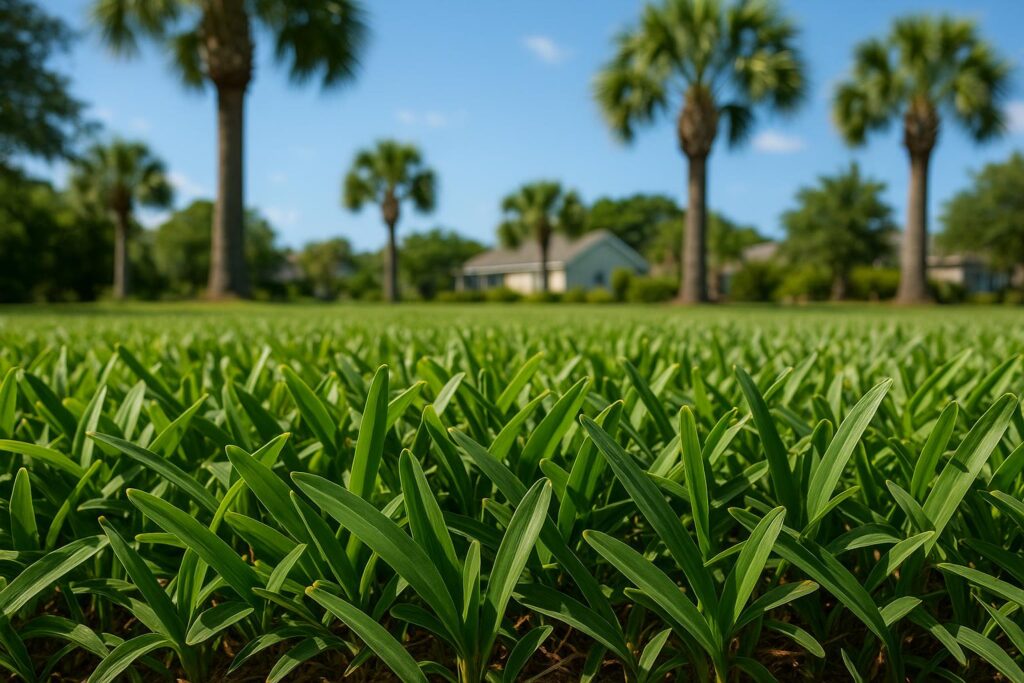
St. Augustine grass (Stenotaphrum secundatum) is identifiable by its distinctively wide, flat blades — significantly broader than centipede’s narrow leaf — with rounded tips and a coarse texture that feels dense and almost padded underfoot when the lawn is healthy. The stolons (above-ground runners) are also distinctive: thick, flat, and almost stem-like in appearance, running visibly across the surface rather than the finer, more grass-like stolons of centipede. The color of healthy St. Augustine ranges from a deep blue-green to a medium green, generally darker than centipede.
The two grasses are sometimes confused in thin or mixed stands, but a direct comparison of the leaf blade width makes identification straightforward — St. Augustine blades are typically two to three times wider than centipede blades. In North Myrtle Beach neighborhoods, some properties have both grass types present in different areas of the yard, particularly where shade or drainage patterns have favored one over the other over time.
St. Augustine vs. Centipede: Key Differences That Affect Management
The most consequential difference from a management perspective is fertilization. Centipede is a low-fertility grass that is genuinely harmed by excess nitrogen — it produces thatch, weakens roots, and increases pest susceptibility when over-fed. St. Augustine is a moderate-to-high-fertility grass that needs and responds well to higher nitrogen inputs. A fertilization program appropriate for St. Augustine would damage a centipede lawn, and a centipede program leaves St. Augustine nitrogen-starved and visibly thin. If you are applying the same fertilizer program to your St. Augustine lawn that your neighbor uses on centipede, you may be systematically under-feeding your turf.
Traffic tolerance is the second major difference. St. Augustine recovers from foot traffic and mechanical wear significantly faster than centipede, making it the better choice for yards with active children, pets, or frequent entertaining on the lawn. Centipede in high-traffic areas thins progressively over seasons — St. Augustine in the same conditions may thin during the heaviest-use periods but fills back in more aggressively during the growing season.
Shade Tolerance: Where St. Augustine Genuinely Outperforms
This is St. Augustine’s most significant practical advantage over centipede in North Myrtle Beach landscapes. While centipede requires a minimum of six hours of direct sun and fails progressively in anything less, St. Augustine performs acceptably in as little as four hours of filtered sunlight and handles the dappled shade under live oaks and large canopy trees far better than any other warm-season grass available for coastal SC installation. Properties with significant mature tree canopy that have struggled to maintain centipede in shaded areas often see dramatically better results when those areas are converted to St. Augustine.
The shade tolerance advantage has limits — St. Augustine does not succeed in true deep shade with less than three hours of daily sun, and no warm-season grass performs well under a dense, low-canopy live oak with year-round coverage. But in the large middle ground of partial shade and filtered light conditions that characterize most North Myrtle Beach residential lots with mature landscaping, St. Augustine’s shade tolerance is the decisive argument for choosing it over centipede.
Fertilization Requirements for St. Augustine in Coastal SC
St. Augustine in North Myrtle Beach performs well on three to four applications of nitrogen per year during the active growing season — significantly more than the one to two applications that are appropriate for centipede. A general annual nitrogen target for St. Augustine in coastal SC is three to four pounds of actual nitrogen per 1,000 square feet, applied in March, May, July, and optionally again in early September. Use a complete fertilizer (containing nitrogen, phosphorus, and potassium) for spring and early summer applications, and a maintenance fertilizer lower in phosphorus for mid and late season.
Iron supplements are valuable for St. Augustine on North Myrtle Beach’s sandy coastal soil, which can lock up iron at pH levels above 6.5. If your St. Augustine shows interveinal chlorosis — yellow blades with green veins — in summer, an iron sulfate foliar application provides fast greening while a longer-term soil pH correction addresses the underlying cause. St. Augustine showing uniform yellowing despite adequate fertilization and irrigation is often an iron availability issue rather than a nutrient deficiency per se.
Pest Vulnerabilities Specific to St. Augustine
St. Augustine is more susceptible to certain pests than centipede, and one in particular deserves close attention in coastal SC: the chinch bug. St. Augustine is actually the primary host grass for the southern chinch bug (Blissus insularis), which is the same species that damages centipede but feeds far more aggressively on St. Augustine under heat stress conditions. St. Augustine lawns in North Myrtle Beach should be inspected weekly for chinch bug activity from June through September — the infestation pattern (yellow patches concentrated in hot, sunny edges) and the flotation test identification method are the same as for centipede, but the feeding intensity and potential damage rate are higher.
SAD — St. Augustine Decline — is a viral disease specific to St. Augustine that does not affect centipede. Infected plants show chlorotic mottling on leaf blades, stunted growth, and gradual decline that spreads through the lawn over multiple seasons. There is no cure once a lawn is infected, and the practical response is replacing infected turf with a SAD-resistant variety such as Floratam or Raleigh when renovation becomes necessary. Using a Floratam or SAD-resistant variety from the outset is the best prevention strategy.
Mowing Height and Frequency for St. Augustine
St. Augustine is mowed significantly higher than centipede. The correct mowing height range for St. Augustine in North Myrtle Beach is 3 to 4 inches, with 3.5 inches being the ideal target for most properties. Mowing lower than 3 inches scalps the coarse stolons, removes too much leaf area, and produces a ragged, brown appearance that invites weed encroachment into the thinned surface. The grass does not tolerate the low-mow aesthetic that some homeowners prefer from centipede or bermudagrass.
Mowing frequency in the growing season is similar to centipede — weekly during the June through September peak growth period, tapering to every 10 to 14 days as growth slows in fall. St. Augustine’s broad leaf blades require a sharp mower blade more critically than finer-textured grasses; a dull blade tears rather than cuts, leaving ragged blade ends that turn tan at the tips and look significantly worse than a clean-cut lawn. Sharpening the mower blade once in spring and once mid-season is the minimum maintenance for maintaining good appearance on a St. Augustine lawn.
Frequently Asked Questions
Is St. Augustine or centipede better for North Myrtle Beach?
Neither is universally better — the right choice depends on your specific property conditions. Centipede is the lower-maintenance choice for full-sun, low-traffic yards with the sandy acidic soil that dominates the Grand Strand. St. Augustine is the better choice for shady properties, high-traffic areas, yards near salt water, and homeowners who want a denser, darker green appearance and are willing to invest in higher fertilization and more active pest monitoring.
Why does my St. Augustine lawn look yellow despite regular watering and fertilization?
Yellowing in St. Augustine despite watering and fertilization usually indicates iron deficiency caused by high soil pH — a condition where iron is present in the soil but chemically unavailable to roots. Check soil pH; if it is above 6.5, apply a foliar iron sulfate spray for immediate greening and begin a soil acidification program with elemental sulfur for lasting correction.
How often should I fertilize St. Augustine grass in North Myrtle Beach?
St. Augustine in coastal SC benefits from three to four fertilizer applications per year during the active growing season: early spring (March), late spring (May), mid-summer (July), and optionally early fall (September). Use a balanced fertilizer with controlled-release nitrogen for best results and avoid application after mid-September to allow the grass to harden off before winter.
What is the best mowing height for St. Augustine in coastal SC?
Mow St. Augustine at 3 to 4 inches, with 3.5 inches as the ideal target for most North Myrtle Beach properties. Never cut lower than 3 inches, which scalps the stolons and produces the ragged, thin appearance that allows weed encroachment. St. Augustine is a tall-mow grass — resist the temptation to cut it lower for a neater look.
Can I mix St. Augustine and centipede grass in the same lawn?
The two grasses can coexist in different areas of a property where conditions naturally favor one over the other, but they require meaningfully different fertilization programs and should not be treated as a single uniform lawn. Over time, the grass best adapted to each area’s conditions will naturally dominate that zone, which is generally the appropriate outcome.
Does KeckCo maintain St. Augustine lawns in North Myrtle Beach?
Yes. KeckCo Turf and Ornamental Services provides lawn maintenance, fertilization, pest management, and renovation services for St. Augustine lawns throughout North Myrtle Beach, Little River, and the Grand Strand. We tailor management programs to St. Augustine’s specific nutritional and pest monitoring requirements. Call 843-273-0735.
St. Augustine is a genuine high performer in the right conditions on the Grand Strand — and a disappointment in the wrong ones. Shade tolerance, salt tolerance, and traffic resilience are its clear strengths. Higher fertilization requirements and chinch bug vulnerability are the management realities that come with it. Matching the grass type to the property conditions and then managing it correctly for what it actually is — not what centipede needs — is what produces the lush, dense results that St. Augustine, at its best, delivers consistently.
Questions about whether St. Augustine is right for your North Myrtle Beach property?
KeckCo Turf and Ornamental Services evaluates grass type selection and manages both St. Augustine and centipede lawns throughout the Grand Strand. Call us for a property assessment.