
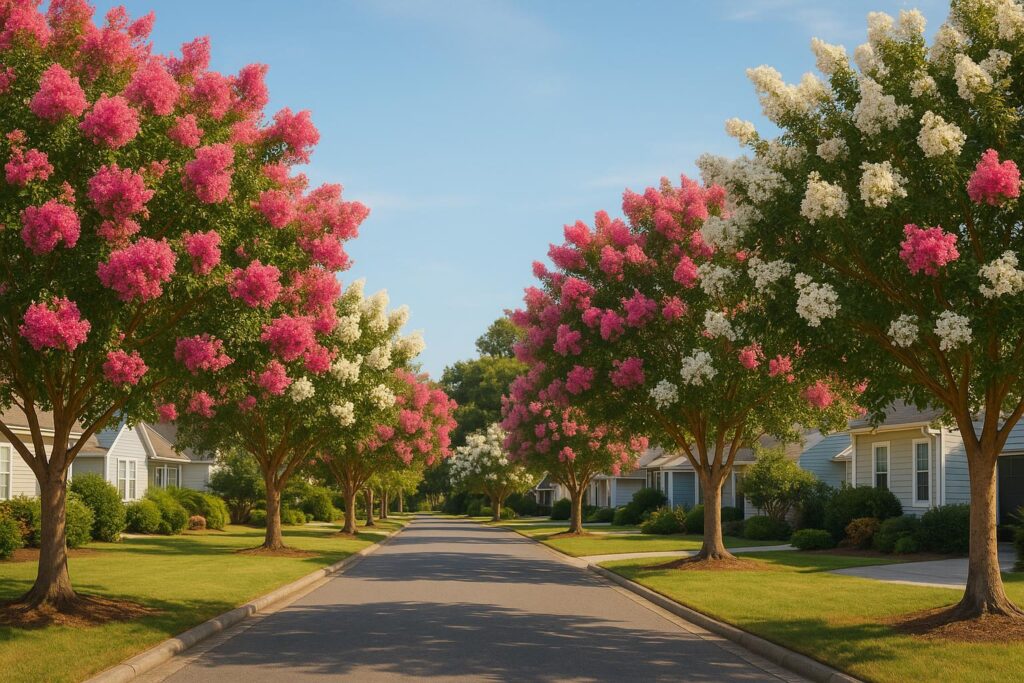
Crape myrtles are the signature ornamental tree of North Myrtle Beach — they are everywhere, they bloom for months through summer and into fall, and they tolerate coastal heat, sandy soil, and salt air with a resilience that most ornamentals cannot match. They are also one of the most consistently abused trees in American landscapes, subjected to a pruning practice so damaging and so widespread that arborists have given it a name: crape murder. Understanding what crape myrtles actually need in fall — and what they most definitively do not — is the difference between trees that get more beautiful every year and trees that are permanently disfigured while still technically alive.
At KeckCo Turf and Ornamental Services, crape myrtle care is part of what we manage on landscape properties throughout the Grand Strand. Here is what fall means for this iconic coastal tree and how to set it up for a strong showing next year.
- Understanding the fall bloom and what comes after
- When to stop fertilizing and why it matters
- The pruning timing question — and the definitive answer
- Crape murder: what it is, why it happens, and why to stop
- What correct crape myrtle pruning actually looks like
- Fall pest and disease checks
- Frequently Asked Questions
Understanding the Fall Bloom and What Comes After
Crape myrtles in North Myrtle Beach typically reach their peak bloom in July and August, with a secondary bloom flush in September on many varieties. This fall flush, while usually less dramatic than the midsummer peak, can be quite beautiful and extends the ornamental value of these trees well into September and sometimes October on the Grand Strand. The fall bloom is triggered by the same conditions as the summer bloom — warmth and active vegetative growth — and represents the tree’s final growth push before fall temperatures signal it to begin hardening off for winter.
After the fall bloom, crape myrtles begin a natural transition toward dormancy that mirrors what is happening to the rest of the warm-season landscape. Flower clusters develop into seed heads that provide visual interest and wildlife food through fall and winter. Foliage begins developing the orange, red, and yellow fall color that many varieties display quite dramatically before leaves drop in November and December. The tree is not declining — it is cycling through a natural seasonal arc that is worth observing and respecting rather than interrupting with aggressive intervention.
When to Stop Fertilizing and Why It Matters
Stop fertilizing crape myrtles with nitrogen by mid-August in North Myrtle Beach — September at the absolute latest. Nitrogen applied in fall stimulates new vegetative growth at exactly the time the tree is trying to harden off its existing tissue in preparation for winter. This new growth is soft, immature, and highly vulnerable to cold damage from the hard freeze events that occur several times per winter in coastal Horry County. A crape myrtle that is pushing new growth in October because of late-season nitrogen is not more vigorous — it is more vulnerable, and the tender tips of that new growth are often the first material to be killed by a January freeze.
If you have a regular fertilization program for your crape myrtles, plan the last nitrogen application for late July or early August, giving the tree time to process and harden that growth before fall arrives. A light application of potassium — which does not stimulate the soft growth that nitrogen does but does support cold hardiness — can be applied in September or early October without the same risk.
The Pruning Timing Question — and the Definitive Answer
The single most important thing to understand about crape myrtle pruning timing is this: fall is the wrong time. Do not prune crape myrtles in fall — not light shaping, not deadheading the spent seed heads, and certainly not significant structural cutting. The correct window for any crape myrtle pruning is late winter, specifically late January through early March in North Myrtle Beach, just before the first signs of spring growth emerge. Pruning in fall removes the woody material that provides some cold protection to branch tips, stimulates growth responses that conflict with winter hardening, and eliminates the seed heads that provide winter interest and wildlife food value.
The temptation to prune in fall is understandable — the tree looks messy after bloom, the seed heads are not universally attractive, and there is a natural impulse to tidy up. Resist that impulse. The seed heads are not damaging the tree, they will not cause problems over winter, and removing them in fall costs more than the tidiness they provide is worth. The tree knows what it is doing with its own seasonal cycle, and intervening against that cycle with fall pruning consistently produces worse outcomes than waiting for the correct late-winter window.
Crape Murder: What It Is, Why It Happens, and Why to Stop
Crape murder is the practice of cutting crape myrtles back to large, flat stubs — either at a specific height (typically 6 to 10 feet from the ground) or at the main trunk — leaving a forest of blunt stumps that bear no resemblance to the natural structure of the tree. This practice is so named because it is genuinely damaging: the tree responds to this severe mutilation by producing masses of vigorous, vertical water sprouts from the cut points, the stubs never heal cleanly, the natural elegant form of the tree is permanently destroyed, and the cut surfaces become entry points for decay and disease that the tree carries for the rest of its life.
Crape murder is unfortunately widespread in coastal SC and throughout the South, perpetuated by the widespread but incorrect belief that crape myrtles bloom on new growth and therefore need to be cut back hard every year to promote flowering. This is not true — crape myrtles bloom on both current-season growth and the tips of last year’s branches, and the best blooming specimens are those that have never been topped. The practice originated as a misapplication of pruning principles from other plant types and spread through observation of neighbors’ practices without questioning whether the underlying rationale was accurate.
What Correct Crape Myrtle Pruning Actually Looks Like
Correct crape myrtle pruning in late winter accomplishes four things without destroying the natural form: it removes the previous season’s seed heads at their point of attachment to the branch; it removes any crossing, rubbing, or inward-growing branches that clutter the interior canopy; it raises the canopy skirt by removing suckers at the base and low-growing side branches below a desired clearance height; and it removes any dead or damaged material from the previous season. None of this requires cutting any branch larger than the diameter of a finger.
The signature characteristic of a correctly pruned crape myrtle is that after pruning, it still looks like a crape myrtle — with its natural vase shape, gracefully arching branches, and the attractive exfoliating bark that develops on mature specimens. A correctly pruned tree should require no justification or apology. If the result after pruning looks like a row of fence posts or telephone poles, the pruning method was wrong.
Fall Pest and Disease Checks
Two conditions are worth checking on crape myrtles as summer transitions to fall in North Myrtle Beach. Powdery mildew — a fungal disease that appears as a white, powdery coating on leaves and new growth — is common on crape myrtles in the humid coastal climate, particularly on older non-resistant varieties. Mild infestations are cosmetic and resolve on their own as temperatures cool and humidity drops in fall. Severe infestations on trees that repeatedly suffer from powdery mildew are best addressed over the long term by selecting and replanting with mildew-resistant varieties rather than repeated fungicide applications.
Crape myrtle aphids — a specific aphid species that feeds only on crape myrtles — can cause significant late-summer damage manifesting as yellowed, distorted leaves, heavy honeydew deposits on lower branches and surrounding surfaces, and the black sooty mold that grows on honeydew deposits. If aphid populations are still active in September, a late-season treatment with insecticidal soap or a systemic insecticide controls the population before winter. Left untreated, aphids typically decline naturally as temperatures fall, but sooty mold deposits on surfaces below the tree may require pressure washing in the fall cleanup.
Frequently Asked Questions
When should crape myrtles be pruned in North Myrtle Beach?
Late January through early March is the correct pruning window for crape myrtles in coastal SC — just before the first signs of spring growth. Never prune in fall, which removes cold protection and stimulates growth that conflicts with winter hardening. Correct pruning removes seed heads, crossing branches, suckers at the base, and dead material without cutting any branch larger than finger diameter.
What is crape murder and how do I avoid it?
Crape murder is the practice of cutting crape myrtles back to flat stubs — topping them at 6 to 10 feet or cutting back to the main trunk. This permanently destroys the natural form, creates decay entry points that persist for the life of the tree, and produces masses of weak water sprouts from the cut surfaces. Avoid it by limiting pruning to the selective removal of small branches and suckers rather than any significant reduction of the main branch structure.
Should I cut off the seed heads on my crape myrtles in fall?
No. Leave seed heads on crape myrtles through fall and winter — they provide visual interest, wildlife food value, and removing them in fall provides no benefit to the tree. Remove them in late winter as part of the annual light pruning at the correct timing window, cutting each seed head cluster at its point of attachment to the branch rather than cutting the branch itself.
Why does my crape myrtle have black powder on its leaves?
Black powder on crape myrtle foliage is sooty mold — a fungus that grows on the honeydew secreted by crape myrtle aphids. The mold itself does not directly damage the tree, but the aphid infestation causing it may warrant treatment. On surfaces below the tree (patios, vehicles, lawn furniture), sooty mold deposits typically require pressure washing to remove after the infestation is controlled.
How long do crape myrtles bloom in North Myrtle Beach?
Crape myrtles in North Myrtle Beach typically bloom from June through September, with peak bloom in July and August and a secondary flush in September on many varieties. The total bloom duration of 90 to 120 days is one of the longest of any ornamental flowering tree available for coastal SC landscapes, which is a significant part of what makes them so dominant in Grand Strand residential plantings.
Does KeckCo provide crape myrtle pruning and care in North Myrtle Beach?
Yes. KeckCo Turf and Ornamental Services includes crape myrtle pruning in our ornamental care programs throughout North Myrtle Beach and the Grand Strand. We prune at the correct late-winter timing using correct technique — never topping — to maintain natural form and structure year over year. Call 843-273-0735.
The crape myrtles in your North Myrtle Beach yard are among the most naturally low-maintenance ornamental trees you could have chosen — they want very little from you other than reasonable growing conditions and the discipline to leave them alone in the fall when the urge to tidy up is strongest. Give them that respect, schedule their pruning correctly in late winter, and they will reward you with decades of increasingly spectacular bloom from increasingly beautiful trees.
Want your crape myrtles pruned correctly this winter?
KeckCo Turf and Ornamental Services prunes crape myrtles and manages ornamental landscapes throughout North Myrtle Beach and the Grand Strand — always correctly, never with a topping saw.