
Every season on the Grand Strand has a case to be made for sod installation — spring’s moderate temperatures, summer’s fast growth, winter’s slow establishment demand — but September is the month that consistently outperforms every other on the calendar for new turf success in North Myrtle Beach. The conditions that converge in September create a window that is unlikely to be matched at any other point in the year, and homeowners who plan around it rather than installing out of convenience in other months see the difference clearly in how well their new turf establishes.
At KeckCo Turf and Ornamental Services, we install more sod in September and October than in any other two-month period, and we do it deliberately. Here is what makes this window so valuable and how to make the most of it.
- Why September produces the best sod establishment results
- How September compares to spring, summer, and winter installation
- Site preparation before sod goes down
- Installation day: what to expect and what to insist on
- The critical four weeks after installation
- Mistakes that kill new sod before it roots
- Frequently Asked Questions
Why September Produces the Best Sod Establishment Results
Sod establishment is fundamentally a root development challenge. The cut sod has lost its connection to the ground it was grown in, and every day between harvest and installation the root system degrades. Once installed, it needs to push new roots into the prepared soil below quickly enough to sustain itself before those original roots fail entirely. The conditions that most favor rapid root establishment are: warm soil temperatures that drive root metabolism, moderate air temperatures that reduce the shoot’s water demand, and reliable moisture availability in the root zone without the waterlogging that would deprive roots of oxygen.
September in North Myrtle Beach hits all three. Soil temperatures in early September on the Grand Strand run between 72°F and 78°F — warm enough for vigorous root growth but well below the peak stress temperatures of July and August that can outpace root development in freshly installed sod. Air temperatures moderate progressively through the month, reducing the evapotranspiration demand that forces new sod to rely on its limited root system before that system is adequately established. And September in coastal Horry County brings more consistent and reliable rainfall than the dry-then-deluge summer pattern, supplementing irrigation more evenly through the establishment period.
How September Compares to Spring, Summer, and Winter Installation
Spring installation — April through May — is the second-best window in coastal SC. Soil temperatures are rising, root development is active, and the moderate temperatures before summer heat arrives give new sod a reasonable establishment window. The limitation is that spring-installed sod faces its first summer stress within 8 to 10 weeks of installation, before roots have had time to develop the deep, drought-resilient system that makes established turf weather the season well. New spring sod needs intensive irrigation management through July and August to survive its first summer without setback.
Summer installation — June through August — is the most challenging window. Heat stress on freshly cut sod arrives immediately, evapotranspiration demand is at its annual peak, pest pressure from chinch bugs and grubs falls precisely on the period when the new root system is least capable of supporting recovery, and the daily irrigation demands are highest precisely when water costs most. Summer sod can succeed with very attentive management, but failure rates are meaningfully higher than fall or spring installation and the management burden is substantially greater. Winter installation in coastal SC is possible — unlike northern climates, the ground does not freeze and some root development continues — but growth is slow, the turf enters dormancy before substantial establishment can occur, and the new sod faces a long winter of vulnerability before spring growth allows meaningful recovery of weaknesses in the installation.
Site Preparation Before Sod Goes Down
1Kill existing vegetation completely. Apply a non-selective herbicide (glyphosate) to the entire installation area and allow 10 to 14 days for full kill-down. A second application on persistent weeds is better than installing over partially killed vegetation that regrows through the new sod.
2Remove dead material. Scalp-mow and dethatch or vacuum the killed vegetation. New sod needs direct contact with prepared soil to root — thatch and dead organic matter between the sod and the soil significantly delay or prevent rooting.
3Correct the soil. This is the step most homeowners skip and most regret. If a soil test has identified pH issues — common in North Myrtle Beach where soil tends toward alkalinity in developed areas — apply elemental sulfur now so it has time to begin working before the sod goes down. Grade any low spots that cause standing water. Light topdressing with quality sandy loam improves soil structure where existing soil is extremely poor.
4Apply starter fertilizer. A phosphorus-forward starter fertilizer applied immediately before sod installation provides immediate nutritional support for root development without the flush of top growth that high-nitrogen products cause. Work it lightly into the top inch of soil before laying sod.
5Irrigate the prepared soil 24 hours before installation so the root zone is moist but not waterlogged when the sod arrives.
Installation Day: What to Expect and What to Insist On
Freshly cut sod begins degrading within hours of harvest, and the gap between harvest and installation is one of the most important quality variables in any sod project. Insist on sod that was harvested the same day or the previous day, kept moist, and stored in the shade rather than stacked in direct sun. Sod that arrives hot, dry, or yellowing at the cut edges has already lost establishment capacity that cannot be recovered once it is in the ground.
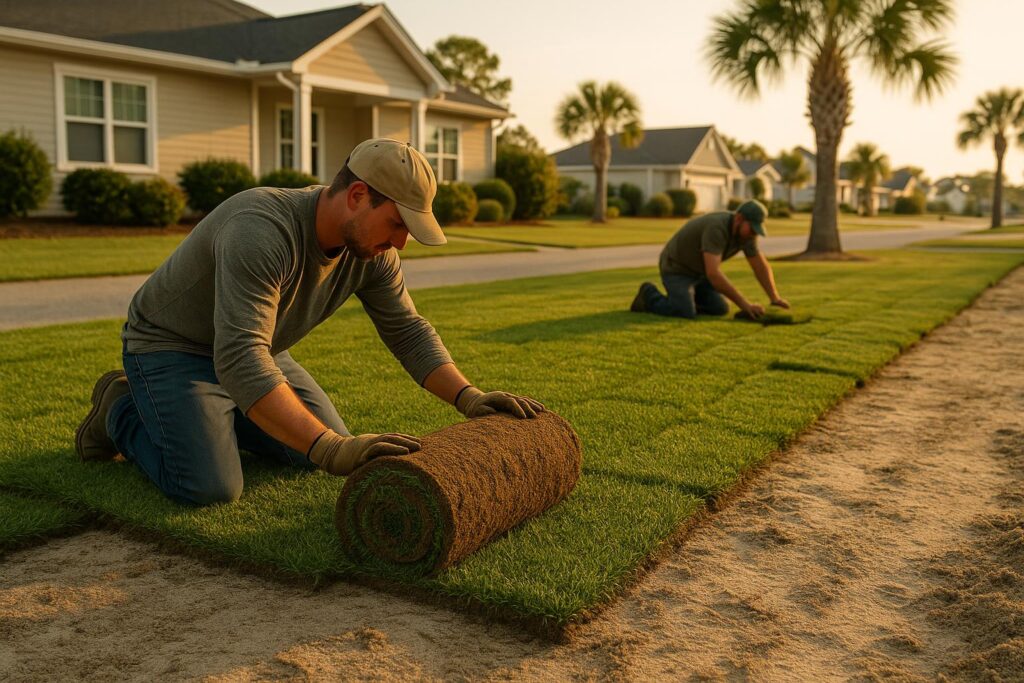
During installation, each sod piece should be placed tightly against adjacent pieces with joints staggered in a brick-like pattern — gaps between pieces allow soil drying and weed germination that compromises the installation’s uniformity. After all pieces are placed, the sod should be rolled with a water-filled sod roller to press it firmly against the soil surface and eliminate air pockets beneath the pieces. This firm contact between the sod underside and the prepared soil is what initiates rooting — skipping the rolling step is one of the most common professional installation shortcuts that homeowners should specifically confirm is being done.
The Critical Four Weeks After Installation
The establishment window for fall-installed sod in North Myrtle Beach runs four to six weeks, during which the sod is transitioning from surviving on the original harvested root system to sustaining itself on new roots it has pushed into the prepared soil. This transition period has specific irrigation requirements that differ from normal lawn irrigation and must be followed carefully to avoid both drying out (which kills new roots) and waterlogging (which deprives roots of oxygen).
Weeks one and two require daily irrigation — enough to keep the sod surface consistently moist without ponding. The goal is maintaining moisture in the sod-soil contact zone where new roots are initiating. In week three, as rooting is confirmed by gentle resistance to tugging, reduce to every-other-day irrigation of greater depth to encourage roots to chase moisture deeper into the soil. By week four, transition to normal irrigation scheduling appropriate for the season. The first mow should wait until the sod resists being pulled up when you tug firmly on a corner — this confirmation of rooting is the right trigger, not a calendar date.
Mistakes That Kill New Sod Before It Roots
The most common and most devastating mistake is installing sod over soil that has not been adequately prepared — particularly over compacted soil with a thatch or debris layer that prevents direct sod-to-soil contact. Sod laid on top of uncleared thatch or debris simply cannot root into the underlying soil and fails within weeks even with perfect irrigation. The preparation investment is what the installation success is built on.
The second most common mistake is reducing irrigation too quickly in the belief that the sod looks healthy and does not need continued close attention. New sod can look established while roots are still shallow and fragile — a single missed irrigation day during a heat event in the first three weeks can set back or kill the root system before it has grown deep enough to be resilient. Follow the full four-week establishment protocol regardless of how the surface looks, and let the tug test rather than visual appearance confirm that normal watering can begin.
Frequently Asked Questions
How much does sod installation cost in North Myrtle Beach?
Sod installation costs in the North Myrtle Beach area typically range from $0.60 to $1.20 per square foot for centipede or St. Augustine sod itself, plus site preparation and labor. Total installed project costs for an average residential lawn of 3,000 to 5,000 square feet commonly run between $2,500 and $6,000 depending on preparation requirements, site access, and the extent of any grading or drainage work needed. KeckCo provides detailed quotes based on individual property assessment.
How long after September sod installation before I can use my lawn normally?
Most September-installed sod in North Myrtle Beach is ready for normal foot traffic four to six weeks after installation, once rooting is confirmed by the tug test. Avoid heavy use — children playing, pet activity, lawn furniture — during the first four weeks. The sod can be mowed once it resists tugging firmly, typically around week three to four of establishment.
What grass type should I use for September sod installation in North Myrtle Beach?
Centipede grass is the standard choice for most North Myrtle Beach residential properties — it is well-adapted to coastal SC’s sandy soil, low fertility requirements, salt air, and the moderate shade tolerance needed for many residential lots. St. Augustine is the better choice for shadier properties or areas needing higher traffic tolerance. Zoysiagrass is worth considering for premium applications requiring the highest turf density and traffic resistance.
Can I install sod myself or do I need a professional?
Small repairs and patches — under a few hundred square feet — are manageable DIY projects for homeowners comfortable with physical labor and willing to follow proper preparation and establishment protocols. Full lawn renovation of several thousand square feet benefits strongly from professional installation for site preparation accuracy, sod quality sourcing, and the rolling and irrigation setup that significantly affect establishment outcomes.
How soon before winter is too late to install sod in coastal SC?
Mid-October is generally the latest reliable window for centipede and St. Augustine sod installation in coastal Horry County. Sod installed after mid-October has insufficient time to root before growth slows as soil temperatures approach 60°F. Late-October or November installation is possible in mild years but carries meaningfully higher failure risk and should be approached cautiously.
Does KeckCo install sod in North Myrtle Beach in September?
Yes. KeckCo Turf and Ornamental Services provides complete sod installation services including site preparation, sod sourcing, installation, and post-establishment guidance for residential properties throughout North Myrtle Beach, Little River, and the Grand Strand. September is our busiest installation month — call 843-273-0735 now to get on the fall schedule before it fills.
September is not just a good time to install sod in North Myrtle Beach — it is the best time, and the window is shorter than it feels. Soil temperatures begin their descent toward the threshold that slows root development in October, and the fall schedule for sod contractors fills quickly once homeowners who have been planning a renovation all summer finally move forward. If a new lawn is on your agenda for this fall, the time to schedule it is now, not when September is half over.
Ready to install new sod this September?
KeckCo Turf and Ornamental Services installs centipede and St. Augustine sod throughout North Myrtle Beach and the Grand Strand. Fall slots fill fast — call us today.