

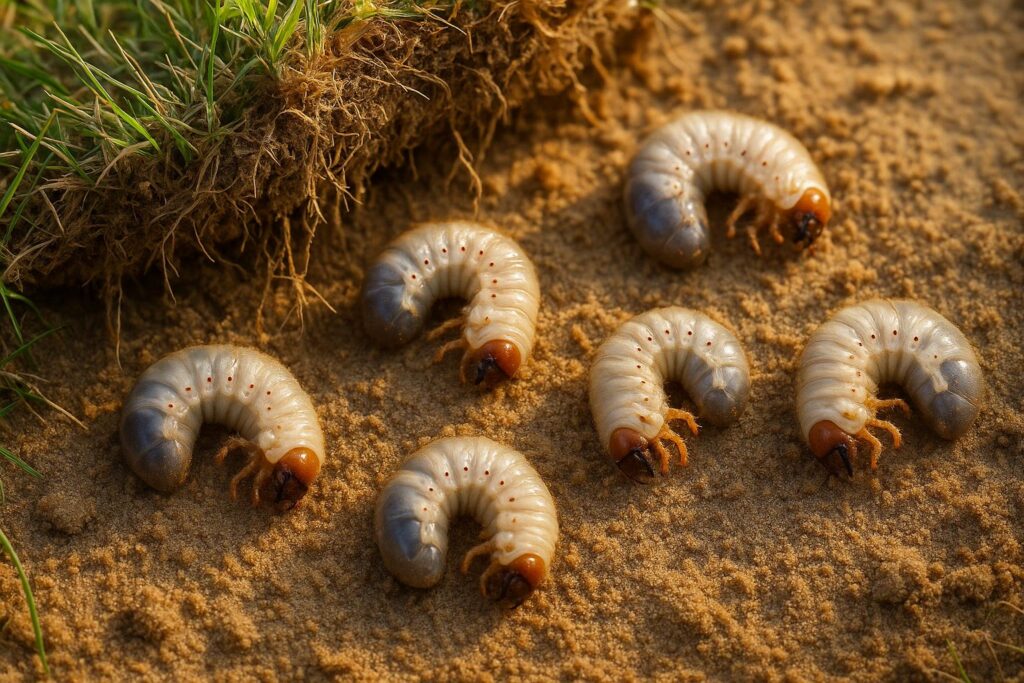
Here is what makes grubs so destructive in coastal South Carolina: by the time you see the damage, the worst of it has already happened underground. White grubs — the larvae of beetles like the Japanese beetle and masked chafer — hatch in summer, spend weeks feeding on grass roots just beneath the soil surface, and leave behind patches of turf that look drought-stressed right up until you tug on the grass and it lifts off the ground like a loose rug.
July is the month that determines whether your North Myrtle Beach lawn will have a grub problem this fall. Adult beetles are laying eggs in your lawn right now, and the window to intercept those eggs before they hatch into feeding larvae is narrow. Miss it, and you are managing damage instead of preventing it.
The Grub Lifecycle and Why July Is Critical
Adult beetles — most commonly Japanese beetles and June bugs along the Grand Strand — emerge in late spring and early summer, feed on ornamental plants, and then lay their eggs in turf just below the soil surface in June and July. Those eggs hatch into small white C-shaped larvae (grubs) within 2–3 weeks. In late summer, these young grubs feed voraciously on grass roots at a depth of just 1–3 inches — shallow enough to sever the entire root system of a centipede or St. Augustine lawn.
By September, grubs burrow deeper into the soil to overwinter, and the damage is done. The key insight: preventive grub treatments work by killing newly hatched larvae before they reach a damaging size and depth. That window falls squarely in July. Products applied in August or September face mature, deep-feeding grubs that are far harder to control.
Signs Your Lawn May Already Have Grubs
The most telltale sign of grub damage is turf that looks drought-stressed in irregular patches despite adequate irrigation. When you press on the affected area, it may feel spongy, and when you pull on the grass, entire sections lift away from the soil because the roots have been eaten through. This “loose carpet” test is the definitive field diagnosis for active grub feeding.
Secondary signs include increased bird activity — starlings, crows, and mockingbirds — probing and pecking the lawn in concentrated areas. Armadillos and moles, both common in coastal Horry County, follow active grub populations and will tear up turf while foraging. If you are seeing animal digging alongside patchy browning, grubs are very likely the underlying cause.
How Sandy Coastal Soil Affects Grub Activity
North Myrtle Beach’s sandy, well-draining soil creates both advantages and challenges for grub control. Sandy soil is easy for grubs to move through, and the loose particle structure means root damage spreads quickly because turf has less physical support. On the positive side, saturated soil is less hospitable to egg survival, and fast drainage means waterlogged conditions rarely persist.
Sandy soil also affects how grub control products move through the soil profile. Granular preventive treatments need water activation to move into the root zone — in sandy soil, they can move through too quickly if over-irrigated after application. Following label irrigation guidelines carefully is especially important in coastal SC’s loose soil conditions.
Preventive Treatment: Timing and Product Selection
1Choose the right product for the timing. Chlorantraniliprole (sold as Acelepryn) is the gold standard — it can be applied from late May through July and remains effective for months. Imidacloprid and thiamethoxam are also effective preventives but have a narrower window and should be applied specifically in June or July.
2Apply evenly across the lawn. Use a broadcast spreader for granular products and a calibrated sprayer for liquid formulations. Uneven coverage leaves untreated zones where grubs can establish and spread.
3Water in immediately after application. Most preventive grub products need at least 0.5 inches of irrigation to move them into the soil root zone. Apply in the morning and run irrigation immediately after, or apply before a forecasted rain event.
4Avoid nitrogen fertilizer at the same time. Nitrogen pushes new root growth, which can actually attract higher grub feeding. Hold any scheduled fertilization until after the grub treatment has been watered in and settled for a few days.
What to Do If Grubs Are Already Active
If you discover grubs mid-season after the preventive window has passed — confirmed by the loose-carpet test or visible larvae in the soil — you need a curative product rather than a preventive one. Trichlorfon (marketed as Dylox) acts quickly on mature grubs and is the most commonly used curative option. It breaks down faster in the environment, so timing and water activation are both critical.
After treating an active infestation, the affected turf will need recovery support. Keep the area irrigated appropriately, avoid heavy foot traffic, and resist the urge to fertilize with nitrogen immediately. In cases where large areas were completely stripped of roots, sodding damaged sections is often faster than waiting for the grass to spread naturally from surrounding areas.
Common Mistakes with Grub Control
The most common mistake is waiting until visible damage appears before treating. At that point, preventive products are ineffective and the damage is already done. Treating in July — even without confirmed grub presence — is worthwhile on any lawn that had grub activity in previous years or sits in an area with heavy beetle populations.
The second most common mistake is under-irrigating after treatment. Granular grub products sitting on the surface are doing nothing — they need water to carry them into the soil. Many homeowners apply a product, see no immediate result, and assume it is not working, when the real issue is that the product never reached the target zone.
Frequently Asked Questions
How do I know if my lawn has grubs or just drought stress?
The definitive test is the tug test: grab a handful of the brown turf and pull firmly. If it peels away from the soil like a loose mat with little root resistance, grubs have eaten the root system. Drought-stressed grass resists pulling because roots are still intact.
Are grubs common in North Myrtle Beach?
Yes. The Grand Strand area has healthy populations of Japanese beetles, masked chafers, and June bugs, all of which lay eggs in residential turf. Sandy coastal soil is particularly hospitable for egg survival and larval movement, making grub pressure a routine concern for North Myrtle Beach homeowners.
Can I use a natural or organic grub treatment?
Beneficial nematodes and Bacillus thuringiensis galleriae (Btg) are biological options with some effectiveness against young grubs. They require careful timing and moist soil application, and their efficacy tends to be lower than synthetic options. They work best as part of an integrated pest management approach rather than as standalone treatments.
Will grubs come back every year if I treat once?
Grub pressure varies year to year based on adult beetle populations and weather patterns. A single preventive treatment handles one season but does not eliminate future risk. Properties with a history of grub damage benefit from an annual preventive application each July as part of a complete summer lawn care program.
Does KeckCo offer grub prevention treatments?
Yes. KeckCo Turf and Ornamental Services offers grub prevention treatments for residential properties throughout North Myrtle Beach, Little River, and the Grand Strand. We can also include grub prevention as part of a complete seasonal lawn care program.
What time of year should I treat for grubs in Horry County?
The preventive treatment window in Horry County and coastal SC is generally late June through mid-July, targeting eggs and newly hatched larvae. Curative treatments can be applied through August for existing infestations but are less effective on mature larvae than preventive applications made in the correct window.
Grub control is one of those lawn care tasks where timing is everything and the cost of waiting is measured in dead turf. If you are in North Myrtle Beach and your property had grub damage last fall — or if you are seeing beetles on your ornamental plants this summer — July is the time to protect your lawn, not September when the damage is already visible.
Protect your lawn from grubs this July
KeckCo Turf and Ornamental Services applies professional grub prevention treatments throughout North Myrtle Beach and the Grand Strand. Call us before the treatment window closes.