
Is Summer a Good Time to Install Sod in Coastal SC? (Pros, Cons, and What Actually Works)
It’s a question that comes up every summer along the Grand Strand: the lawn has a bare patch, a storm took out a section of turf, or a homeowner is finally ready to replace a yard that’s never looked right — and they want to know if summer is too late to install sod. The honest answer is that summer sod installation in coastal South Carolina is possible and can work well, but it’s not the same as spring or fall installation. The stakes are higher, the establishment window is more demanding, and the margin for error is narrower. Done right, summer sod takes root quickly in warm coastal soil. Done carelessly, it dries out and fails within days.
This guide breaks down the real pros and cons of summer sod installation in North Myrtle Beach, what the right approach looks like from site prep through establishment, and what to know about sod selection for coastal SC’s specific soil and climate conditions.
The Real Advantages of Summer Sod Installation in Coastal SC
Summer isn’t the ideal window for sod installation — but it’s not without genuine advantages, particularly in a coastal South Carolina climate that behaves differently than the national averages most sod guides are written around.
Warm soil accelerates rooting. Centipede and St. Augustine grass root most aggressively when soil temperatures are above 70°F. In North Myrtle Beach, soil temperatures from June through September stay comfortably in that range — often hitting 80°F or higher at sod depth. This warm soil environment drives faster initial rooting than fall or early spring installation, where cooling soil temperatures slow the establishment process considerably. A sod piece installed in July in Horry County’s warm sandy soil can show root development within a week. The same piece installed in October may take three weeks to show comparable progress.
Warm-season grasses are actively growing. Centipede and St. Augustine are in their peak growth phase in summer. Active metabolic processes mean the grass is ready to push new roots and spread — the plant’s biology is working in favor of establishment rather than against it. Installing warm-season sod during its natural active growth window aligns with how the grass wants to behave.
Frequent summer rain supplements irrigation. North Myrtle Beach averages over five inches of rain in both July and August. While supplemental irrigation is still essential — natural rainfall is too inconsistent to rely on for establishment-frequency watering — summer storms can meaningfully reduce the irrigation burden compared to a dry spring installation window.
Visible results appear quickly. For homeowners who want a finished-looking lawn for the remainder of summer — for outdoor entertaining, property value, or simply aesthetics — summer installation with proper care can produce a presentable lawn within three to four weeks, before the season ends.
The Risks That Make Summer Installation More Demanding
The same heat that drives fast rooting in summer also creates the primary risk factor: evaporative demand that exceeds a new sod’s ability to absorb water before its roots are established. A sod piece sitting on top of sandy coastal soil in 95°F heat with no root system yet developed can desiccate within hours if water is withheld. This is not a theoretical risk — it’s the leading cause of summer sod failure in North Myrtle Beach installations.
The establishment window is unforgiving. In spring or fall, a new sod installation can survive a missed watering or a day of neglect without catastrophic consequences. In summer, a single day without adequate moisture during the first week of establishment can kill newly laid sod before roots ever develop. This is especially true in North Myrtle Beach’s fast-draining sandy soil, which holds very little moisture reserve at the surface where new sod roots are trying to establish.
Heat stress compounds any installation error. Sod that is poorly graded, has gaps between pieces, or was laid over existing vegetation has reduced soil contact — and in summer heat, reduced soil contact means accelerated drying. Errors in site preparation or installation technique that might be survivable in cooler months become lethal to new sod in July and August heat.
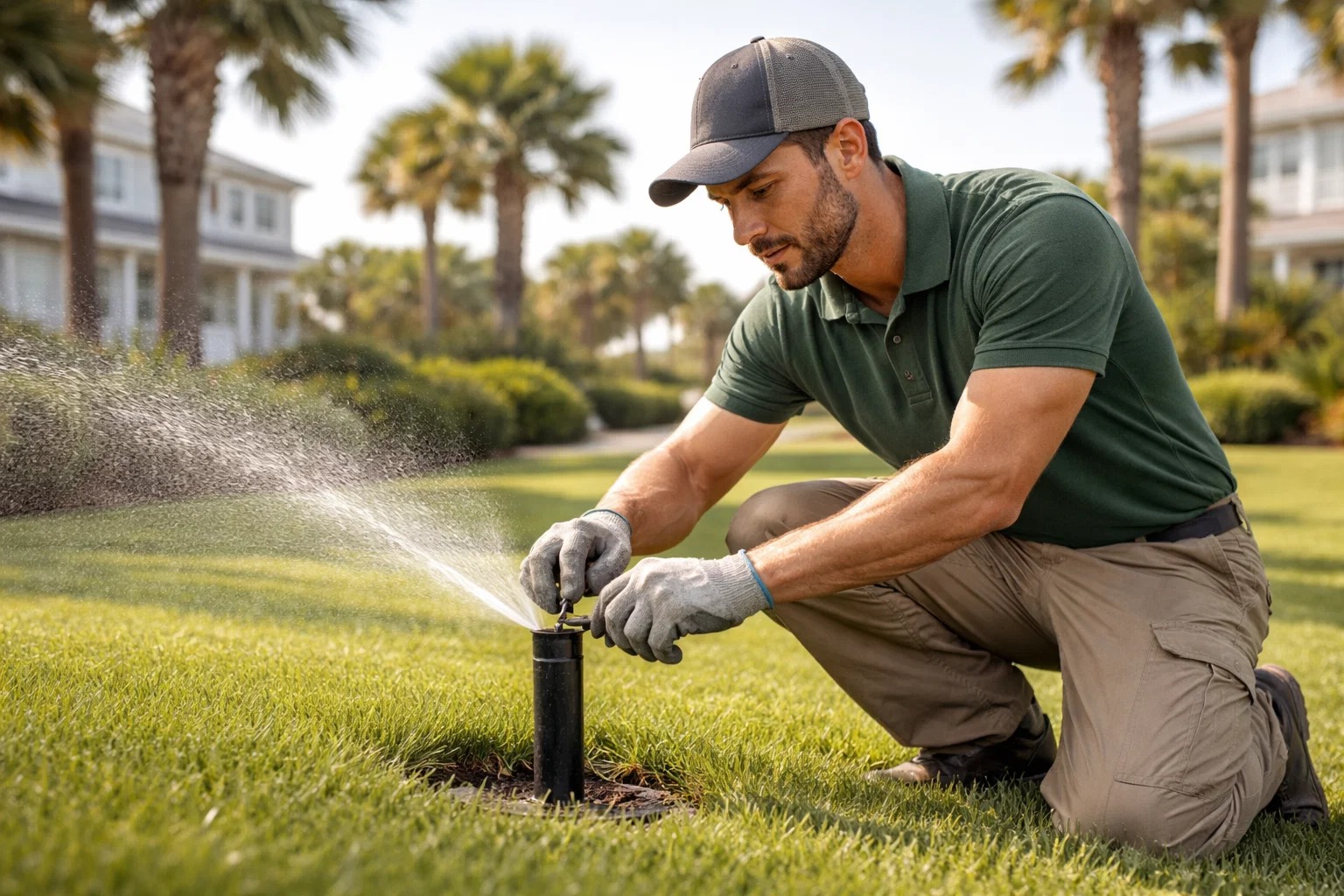
Irrigation system capacity matters more. Summer sod establishment requires two to three watering cycles per day for the first week to ten days. If your existing irrigation system can’t cover the new sod area adequately at that frequency — or if heads are misaligned and leaving dry spots — failure is likely before roots establish. A pre-installation irrigation check is not optional for summer sod projects.
Choosing the Right Sod Type for North Myrtle Beach
Sod selection for coastal South Carolina should be driven by three factors: the sun exposure of the installation area, the maintenance expectations of the homeowner, and the specific characteristics of the coastal sandy soil environment. Getting this right before installation determines how well the lawn performs for years — getting it wrong means struggling with a grass type that was never suited to the conditions.
Centipede grass is the right choice for most North Myrtle Beach homeowners installing a full-sun to mostly-sun lawn. It’s the dominant turf type throughout Horry County for good reasons: it’s adapted to the slightly acidic, low-fertility sandy soils of coastal SC, it requires less fertilizer than bermuda or St. Augustine, and it has excellent heat tolerance once established. It’s not the fastest-spreading grass — bermuda fills in bare spots faster — but its low maintenance requirements and natural compatibility with coastal SC soil conditions make it the most practical long-term choice for the majority of residential applications.
St. Augustine grass is the better choice for areas with significant shade — under tree canopies, on north-facing sides of structures, or in areas that receive fewer than six hours of direct sun per day. Centipede’s performance drops off noticeably in lower-light conditions, while St. Augustine maintains acceptable density and color. St. Augustine also establishes somewhat faster than centipede and is slightly more tolerant of salt spray — an advantage for properties closest to the ocean or tidal areas. It requires more water and slightly more fertilizer than centipede once established.
Bermuda grass is an option for high-traffic, full-sun situations — athletic areas, heavily used play areas, or homeowners who want the fastest-spreading, most aggressive turf available. It requires the most maintenance of the three, needs higher fertilization, and goes completely dormant and brown in winter. For most North Myrtle Beach residential applications, centipede is a better fit — but bermuda has a role in specific high-demand situations.
Site Preparation and Installation: What Success Requires
The difference between summer sod that establishes successfully and summer sod that fails within a week almost always comes down to site preparation. Proper prep isn’t just helpful in summer — it’s the foundation on which everything else depends. In hot coastal conditions, there’s no recovering from a bad foundation with better watering.
-
1Kill and remove all existing vegetation. Apply a non-selective herbicide (glyphosate) to the installation area at least two weeks before sod day. Allow all existing grass and weeds to fully die and brown out, then rake or scalp clear. Don’t shortcut this step — any living vegetation under new sod competes for moisture during establishment and will grow through the sod over time.
-
2Grade the soil for drainage and a smooth surface. The finished soil surface should be approximately three-quarters of an inch below surrounding hard surfaces (driveways, sidewalks, edging) to account for sod thickness. Grade away from the house foundation and eliminate any low spots where water pools. In North Myrtle Beach’s flat coastal terrain, even minor grade issues can create saturation pockets that suffocate new sod roots.
-
3Test and amend soil pH if needed. Centipede grass performs best in slightly acidic soil with a pH between 5.0 and 6.0 — which is where most Horry County sandy soils naturally fall. A quick soil test before installation confirms pH and basic fertility. If pH is above 6.5, a light application of sulfur before sodding can improve the soil environment for centipede establishment.
-
4Moisten the soil before laying sod. Water the prepared soil area thoroughly the evening before sod installation. The goal is moist soil at the surface — not muddy, not dry. Moist soil moderates the temperature difference between the sod and the ground, improves initial contact, and gives new roots an immediate moisture source while they begin to develop.
-
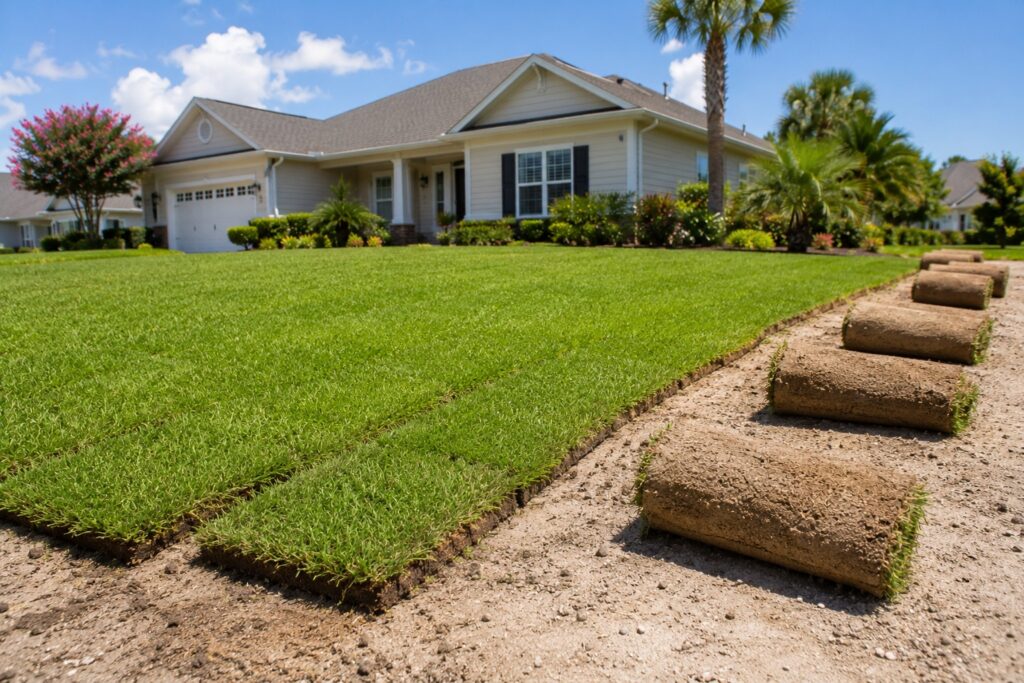
5Lay sod in a staggered brick pattern and butt edges tightly. Offset each row by half a sod length to avoid continuous seams. Butt edges tightly — gaps between sod pieces dry out and die, creating seam lines that persist long after establishment. On slopes, lay sod perpendicular to the slope direction and stake pieces if needed to prevent slipping before roots establish.
-
6Roll and water immediately after installation. Roll the sod with a lawn roller to improve soil-to-sod contact across the full surface — this is the single most important step immediately post-installation for summer sod success. Then water thoroughly within the first 30 minutes of laying. Don’t wait until the whole area is complete to begin watering — in summer heat, sod laid at 8 a.m. on one end of the yard needs water before noon, not when the whole job is done at 2 p.m.
The Summer Establishment Watering Schedule That Actually Works
Watering is where summer sod installation is won or lost. The schedule that works for established lawn maintenance — deep and infrequent — is completely wrong for new sod in summer. New sod with no root system has zero drought tolerance. It relies entirely on surface moisture until roots develop, which in sandy coastal soil means that surface dries out faster than almost anywhere else.
Here is the establishment schedule that works for summer sod in North Myrtle Beach conditions:
Days 1–10 (Pre-rooting phase): Water two to three times per day — morning, midday, and late afternoon. Each cycle should be long enough to keep the sod and the top inch of soil consistently moist. The goal is to never let the sod surface dry out during daylight hours. This is the most intensive phase and the one where most summer sod failures occur if watering is skipped or reduced.
Days 11–21 (Early rooting phase): Begin reducing to once daily watering as roots start developing into the soil below. Test for root development by gently tugging a corner of several sod pieces — resistance means roots are anchoring. Continue daily watering but allow the surface to dry slightly between cycles, which encourages roots to grow downward in search of moisture rather than staying shallow.
Days 22–42 (Establishment phase): Transition to every-other-day watering, then to a normal two-to-three-times-per-week schedule as the sod fully establishes. By week four to six, the lawn should be able to handle a standard irrigation schedule and light foot traffic.
First mowing: Wait until the sod is firmly rooted and has reached approximately three inches in height before the first mow — typically two to three weeks after installation in summer. Use a sharp blade and never remove more than one-third of the blade height in a single mowing. The first mow at the correct height (1.5 to 2 inches for centipede) is one of the most important events in the establishment process.
Related Reading from the KeckCo Blog
- How Much Water Does a North Myrtle Beach Lawn Really Need in July?
- Fertilizing Centipede Grass in North Myrtle Beach: A Seasonal Guide
- Summer Mowing Mistakes That Stress Centipede Grass in North Myrtle Beach
- How to Spot and Stop Drought Stress on Coastal SC Lawns
- Spring Lawn Care Checklist for North Myrtle Beach
Frequently Asked Questions
Can you install sod in July and August in North Myrtle Beach?
Yes — centipede and St. Augustine sod can be successfully installed in July and August in North Myrtle Beach, but it requires more intensive watering and establishment care than spring or fall installation. The warm soil temperatures actually accelerate rooting, which is an advantage. The risk is that high heat and evaporation demand can exceed a new sod’s ability to absorb water before roots establish — which is why daily watering multiple times per day in the first two weeks is non-negotiable for summer installation success.
What is the best time of year to install sod in coastal South Carolina?
Late spring — mid-April through May — is the optimal window for sod installation in coastal SC. Soil temperatures are warm enough to drive active rooting, air temperatures are not yet at peak summer stress levels, and the natural rainfall pattern supports establishment without as much supplemental irrigation. Early fall (September through October) is the second-best window. Summer installation is workable but demands more intensive establishment management than either spring or fall.
How often should I water new sod in summer in North Myrtle Beach?
New sod in North Myrtle Beach during summer heat needs watering two to three times per day for the first seven to ten days — enough to keep the sod and the top inch of soil moist at all times without creating standing water. Mornings, midday, and late afternoon cycles work well. After ten to fourteen days, when the sod begins to root into the sandy soil below, irrigation can be reduced to once daily. By weeks three to four, a normal two-to-three-times-per-week deep watering schedule can be established.
How long does sod take to root in summer in coastal SC?
In North Myrtle Beach’s warm summer soil, centipede and St. Augustine sod typically begin showing root development within seven to ten days of installation. By two to three weeks, light rooting into the sandy soil below should be evident — you can test by gently tugging a corner of a sod piece to check for resistance. Full establishment, where the sod can handle normal foot traffic and a standard watering schedule, typically takes four to six weeks in summer conditions, faster than fall-installed sod which establishes more slowly in cooling soil.
Can I install sod over existing grass or weeds?
No — installing sod over existing vegetation is one of the most common and costly sod installation mistakes. Existing grass and weeds create an uneven base that prevents good sod-to-soil contact, which is essential for rooting. They also compete with new sod for moisture and nutrients during the critical establishment window, and many will grow through the sod over time. The area to be sodded should be treated with a non-selective herbicide, allowed to fully die back, and then cleared and graded before sod is laid.
What type of sod is best for North Myrtle Beach?
Centipede grass is the most widely used and generally best-suited sod type for North Myrtle Beach’s sandy coastal soil and low-maintenance landscape expectations. It’s heat-tolerant, drought-tolerant once established, requires less fertilizer than most other warm-season grasses, and performs well in the slightly acidic sandy soils of Horry County. St. Augustine is the preferred choice for shadier locations, as it tolerates lower light levels than centipede. Bermuda is an option for high-traffic, full-sun areas but requires more maintenance than either centipede or St. Augustine.
Does KeckCo install sod in North Myrtle Beach in summer?
Yes. KeckCo Turf and Ornamental Services installs centipede, St. Augustine, and bermuda sod across North Myrtle Beach, Little River, Myrtle Beach, and the Grand Strand — including summer installations with the proper site preparation, grading, and establishment watering program to maximize success in coastal SC summer conditions. Call 843-273-0735 or visit keckcoturf.com to schedule an estimate.
Summer sod installation in coastal South Carolina isn’t the path of least resistance — but it’s a viable path when approached correctly. Warm soil temperatures, active grass growth, and the real-world need to repair or establish lawns during the summer season all make it a legitimate option for North Myrtle Beach homeowners who can commit to the establishment watering schedule it demands. The margin for error is narrow, the preparation has to be right, and the first two weeks require daily attention. But for a lawn installed and established properly in June or July, fall arrives with a turf that’s already rooted, spreading, and ready to go into the cooler months on solid footing.
Ready to Install Sod in North Myrtle Beach This Summer?
KeckCo Turf and Ornamental Services handles sod installation from site prep and grading through laying and establishment — with the experience to get summer installs right in coastal SC’s demanding conditions. Whether you’re repairing storm damage, replacing a struggling lawn, or starting fresh, Brian Keck’s 20-plus years managing coastal turf means your sod project gets done the way golf course-quality turf management demands.