
It seems like it should not happen — your lawn gets a thorough soaking from a summer thunderstorm, and it looks worse afterward than before the rain started. Yet across North Myrtle Beach and the Grand Strand every July, exactly this plays out on lawn after lawn. The problem is not the water itself. It is everything the rain does to an already-stressed summer lawn in coastal SC: compaction, erosion, fungal activation, soil oxygen depletion, and in some cases, algae growth in low spots that never fully drain.
Understanding why your lawn degrades after heavy rain — and knowing how to respond — can shorten the recovery window from several weeks to just a few days. At KeckCo Turf and Ornamental Services, we work through these post-storm recovery situations throughout the Grand Strand every summer. Here is the diagnostic framework we use and the steps that actually accelerate recovery.
What Heavy Rain Actually Does to a Summer Lawn
A summer thunderstorm in North Myrtle Beach can drop 2–4 inches of rain in under an hour — far faster than most soil can absorb, even well-draining coastal sandy soil. When rainfall exceeds the soil’s absorption rate, runoff occurs and the top layer of soil becomes saturated. Grass roots, which need both water and oxygen to function, suddenly find themselves in an oxygen-depleted environment. Root function slows, nutrient uptake decreases, and the grass shows stress symptoms very similar to drought — despite having more water than it can use.
Meanwhile, the physical impact of large raindrops on bare or thin turf areas causes surface compaction, sealing the top of the soil profile and slowing drainage further. Organic matter and loose sandy particles can wash into low areas, and fine sediment can form a thin crust over the soil surface that significantly reduces water infiltration for days after the storm event.
Standing Water and Low-Spot Problems
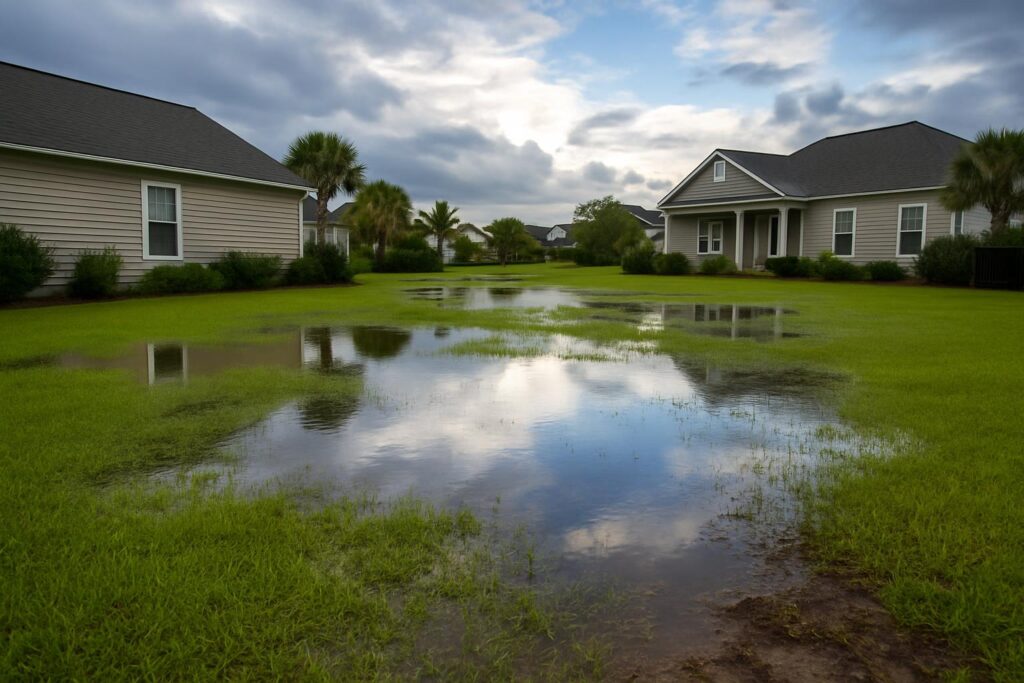
The most visible post-rain problem is standing water in low areas of the yard — places where the ground is lower than surrounding areas and water naturally collects. In North Myrtle Beach’s relatively flat coastal terrain, low spots are extremely common and often coincide with areas where developers graded poorly during original construction, or where soil has settled unevenly over time.
Standing water more than 24–48 hours after a rain event is not a normal drainage characteristic — it signals either a grading problem, a soil compaction layer below the surface, or poor drainage infrastructure. The grass sitting in prolonged standing water will lose root function rapidly, and the waterlogged soil becomes a breeding ground for fungal diseases and mosquitoes. These are not problems that fix themselves with time; they require structural drainage solutions to resolve.
Fungal Disease Activation After Rain Events
Every significant summer rain event in coastal SC activates dormant fungal spores that live in the soil and thatch layer. Brown patch, dollar spot, and pythium blight all have one thing in common: they need a period of wet turf combined with warm temperatures to initiate active growth. After a July thunderstorm in North Myrtle Beach, both conditions are met simultaneously — and if your lawn was already stressed or had a history of fungal disease, visible symptoms can appear within 24–48 hours of the rain event.
The key is to watch for circular brown areas, slimy gray patches in early morning, or smoke-ring patterns appearing within 1–3 days of a significant rain. These are early indicators that warrant a fungicide application before the disease expands significantly. Acting on the first day you see symptoms is dramatically more effective than waiting a week.
Soil Compaction and Oxygen Loss
Heavy rainfall physically compacts the surface of sandy coastal soil, particularly in areas with thin turf coverage or recent foot traffic while the soil is wet. Compacted soil reduces water infiltration, slows evaporation, and limits the oxygen exchange that grass roots need. You may notice the affected areas feel harder underfoot and drain more slowly than surrounding turf even days after the rain event has passed.
Avoid all heavy foot traffic and equipment use on saturated turf — this accelerates compaction significantly and can create ruts and depressions that persist for months. Light core aeration after the soil has partially dried can help open compacted areas and accelerate recovery, but only once the turf is firm enough to work without causing additional damage.
Step-by-Step Lawn Recovery After Heavy Rain
1Allow 48–72 hours for initial drainage before doing anything else. Walking on, mowing, or treating a saturated lawn causes more harm than the rain did.
2Assess standing water. Areas still holding water after 48 hours need drainage investigation. Note the location and extent for follow-up.
3Inspect for fungal symptoms once the dew has dried in late morning. Look for circular brown areas, slimy patches, or smoke-ring patterns. Treat immediately if detected.
4Turn off or reduce irrigation for 5–7 days after significant rain events. Your irrigation controller should ideally have a rain sensor that does this automatically.
5Resume mowing only when the turf is firm enough to walk on without leaving footprints. Mow at your normal height — do not attempt to cut wet grass or overgrown turf all at once.
6Address any erosion damage to ornamental beds, mulch displacement, or soil washing across hardscape surfaces once the ground is workable.
When Drainage Is the Real Underlying Problem
If your lawn consistently looks stressed after rain events — standing water lingers for days, certain areas never seem to fully recover between storms, or you see perpetual algae growth in low spots — the issue is structural drainage, not lawn care technique. North Myrtle Beach properties with poor drainage infrastructure need a real solution: proper grading to direct water away from low areas, a French drain or catch basin installation, or in some cases, a combination of both.
Addressing drainage properly is one of the highest-return investments a North Myrtle Beach homeowner can make. A well-drained yard does not just look better after storms — it supports healthier turf year-round, reduces pest and disease pressure, and eliminates the mosquito breeding habitat that standing water creates during summer.
Frequently Asked Questions
How long should it take for my North Myrtle Beach lawn to recover after heavy rain?
In well-drained coastal SC sandy soil, a healthy lawn should show significant improvement within 3–5 days after a major rain event. If your lawn still looks stressed after a full week with normal weather following the storm, the issue is likely poor drainage, soil compaction, fungal disease, or a combination of these rather than simply rain stress.
Why does my lawn have a bad smell after heavy rain?
A sulfur-like or rotten smell from lawn areas after rain usually indicates anaerobic conditions — soil that has been saturated long enough to deplete oxygen and begin decomposing organic matter without it. This is a sign of chronic drainage problems in affected areas and should be investigated rather than ignored.
Should I apply fungicide before or after heavy rain?
Preventive fungicide applications should be made before expected rain events, as the wet conditions following rain are exactly when fungal disease initiates. If an unexpected storm occurs, wait for the turf surface to dry and then inspect for early symptoms before applying — applying fungicide to soaking-wet turf is largely ineffective.
My grass is green but has bare muddy patches after rain — what happened?
Bare muddy patches after rain usually indicate areas with thin turf coverage where the rain impact washed away the limited grass cover and displaced the underlying sandy soil. These areas need reseeding or sodding after drainage improves, and the thin coverage itself is usually a sign of compaction, shade, or drainage issues that caused turf failure in those spots.
Does KeckCo provide drainage solutions for yards with standing water problems?
Yes. KeckCo Turf and Ornamental Services provides drainage assessment, grading, French drain installation, and catch basin solutions for North Myrtle Beach and Grand Strand properties with chronic standing water or post-rain drainage problems. Contact us to discuss your yard’s specific situation.
Is it normal for my centipede grass to look yellow after a heavy rain?
Temporary yellowing of centipede grass after heavy rain is common and is usually caused by nitrogen leaching from the root zone in the fast-draining sandy soil. The grass typically recovers its color within a week without intervention. If yellowing persists or intensifies after a week, check for signs of fungal disease or iron deficiency, which can both manifest similarly.
A summer thunderstorm should not be a threat to your lawn — but in coastal SC, without good drainage and prompt post-rain management, it often becomes one. Knowing what to watch for, when to act, and when the problem is bigger than lawn care technique alone is what separates lawns that bounce back quickly from those that limp through the rest of summer.
Dealing with drainage problems or post-storm lawn damage?
KeckCo Turf and Ornamental Services provides drainage solutions, post-storm lawn recovery, and complete lawn care throughout North Myrtle Beach and the Grand Strand.