
Most people in North Myrtle Beach get the itch to plant in April, when the garden centers fill up and everything is blooming. It is an understandable instinct, but in coastal South Carolina it is the harder season to plant in. A shrub set in the ground in spring has only a few weeks before it faces a Grand Strand summer: ninety-degree days, sandy soil that dries out within hours, salt-laden wind, and the occasional tropical storm. Many spring plantings spend their first summer simply trying to survive.
Fall planting in North Myrtle Beach flips that equation. Plants set in the ground in October and November go into warm soil and cool air, and they spend the entire mild coastal winter growing roots instead of leaves. By the time summer arrives they are established, drinking from a wider root zone, and far less dependent on you and a hose. At KeckCo Turf and Ornamental Services, fall is when we do most of our landscape installation work, and this guide explains why, what to plant, and how to do it right.
Why fall beats spring for planting on the Grand Strand
Roots and shoots grow on different schedules. Leaves and stems respond to air temperature and day length, and they slow down sharply as the days shorten in October. Roots respond to soil temperature, and roots of most woody plants keep growing whenever the soil is above roughly 40°F. On the coast, our soils stay well above that through most of the winter, so a tree or shrub planted in fall can keep extending its roots for months while the top of the plant asks for very little water.
That head start is what matters in sandy coastal soil. Sand holds very little water, so a newly planted shrub with roots confined to its original root ball dries out quickly once summer arrives. A fall-planted shrub has had four or five months to push roots out into the surrounding soil, which multiplies the volume of soil it can draw from and makes it far more tolerant of heat, wind, and the inevitable missed watering.
Fall also brings more reliable rainfall and lower evaporation than late spring, cooler working conditions for the plant and the crew, and fewer pest problems while the plant settles in. Clemson Extension has long recommended fall as the preferred planting season for most trees and shrubs in South Carolina, and the coast benefits from that advice more than anywhere else in the state because our winters are so mild.
What to plant: trees and shrubs that thrive in coastal conditions
The right plant in the right spot does more for a coastal landscape than any amount of fertilizer or irrigation. Native and coastal-adapted species handle sandy soil, salt spray, and wind with very little help, and fall is the ideal time to get them established.
For hedges and screens, wax myrtle and yaupon holly are the workhorses of North Myrtle Beach landscapes. Both are native, both tolerate salt spray and drought once established, and both are available in compact forms for foundation plantings. Dwarf yaupon makes a tidy low hedge, while wax myrtle grows quickly into a dense privacy screen. Fall is also a good time to add Indian hawthorn, pittosporum, and podocarpus where you want a more formal evergreen look.
For trees, live oak and Southern magnolia are long-term investments that define the look of the Grand Strand, and both establish best when planted in fall. Sabal palmetto, the state tree, is the exception to the rule: palms prefer to be planted when the soil is warm, so we set palms in late spring and early summer rather than fall. For color and texture, muhly grass, coontie, and native flowering shrubs such as beautyberry fill beds without much maintenance.
How to plant a tree or shrub so it establishes quickly
The technique matters as much as the timing. Most planting failures we are called to look at in North Myrtle Beach come down to a hole that was too deep, roots that were never loosened, or mulch piled against the trunk.
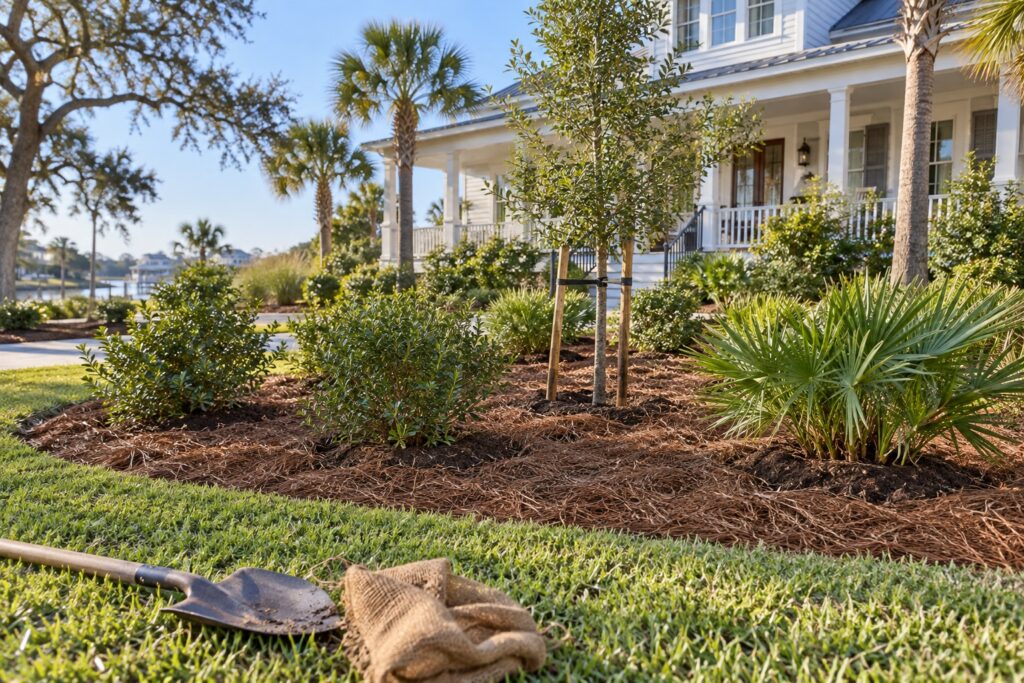
1Dig wide, not deep. Make the hole two to three times as wide as the root ball but no deeper than the root ball is tall. Roots spread outward into loose soil, and a wide hole gives them an easy start.
2Set the plant slightly high. The top of the root ball should sit an inch or two above the surrounding grade. Sandy soil settles, and a plant set too deep slowly suffocates at the root flare.
3Loosen circling roots. Container plants are often root-bound. Tease or score the outside of the root ball so roots grow outward instead of continuing to circle. Remove burlap, twine, and wire baskets from the top of balled-and-burlapped trees.
4Backfill with the native soil. Heavily amending only the planting hole creates a pocket that roots are reluctant to leave. A modest amount of compost mixed into the backfill is fine, but the plant needs to learn to live in the soil it will grow in.
5Water in thoroughly and mulch. Soak the root ball and backfill to settle the soil and remove air pockets, then spread two to three inches of pine straw or shredded mulch out to the edge of the planting hole, keeping it a few inches away from the trunk.
Watering new plantings through a coastal winter
Fall planting reduces how much you have to water, but it does not eliminate it. The root ball of a new shrub dries out much faster than the surrounding soil, especially in sand, and a dry root ball cannot pull water from moist soil around it. For the first two to three weeks, water new plantings every two to three days unless it rains.
After that, most fall-planted shrubs need a deep soaking about once a week through November and every ten to fourteen days during the cooler winter months when rainfall is light. Trees need longer: a common guideline is one to two gallons of water per inch of trunk diameter at each watering, applied slowly at the root ball. A soaker hose or a dedicated drip zone on your irrigation system makes this easy and avoids overwatering the surrounding lawn.
Before a hard freeze, a deep watering a day or two ahead actually helps, because moist soil holds and releases more heat than dry soil. If your irrigation system is being winterized, plan a hand-watering routine for new plantings so they do not go dry during a dry winter stretch.
Common fall planting mistakes to avoid
Planting too deep is the most frequent and the most damaging, because the plant may look fine for a year or two before declining. Volcano mulching, the habit of piling mulch high against the trunk, causes similar slow damage by keeping bark constantly wet and inviting rot and insects.
The second category of mistakes is plant choice. Plants from inland nurseries that are not salt-tolerant, sun-loving shrubs planted on the shady north side of a house, and fast-growing trees placed too close to the foundation or driveway all create problems that no amount of care can fix later. It pays to look at the mature size on the tag and place each plant where it will fit in ten years, not just this season.
Finally, many homeowners plant in fall and then forget about water entirely once the weather cools. The plant does not show stress the way it would in July, but a root ball that dries out repeatedly over the winter will establish slowly and struggle in its first summer. A few minutes of watering each week through the winter is the cheapest insurance you can buy for a landscape investment.
- Wax Myrtle: The Best Coastal SC Hedge and Privacy Shrub You’re Probably Not Using
- Native and Drought-Tolerant Plants for Low-Maintenance Coastal Carolina Landscapes
- Evergreens That Shine Year-Round in Coastal Yards
- The Best Cold-Tolerant Plants for Coastal Gardens
- Mulch vs Pine Straw: Which Is Better for Coastal South Carolina Landscapes?
Frequently Asked Questions
Is fall a good time to plant shrubs in North Myrtle Beach?
Yes, fall is the best time to plant most trees and shrubs in North Myrtle Beach. Coastal soils stay warm enough for root growth through most of the winter, so plants set in October and November spend months building roots before facing summer heat. They establish faster and need far less watering in their first summer than spring plantings.
How late in the year can I plant trees in coastal South Carolina?
On the Grand Strand, the ideal window runs from early October through early December, and planting can continue through winter because the ground rarely freezes. The earlier in fall you plant, the more root growth the plant achieves before summer. Palms are the exception and should be planted in late spring or early summer.
What are the best shrubs for salt air in North Myrtle Beach?
Wax myrtle, yaupon holly, Indian hawthorn, pittosporum, and podocarpus all handle salt spray well, and wax myrtle and yaupon are native to the coast. For oceanfront and Intracoastal Waterway properties with heavy salt exposure, native species are the safest choice. Fall is the right time to plant all of them.
How often should I water new plants in the fall?
Water new plantings every two to three days for the first two to three weeks unless it rains. After that, a deep soaking once a week through November and every ten to fourteen days in winter is usually enough. Check the root ball itself, because it dries out faster than the surrounding sandy soil.
Should I fertilize new trees and shrubs when I plant them in fall?
No. Fertilizer at fall planting encourages leafy growth that the new root system cannot support and adds salts to the root zone. Let the plant establish over the winter and fertilize lightly in spring, based on a soil test if possible.
How much does it cost to have shrubs professionally planted in North Myrtle Beach?
Cost depends on plant size, quantity, bed preparation, and whether irrigation changes are needed. A small foundation bed refresh costs far less than a full privacy screen or new tree installation. KeckCo provides free on-site estimates so you know the full scope before any work begins.
Does KeckCo install trees and shrubs in the fall?
Yes. KeckCo Turf and Ornamental Services designs and installs landscape beds, hedges, and trees throughout North Myrtle Beach, Little River, and the Grand Strand, with fall as our preferred planting season. We handle plant selection for coastal conditions, bed preparation, mulching, and drip irrigation. Call 843-273-0735 to plan your fall planting.
On the coast, planting in fall gives every tree and shrub a full mild winter to grow roots before summer arrives. If you have been planning a new hedge, a privacy screen, or a refreshed foundation bed, October and November are the best time of year to put them in the ground.
Ready to plant this fall in North Myrtle Beach?
KeckCo Turf and Ornamental Services designs and installs coastal-tough landscapes, from privacy hedges and foundation beds to trees and drip irrigation, throughout the Grand Strand. Fall is our favorite planting season. Call us to get on the schedule.