
Signs Your Sprinkler System Is Wasting Water (and Money) This Summer
Your irrigation system runs before dawn while you’re still asleep — which means it can waste thousands of gallons over a summer season without you ever seeing it happen. A broken head spraying the street, a zone running twice as long as it should, a slow underground leak feeding a soggy patch in your yard: these are the kinds of problems that quietly add up on your water bill while your lawn gets uneven coverage at best. For North Myrtle Beach homeowners, where summer water usage is already high and utility rates aren’t cheap, a poorly performing sprinkler system isn’t just inconvenient — it’s expensive.
The good news is that most irrigation inefficiencies leave clear signs if you know what to look for. A quick walk-through of your property while the system runs can reveal problems that a professional can fix in a single visit. This guide covers the most common red flags, what’s causing them, and what to do before the peak of summer heat.
Visible Signs of Waste to Look for While the System Runs
The most valuable thing you can do this summer is go outside and watch your sprinkler system run through a full cycle — all zones, from start to finish. Most homeowners have never done this. The system runs at 5 a.m., everything looks fine from inside, and problems quietly continue for months. A single twenty-minute walkthrough can reveal more about your system’s efficiency than a year of water bills.
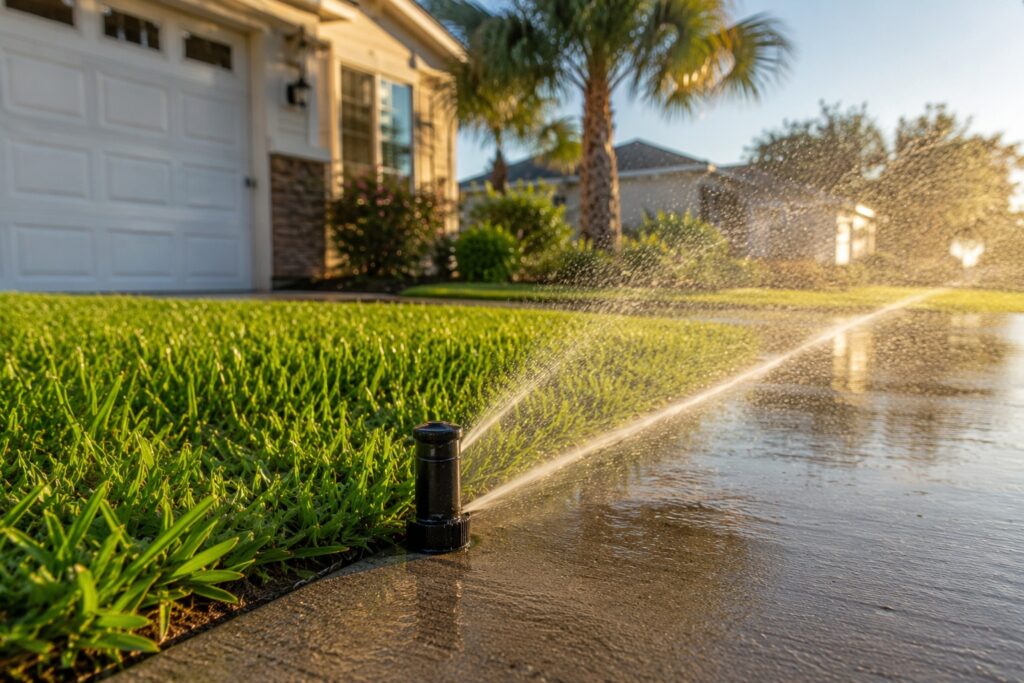
Heads spraying pavement, fences, or the street. This is the most common and most visible waste problem in residential irrigation. A head that’s slightly rotated, knocked sideways by a lawn mower, or simply pointed the wrong way can direct a full zone’s output onto a driveway or sidewalk. None of that water reaches your lawn. In sandy Horry County soil, a misaimed head also tends to create a dry streak in the turf nearby — a brown line that homeowners often mistake for disease or pest damage.
Heads that aren’t popping up fully. A sprinkler head that only rises halfway — or barely clears the soil surface — can’t distribute water evenly. Grass blades and thatch obstruct the spray, and coverage radius drops dramatically. This happens most often when soil has settled around a head, or when system pressure is too low to push heads fully upright. Either way, the zone is delivering far less water than its schedule assumes.
Misting instead of spraying. When system pressure is too high, spray heads produce a fine mist rather than distinct water droplets. That mist is easily carried away by wind — which is a real factor in coastal North Myrtle Beach, particularly in oceanfront neighborhoods. High-pressure misting can lose thirty to fifty percent of water output to wind drift before it ever hits the ground.
Signs of Problems You Notice Between Watering Cycles
Not every irrigation problem is visible while the system is running. Some of the most costly issues only show themselves in the hours and days between cycles — in the condition of your lawn, your landscape beds, and the soil beneath them.
Soggy or perpetually wet patches. If a section of your lawn stays soft and damp even on days when your system hasn’t run and it hasn’t rained, you likely have an underground leak or a valve that isn’t fully closing between cycles. In North Myrtle Beach’s sandy soil, water drains quickly — so persistent soggy areas are a reliable sign that water is actively entering from somewhere it shouldn’t be. Left unaddressed, chronic wet spots develop anaerobic soil conditions that damage grass roots and invite fungal disease.
Strips of turf that are brown and dry while the rest is green. Dry streaks between heads usually indicate a head that’s been damaged, knocked out of position, or clogged with debris. Each head in a zone is designed to overlap with its neighbors — when one fails, the coverage gap it creates shows up as dead or stressed turf. In summer, those dry strips can turn brown within a week of a head going down.
Landscape beds that are constantly saturated. Ornamental beds have different water needs than turf, and they’re often overwatered by rotor heads designed for lawn coverage. If your beds smell musty, show standing water after irrigation, or have plants that are yellowing despite regular fertilization, excess irrigation is a likely cause. Roots sitting in saturated soil suffocate — a problem that’s slow to diagnose and expensive to fix if the plants die.
Water Bill Red Flags and What They Mean
Your water bill is one of the most reliable diagnostic tools for irrigation efficiency — if you know what to look for. Most North Myrtle Beach homeowners on city water receive monthly bills, which makes it straightforward to track usage month over month and flag unusual spikes.
A sudden jump with no schedule change. If your usage climbs sharply from one bill to the next without any change in your watering schedule or weather patterns, something has changed in your system. A head that breaks and runs continuously, a valve stuck open, or a lateral line crack can add hundreds of gallons per day to your usage. This kind of sudden spike is the clearest signal that a physical problem has developed.
Steady creep upward over several months. Slow leaks don’t produce dramatic spikes — they produce a gradual month-over-month increase that’s easy to dismiss as seasonal variation. If your summer bills have been climbing a little higher each year even with the same schedule, a slow underground leak or deteriorating valve is the most likely cause.
High usage even in weeks with heavy rainfall. Your irrigation system should be delivering significantly less water during rainy stretches. If your bill doesn’t drop during a rainy week — or barely changes — your system is either missing a rain sensor or the sensor has failed. Running irrigation cycles the morning after a two-inch Grand Strand thunderstorm is one of the most common and avoidable sources of water waste in coastal SC.
Controller and Scheduling Problems That Silently Waste Water
Hardware failures get noticed eventually — a broken head is visible, a soggy patch is felt underfoot. But controller and scheduling problems are invisible. The system runs exactly as programmed, water flows, and nobody realizes that the program itself is wasteful. These are some of the most common sources of irrigation inefficiency we find on properties across North Myrtle Beach.
A schedule set in spring and never updated. Evapotranspiration rates — the combined water loss from soil and plant surfaces — more than double between April and July in coastal South Carolina. A schedule calibrated for spring conditions will significantly overwater by midsummer. Most irrigation controllers allow seasonal adjustment without reprogramming every zone from scratch, but the adjustment has to be made manually unless you have a smart controller that does it automatically.
Multiple start times instead of cycle-and-soak. Many homeowners program their controller with two or three daily start times thinking it waters more thoroughly. What it actually does is apply water faster than many soils can absorb it, causing runoff. The better approach for North Myrtle Beach’s sandy soil is a single early morning start time with longer zone run times — letting each zone deliver its full output in one deep session rather than several shallow ones.
No rain sensor or a failed rain sensor. A properly functioning rain sensor is one of the cheapest and highest-value components in a residential irrigation system. If yours hasn’t been tested recently, hold it under a running faucet and confirm the system shuts off — sensors can corrode or stick in the open position over time, running your schedule regardless of rainfall.
How to Do a Quick DIY Irrigation Audit
You don’t need specialized equipment to spot most irrigation inefficiencies. A simple walk-through using a few household items will reveal the most common problems in thirty minutes or less. Run each zone individually for a full cycle while you watch — don’t try to evaluate multiple zones at once.
-
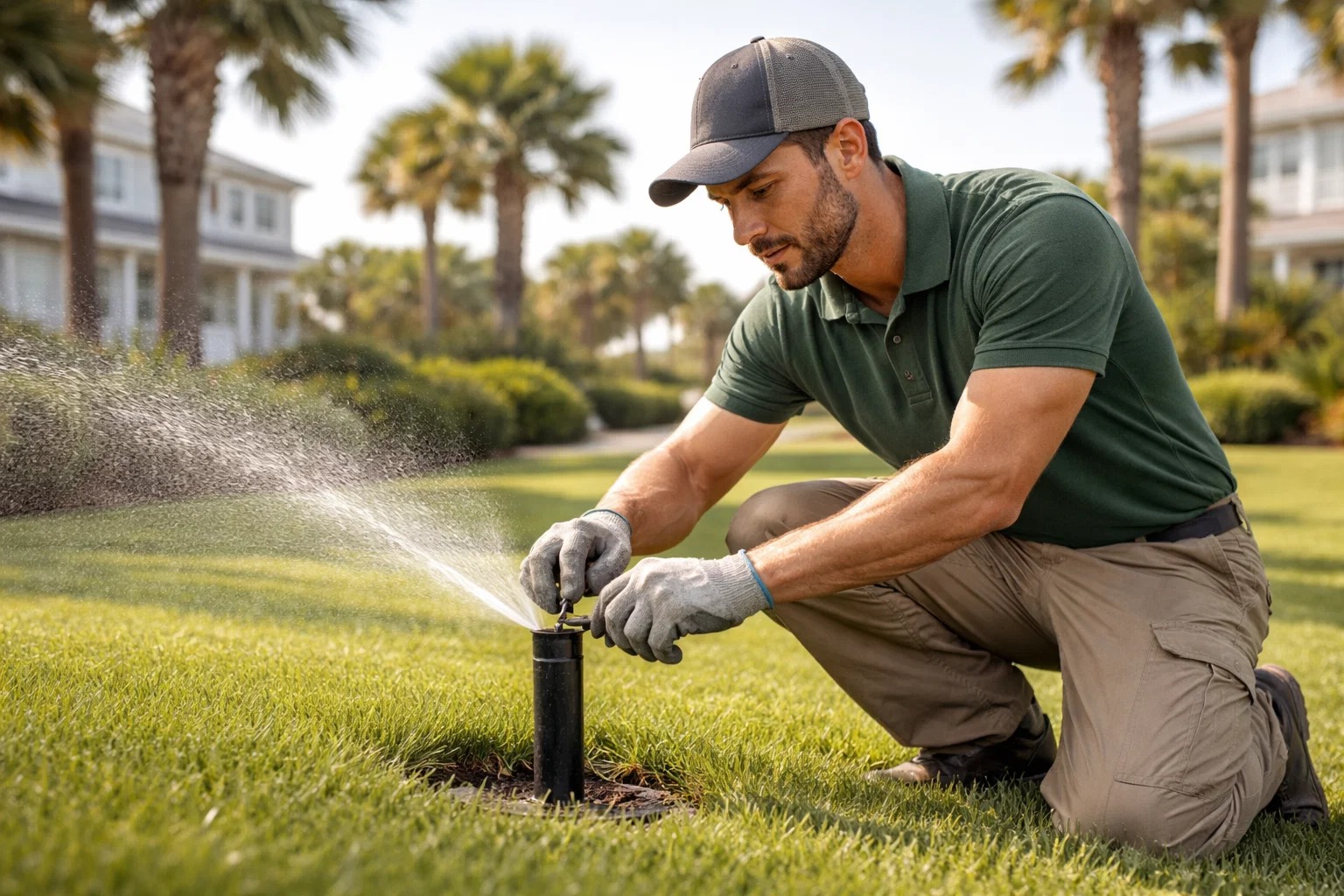
1Run each zone and watch every head. Walk the full coverage area of each zone while it’s active. Note any heads that aren’t rotating, aren’t popping up fully, are spraying pavement, or are producing mist instead of a clear arc of water. Mark problem heads with a small flag or stake.
-
2Place tuna cans across the spray pattern. Set four to six empty tuna cans at different distances from your heads while a zone runs. After the cycle, measure the water depth in each can. Significant variation between cans means your coverage isn’t uniform — some areas are getting too much water and others too little.
-
3Test your rain sensor. With your system in auto mode, hold the sensor under a running faucet or spray it with a hose. The controller should cancel the upcoming cycle within thirty to sixty seconds. If it doesn’t, the sensor needs replacement.
-
4Check soil moisture before and after each zone. Use a screwdriver or soil probe pushed six inches into the ground immediately after a zone completes. The soil should be moist but not waterlogged at that depth. If it’s dry, run time is too short. If water is pooling at the surface, run time is too long for your soil’s absorption rate.
-
5Review your controller program. Check how many start times are set per day, what run times are assigned to each zone, and whether any seasonal adjustment percentage is applied. Compare your current settings against the one-inch-per-week target for centipede grass, accounting for rainfall your gauge has recorded this week.
-
6Walk the property after the system shuts off. Check for areas that feel spongy, look for any heads that are still dripping (valve not fully closing), and note any dry brown streaks that suggest missed coverage. This post-cycle walk ties everything together and confirms what your in-cycle observation found.
Related Reading from the KeckCo Blog
- How Much Water Does a North Myrtle Beach Lawn Really Need in July?
- Irrigation System Startup Guide for Little River, SC
- How to Spot and Stop Drought Stress on Coastal SC Lawns
- Summer Mowing Mistakes That Stress Centipede Grass in North Myrtle Beach
- Why Your Lawn Goes Dormant in August Heat and What to Do About It
Frequently Asked Questions
How do I know if my sprinkler system is leaking underground?
The most common signs of an underground irrigation leak are soft, soggy spots in your yard that stay wet between watering cycles, unexplained green patches that grow faster than the rest of the lawn, and a water bill that climbs without any change in your schedule. You can also shut off your system completely and watch your water meter — if it continues to move, water is escaping somewhere it shouldn’t be.
Why is water pooling on my lawn after the sprinklers run?
Pooling after irrigation usually means one of three things: your zone run times are too long for the soil’s absorption rate, your sprinkler heads are delivering water faster than the soil can take it in (called precipitation rate mismatch), or you have a low-lying area with drainage issues. In North Myrtle Beach’s sandy soil, pooling is less common than in clay soils — so if you’re seeing it, a clogged or misaligned head that’s concentrating water in one spot is often the culprit.
What is the most common reason a sprinkler system wastes water in summer?
The single most common cause is a controller that was set in spring and never adjusted for summer conditions. As temperatures climb in July and August along the Grand Strand, evaporation rates increase and watering needs change — but most homeowners leave their system on a fixed schedule year-round. A system running the same schedule in August as it did in March is almost certainly overwatering some zones and possibly underwatering others.
Can a sprinkler head spraying the sidewalk or driveway damage anything?
It won’t damage the pavement, but it wastes a significant amount of water over a summer season and can contribute to algae growth on concrete in shaded areas. More importantly, water that hits hard surfaces runs off into storm drains rather than reaching your lawn’s root zone — so you’re paying for irrigation that delivers zero benefit to your turf.
How often should I have my irrigation system inspected?
A professional inspection once a year — ideally at the start of the irrigation season in spring — is the minimum for most North Myrtle Beach homeowners. Systems that run frequently through a full coastal SC summer benefit from a mid-season check as well, since heat, UV exposure, and foot traffic can shift or damage heads between spring startup and August. Catching a broken head or pressure problem in June saves weeks of wasted water before you notice it on your bill.
Does KeckCo offer irrigation inspections and repairs in North Myrtle Beach?
Yes. KeckCo Turf and Ornamental Services provides irrigation system inspections, head adjustments, leak detection, and full system repairs across North Myrtle Beach, Little River, Myrtle Beach, and the broader Grand Strand area. Call 843-273-0735 or visit keckcoturf.com to schedule a visit.
Will a smart irrigation controller really save money in North Myrtle Beach?
Yes, and the savings are often substantial. Smart controllers adjust run times automatically based on local weather data — skipping cycles after rain events and scaling back during cooler stretches. In a coastal SC summer with frequent afternoon storms, a smart controller can eliminate dozens of unnecessary irrigation cycles between June and September. Most homeowners recoup the cost of a smart controller upgrade within one to two seasons through reduced water bills.
A sprinkler system that’s working against you instead of for you is one of the most common — and most fixable — problems on North Myrtle Beach properties in summer. The warning signs are usually right there to see: a head spraying the street, a soggy patch that never dries out, a water bill that keeps climbing without explanation. Taking thirty minutes to audit your system now, before the peak of July and August heat, can save you hundreds of dollars and protect the lawn you’ve worked hard to maintain all season.
Think Your Irrigation System Might Be Wasting Water?
KeckCo Turf and Ornamental Services inspects, tunes, and repairs irrigation systems across North Myrtle Beach, Little River, and the Grand Strand. Brian Keck’s background managing golf course irrigation on the coast means your system gets evaluated with the same precision that tournament turf demands — not a quick glance and a guess.