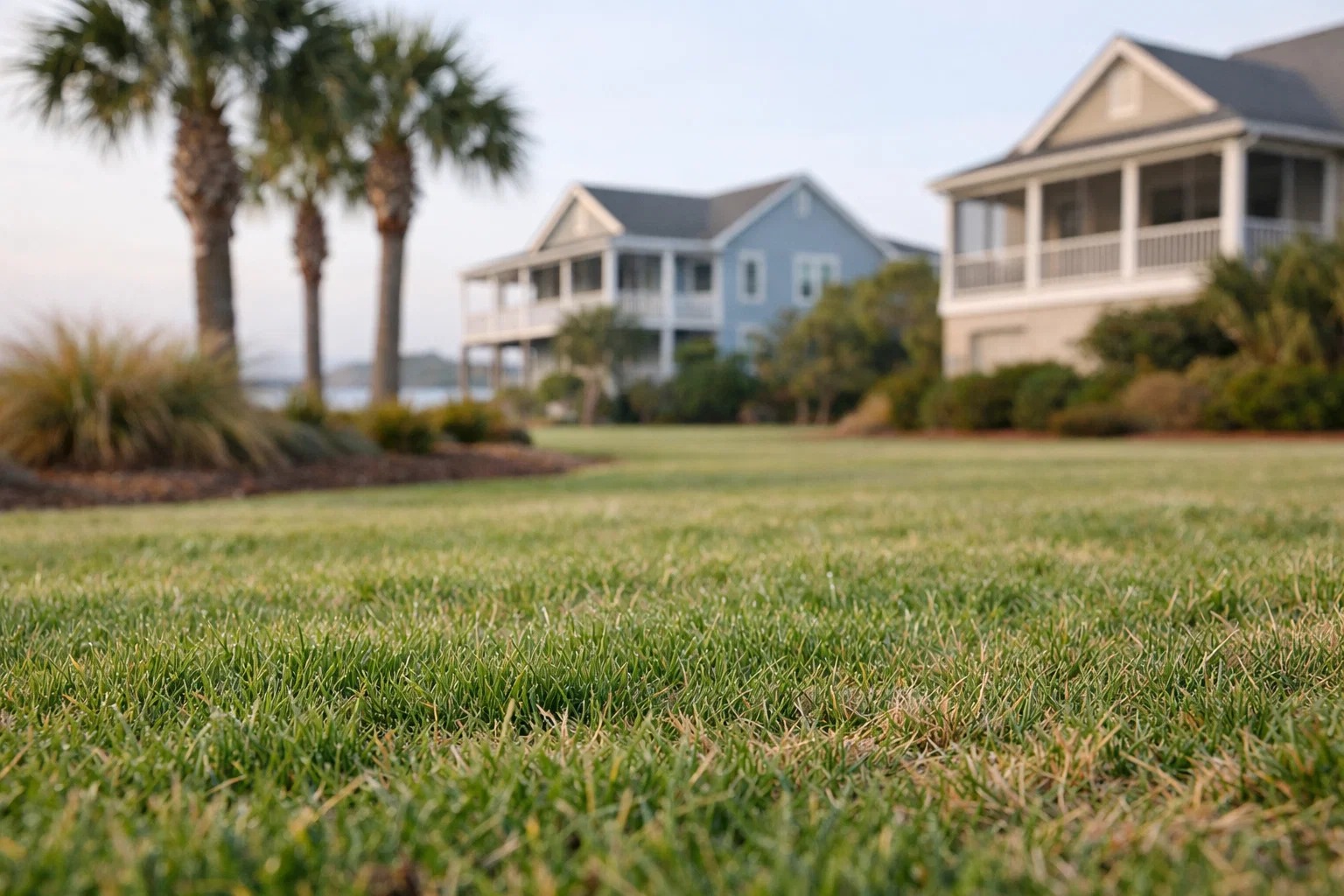

If you’ve been watching your lawn sit dormant all winter and wondering when it’s safe to start doing something about it, you’re not alone. Every spring, North Myrtle Beach homeowners face the same question: is it too early, too late, or just right? The answer depends less on the calendar and more on what’s actually happening in your soil — and on the coast, that’s a different story than what the big national lawn care brands will tell you.
This guide gives you a practical, step-by-step spring checklist built specifically for the warm-season turf and sandy coastal soils of the Grand Strand. Follow it in order, and you’ll set your lawn up for the strongest, greenest summer it’s ever had.
Why spring timing matters differently on the coast
In North Myrtle Beach, spring doesn’t arrive by the calendar — it arrives by soil temperature. The warm-season grasses that dominate lawns across the Grand Strand (centipede, zoysia, bermuda, and St. Augustine) don’t wake up based on what month it is. They respond to soil warmth, and along the coast, that warming happens gradually — sometimes weeks later than homeowners expect after a mild winter, and sometimes earlier after a warm February.
The key thresholds to watch are 55°F soil temperature for pre-emergent applications and 65°F for fertilization. Apply too early and your products either won’t work or will push growth the grass can’t yet support. Apply too late and you’ve handed weeds a head start that’s nearly impossible to recover from before summer.
Our coastal sandy soils retain heat differently than the clay-heavy soils further inland. Sandy soil warms faster in full sun but cools quickly at night, which means surface readings can be deceiving in late February and early March. A cheap soil thermometer — pushed 2–3 inches into the ground in the morning before the sun has warmed the surface — takes the guesswork out entirely.
Assess what winter left behind
Before you put anything on your lawn, walk it. All of it. A slow lap around your property in late February or early March will tell you more than any schedule can. You’re looking for a few specific things that are common in North Myrtle Beach after winter.
Look for bare or thin patches, particularly along driveways, walkways, and the south-facing edges of your property where foot traffic concentrates. These areas often need extra attention in spring — either overseeding (for bermuda) or targeted fertilization to encourage lateral spread. Check for thatch buildup too, especially in centipede and zoysia lawns, where a thick spongy layer at the base of the grass blades can block water and nutrients from reaching the roots.
Also look for winter weed pressure — henbit, chickweed, and annual bluegrass are the three most common offenders in coastal SC during late winter. If you’re seeing patches of fine-leafed green growth while the rest of your lawn is still dormant brown, that’s weeds. Address them before they seed out and compound the problem into next year.
The pre-emergent window — don’t miss it
Pre-emergent herbicide is the single most important spring application for North Myrtle Beach lawns. It creates a chemical barrier in the soil that prevents weed seeds — primarily crabgrass, goosegrass, and spurge — from germinating. Once those seeds have sprouted, pre-emergent does nothing. The window is everything.
In North Myrtle Beach, the pre-emergent window typically opens in late January and closes by mid-February, depending on the year’s weather pattern. You’re targeting that 55°F soil temperature threshold — when soil at 2–3 inches deep holds 55°F consistently for several days in a row, weed seeds are preparing to germinate. Your pre-emergent needs to be in the ground before that happens.
A common mistake is waiting until you see crabgrass to treat for it. By then, you’ve already lost the season. Think of pre-emergent like a vaccination — it works by preventing the problem, not curing it. If you missed the window this year, note it for next January and focus on post-emergent spot treatments through spring and summer to manage what does germinate.
First fertilization of the season
The first fertilizer application of the year sets the tone for your lawn’s entire season. Get it right, and your turf enters summer thick, dense, and competitive against weeds. Get it wrong — by applying too early or with the wrong product — and you push soft growth that’s vulnerable to late cold snaps and fungal disease.
In North Myrtle Beach, hold off on fertilizing until soil temperatures are consistently at or above 65°F. For most years, that means mid-March to early April depending on winter severity. Centipede grass is the most sensitive — it’s famously easy to over-fertilize, and too much nitrogen too early causes a flush of weak growth followed by a hard crash. For centipede, use a low-nitrogen slow-release product and apply it sparingly. Bermuda and zoysia can handle a more aggressive early-season feeding.
The sandy soils along the coast leach nutrients quickly, especially after heavy spring rain events. A slow-release fertilizer formulation holds up far better than a quick-release product that washes through before roots can absorb it. After any significant rainfall over an inch, a follow-up feeding may be warranted within four to six weeks.
Irrigation startup and inspection
If your irrigation system was winterized or left idle over the cooler months, spring is the time to bring it back online carefully. Don’t just flip the timer and walk away — a system that sat idle for three or four months almost always has at least one issue that needs attention before the growing season begins.
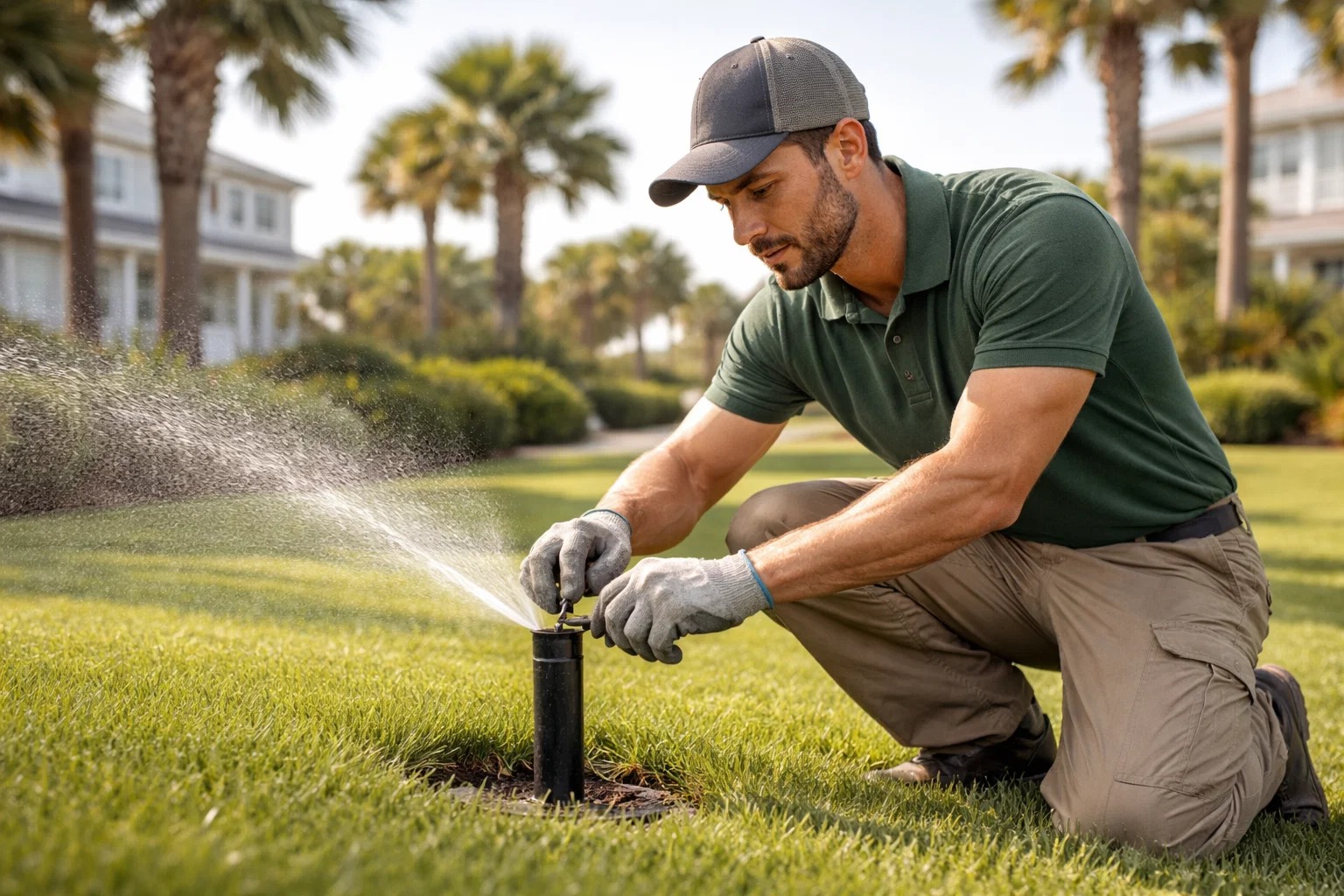
Walk each zone while it runs and watch every head. Look for heads that aren’t rotating, spray patterns blocked by overgrown shrubs or mulch buildup, and heads spraying onto hard surfaces instead of turf. In North Myrtle Beach’s sandy soil, uneven coverage means some areas dry out while others get waterlogged — both conditions create openings for weeds and fungal disease.
Adjust your timer settings for the season. Spring watering needs are much lower than summer — your lawn doesn’t need daily irrigation in March. A good rule for coastal SC warm-season grasses in spring is one deep watering of about an inch per week, early in the morning. Deep and infrequent watering drives roots down into the soil, building drought resistance for the brutal heat of July and August.
Mowing, edging, and early-season scalping
One of the most effective — and most overlooked — spring lawn care practices is early-season scalping. Before your warm-season grass fully breaks dormancy, cutting it short removes the dead winter blades and allows sunlight to reach the soil directly, warming it faster and encouraging quicker, more even green-up across the lawn.
For North Myrtle Beach lawns, scalp bermuda and zoysia down to about half an inch in late February or early March, just as the turf is beginning to show the first hints of green at the base. Centipede should be cut shorter than its normal summer height but not as aggressively — around one inch. St. Augustine should not be scalped; it doesn’t respond well and can set back recovery by several weeks.
Once regular mowing season starts — typically by mid-April in coastal SC — stick to the one-third rule: never remove more than one-third of the blade in a single cut. Set your mower height for your grass type: centipede at 1.5–2 inches, bermuda at 0.5–1.5 inches, zoysia at 1–2 inches, St. Augustine at 3–4 inches. Sharp mower blades matter more than most homeowners realize — a dull blade tears rather than cuts, leaving ragged edges that turn brown and invite fungal infection.
Ornamental beds and mulch refresh
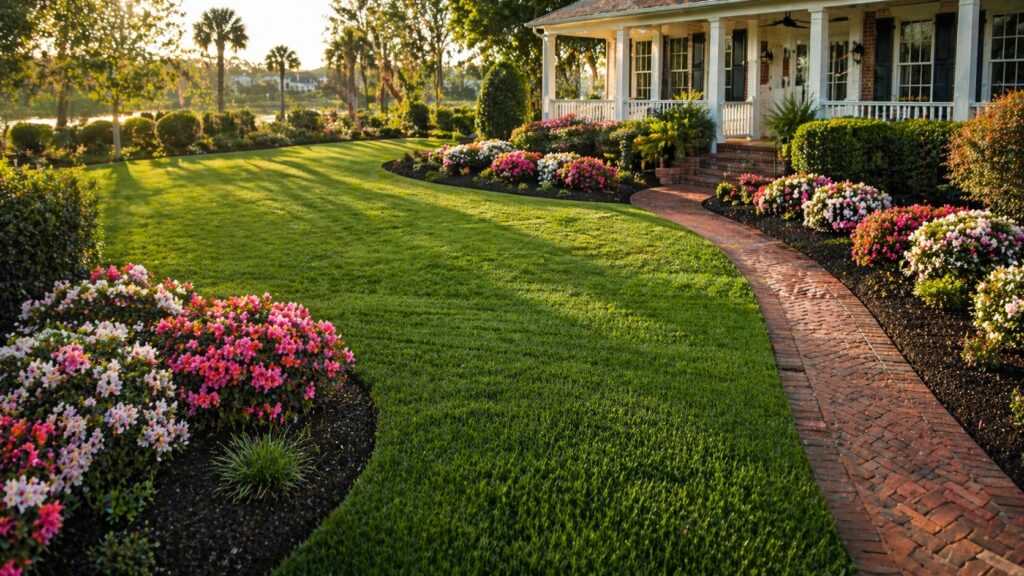
Spring isn’t just about turf. The ornamental beds around your home — whether you’re growing wax myrtle, yaupon holly, azaleas, gardenias, or crape myrtles — need spring attention too, and the timing works perfectly alongside your lawn schedule.
Late February through March is the ideal time to prune most coastal ornamentals before new growth pushes. Cut out any winter-damaged wood, shape shrubs before they flush, and clean up bed edges so they’re well-defined before mulch goes down. One common mistake is pruning crape myrtles too aggressively — a practice so widespread along the Grand Strand it’s been called “crape murder.” A proper pruning removes crossing branches and dead wood, not the entire canopy of the tree.
Apply fresh mulch to beds in early spring after pruning and bed edging. Two to three inches of mulch retains moisture, moderates soil temperature, and suppresses weed germination in the beds — critical on the coast where sandy soil dries out quickly and weeds find every opportunity to establish. Keep mulch pulled back from the crown of shrubs and tree trunks to prevent rot.
Common spring mistakes North Myrtle Beach homeowners make
Even well-intentioned homeowners fall into the same traps every spring. The biggest is fertilizing too early — seeing the first warm days of February and reaching for the spreader before soil temperatures support it. The result is feeding weeds more than your grass, with wasted product that either volatilizes in the heat or washes toward coastal waterways.
A close second is skipping the pre-emergent window. Many homeowners don’t know it exists until they’re pulling crabgrass in June. Pre-emergent is inexpensive and highly effective when timed correctly — it’s the best return on investment of any spring lawn care product, and missing it means fighting weeds reactively all season long.
Over-watering in spring is another common issue, especially for homeowners who set irrigation timers in summer and forget to dial them back. Wet soil in mild spring temperatures is the perfect breeding ground for large patch fungus, which can wipe out significant areas of St. Augustine and zoysia before most homeowners recognize it. If you see circular brown patches expanding in spring, don’t add more water — that’s likely fungal, not drought stress, and more water makes it worse.
Frequently Asked Questions
Answers to the most common spring lawn care questions from North Myrtle Beach homeowners.
In North Myrtle Beach, pre-emergent should go down when soil temperatures at a 2–3 inch depth reach 55°F consistently — typically between late January and mid-February depending on the year. The easiest way to track this is with an inexpensive soil thermometer available at any garden center. Applying after crabgrass has already germinated renders pre-emergent completely ineffective, so timing is everything.
The most common and well-suited grasses for coastal SC are centipede, zoysia, bermuda, and St. Augustine. Centipede is the low-maintenance choice — it thrives in acidic sandy soil and requires minimal fertilization. Bermuda handles high traffic and full sun best. St. Augustine performs well in partial shade and is highly salt-tolerant near the ocean. Zoysia offers dense, attractive turf with strong drought resistance once established. The right choice depends on your sun exposure, traffic levels, and proximity to the water.
Warm-season grasses in North Myrtle Beach break dormancy based on soil temperature, not air temperature. If April has been cooler than average, the soil may not have warmed enough to trigger green-up yet. Centipede in particular is one of the last grasses to show color in spring — it’s normal for it to look dormant well into April. If soil temps are above 65°F and the lawn is still uniformly brown, you may have a soil compaction, thatch, or winter-kill issue worth having a professional look at.
Professional fertilization for an average residential lawn in the North Myrtle Beach area typically ranges from $60 to $150 per application depending on lawn size, grass type, and product used. A full seasonal program covering pre-emergent, fertilization, and weed control typically runs $300 to $600 per year for a standard residential lot. DIY products are less expensive upfront but require accurate timing and product selection — getting it wrong can cost more to fix than professional service from the start.
Salt air doesn’t significantly change when you perform spring tasks, but it does affect grass health over time. After winter storm events that deposit salt spray on your lawn, rinsing with fresh water helps prevent blade burn. Centipede and St. Augustine handle coastal salt exposure better than bermuda in highly exposed locations. Maintaining good soil fertility and dense turf year-round is the best long-term defense against salt stress.
Overseeding in spring is only practical for bermuda grass in coastal SC — it can be seeded as soil temps climb above 65°F. Centipede, St. Augustine, and zoysia are best established from sod or plugs rather than seed. If you overseeded with ryegrass last winter for green color, stop watering it in April and let it die back naturally as temperatures rise — competing with your dormant warm-season turf delays its recovery significantly.
If your lawn has significant bare patches, persistent weed pressure despite pre-emergent applications, standing water or drainage issues, or you’re unsure of your grass type and soil pH, a professional assessment will save you time and money. A trained eye can spot problems a homeowner might treat incorrectly — wasting product and potentially making the issue worse. KeckCo offers on-site assessments for North Myrtle Beach homeowners with no obligation.
Yes — KeckCo Turf and Ornamental Services serves North Myrtle Beach, Little River, Myrtle Beach, and the surrounding coastal Carolina communities. Our seasonal lawn care programs are built specifically for the warm-season grasses and sandy coastal soils of Horry County. Call 843-273-0735 or visit keckcoturf.com to schedule your spring assessment.
Spring lawn care in North Myrtle Beach isn’t complicated — but it is time-sensitive. The difference between a lawn that thrives through summer and one that struggles comes down to a handful of decisions made in February, March, and April, and making them in the right order. Follow this checklist, respect the soil temperature windows, and your turf will reward you all season long.
The coast has its own rules, and homeowners who learn them — sandy soil, salt air, warm-season timing — are the ones with the lawns their neighbors ask about. You don’t have to figure it all out alone.
Let KeckCo handle it for you this spring.
Brian Keck and the KeckCo team bring 20+ years of coastal turf management experience to every property we serve across North Myrtle Beach, Little River, and the Grand Strand. We’ll assess your lawn, build a seasonal plan, and take the guesswork out of every application — from pre-emergent timing to summer fertilization.